Hunger Cues

I struggle with hunger cues. The major struggle is that they exist outside of the prescribed mealtimes of my meal plan. If I could only get hungry when it was convenient, that would be nice. I think I'd prefer not get hungry at all, but alas, that's not going to happen.

Last Friday, it was late and I had already eaten my evening snack. All is well until I start getting hungry again. Like really hungry. And what sounds really good to me at that time were some baked beans. I debated for quite some time about whether to eat those damn beans. I had already eaten "enough" for the day. The beans had lots of salt which means water retention (said in singsong voice). Blah blah blah. Those reasons were my anxiety talking. I was anxious about eating extra, about eating something significantly extra (I've gotten to the point where I can have an extra piece of candy and not freak the hell out), about, mostly, doing something different. Breaking the routine, doing something "risky."

Yes, I define risk as eating something new or different or extra. Anyone still wonder why/if I have an eating disorder? Didn't think so...

I ate the damn beans. I used the CBT skillz (all the work I've done on learning them totally gives them the extra "z") I had been working on with TNT and told myself the following:

  • I was hungry. There was no doubt here.
  • I had been unusually active on Friday (worked a half shift at the bakery).
  • I don't have a history of emotional eating, so the hunger was almost certainly physical.
  • The real risk was negligible- I knew that one serving of baked beans wouldn't hurt in the long run, even if my emotions weren't exactly on board.
I was hungry. I ate. Then I wasn't hungry.

Somehow, this shouldn't result in so freaking much drama. But there you go.

Tonight, something similar happened. I had already had my evening snack (the same thing, come to think of it, that I had on Friday) and I was still freakishly hungry. I wanted, more than anything, to not be hungry because I didn't want to eat again, and I didn't want to have to find something to eat again.

So I tweeted about my feelings, and reminded myself that I need not hate myself for needing to eat more. And that as much as I would like my car to get better gas mileage, I don't begrudge it the fuel when it needs it. I ate an apple and peanut butter.

I feel disgusting right now.
I feel disgusting and I know I did the right thing.

Maybe that last bit is the saving grace.

posted under , , | 15 Comments

Sunday Smorgasbord

This is your weekly smorgasbord, where I trawl the web for ED-related (and not always so related) links, news, research, and more so you don't have to. Enjoy!

As always, send suggestions to carrie [at] edbites [dot] com.


Perfectionism Runs on Mindlessness

What are electrolytes and how are they important?

New insights into the neurological basis of eating disorders

posted under | 6 Comments

My next assignment from TNT

The issue of dating and relationships keeps coming up in therapy for me, and to be honest it's rather relevant. I still don't have any friends down here, outside of the people I work with. And although many of my coworkers are nice and fun while at work, they're not exactly the kind of people I see myself being good friends with (ie, I don't do the beer and marijuana thing for entertainment).

So the fact that I've been living here for about 9 months and still haven't met anyone--romantic or otherwise--spurred TNT into pushing me into trying a variety of options, like signing up for a bellydance class through community ed and, yes, thinking about dating.

Seeing as my dilemma is that I don't even have the foggiest clue of where to meet someone because I don't know anyone and I do NOT do the bar scene, the logical next step (according to TNT) was doing a dating website. Thankfully, my older brother has taken the first step in that regards as he met his wife online, though it wasn't a dating website. I did it once before and the experience wasn't the best, although I was aware enough at the time that it had nothing to do with the guys and everything to do with the fact that I was deep in the ED. And pretty much unilaterally refusing to do anything with food made me a pretty awful date.*

My assignment this week was to sign up for a dating site.** I'm not going to say which one (if you're really curious, you can email me!) for privacy reasons, nor is my profile up yet. I started filling it out, and one of the categories is what you're looking for and why you're here. I said because I was new to the area, etc, and I also figured that writing "My therapist is making me" wouldn't exactly be an encouragement to people. Or at least, the people I potentially want to attract.

This brings up a whole host of issues, the biggest of which is the fact that I don't understand why anyone would date me anyway. It's this core self-belief that, basically, I suck. I know I'm not stupid, I know I'm not totally inept at writing, but the only thing I ever felt confidence in was my ability to be anorexic. Now that my anorexia is in the past tense and I consider my illness (mostly) in remission, I'm back to the old "I suck" mantras.

TNT wanted me to start dating to basically tell the "I suck" mantras to go, well, suck it. That I'm never going to believe that I'm a datable person until I start dating.

So here goes.

*This didn't, however, stop me from going even deeper into the ED because the problem was (obviously!) I needed to weigh less for someone to be attracted to me.

**Actually, it was my assignment last week, but I put it off because of a freelance editing job from hell. Facebook friends, you know what I'm talking about.

How to know if you've got a problem

I love the blog F*ck Feelings. It always provides a great perspective and very useful advice for dealing with what the authors call "the shit sandwiches of life" (their advice: ask for ketchup). They've never really addressed eating disorders, and I was always curious to see how they handled the subject. One of the most recent blog posts gave me my answer.

A woman had written in about being very dissatisfied with her weight, and asking why she was having these problems if she was already on the thin side.

Dr. Lastname ("because doctors always go by their last names") had this to say:

Most people aren’t happy with the way they look or how much they weigh, and all people spend at least a little time each day being unhappy, but many still manage to live normal, albeit slight chubby/grumpy lives.

As to the source of your insecurities, your guess is as good as mine and the many other scientists, clinicians, and desperate-for-a-topic writers who explain this phenomenon. It could be your ex, or it could reading too much Cosmo.

These experts assume, for the most part, that you wouldn’t be so self-critical if you didn’t listen to magazines, celebrities, or your critical-yet-well-meaning grandmother, and just believed in your self. They tell you that self-esteem will conquer all. Of course, they’re wrong.
There’s lots of evidence that self-hating body thoughts can happen to people with perfectly good self-esteem, nice families, and normal bodies. Instead of obsessing about why you feel this way the same way you obsess over calorie counts, stop and ask yourself, first, whether these thoughts are doing you much harm.

I know they’re causing you pain, but ask yourself whether they’re affecting your health or relationships. Right or wrong, you can think you need to lose a few without hiding major parts of your personalities and or being a bad friend or parent.

If you think your body-hate isn’t doing too much harm, try ignoring it. Certain kinds of psychotherapy may help, but watch out if you find yourself becoming more self-obsessed and blaming yourself for not getting better. The mark of good psychotherapy, like good coaching, is that it gives you ideas and motivation for managing a problem without increasing your expectations of control.

If body-hate is hurting your health or relationships—if you purge, have become anemic, or acquired any number of the dire symptoms that come with an eating disorder—assemble a treatment team, including a primary care physician, a psychiatrist and dietitian, and don’t hesitate to put yourself into an around-the-clock “eat-your-food” camp if it’s necessary. It can save your life.

In any case, don’t pin your hopes and self-esteem on self-control, or self-hating thoughts will just get worse. If you make it your job to keep trying and regard the illness as you would the weather, it can’t touch your sense of who you are.

You need never see yourself as a food nut or anorectic; you’re simply a person with eating issues, which puts you in the same camp as 90% of the population. You might feel like shit, but you are truly not alone.

Aside from their perspective on intensive treatment (an around-the-clock "eat your food camp" is an apropos enough descriptor), their benchmarks for determining the difference between disordered eating and eating disorder is pretty darn accurate. Because so many people are obsessed with food and weight, it's often hard to determine where this cultural obsession leaves off and where an eating disorder begins. If your obsessing about food, weight, exercise, etc, are causing any health problems (purging, anemia, marked/unhealthy weight loss) OR if these obsessions are hindering other areas of your life, then you've got a serious psychological problem. Not that you can't or shouldn't address disordered eating, but feeling like crap after reading Cosmo is not, in and of itself, an eating disorder.

It should, however, be a really big sign to stop reading magazines that make you feel like crap.

What do you think of "Dr. Lastname's" assessment of eating disorders in general and this woman in particular? Share away in the comments!

Something different

The shoe thing over the past few days has been something very different for me- buying something not 100% practical, buying something period, listening to my "wants" as well as my "needs," things like that. This is not something I'm used to doing. I've never been a "oh-what-the-hell" kind of person. I don't throw caution to the wind, and I don't like taking risks.

Recovery has asked me to live life very differently than what I am used to, not just during the AN but also to how I was before my illness. I'm not becoming a totally different person, no. But I am trying to approach life a little differently than I have in the past.

Before, I was all work, no play. Not that I wasn't known to try and read at least a few minutes before bedtime, but I didn't relax unless all of my work (studying, chores, etc) was done. It was never done. I still struggle with just relaxing, although I am getting better at it. I took the day off today. I had writing that I probably should have been doing, but I put in an extra-long day yesterday to get enough of my stuff done that I could finish up by tomorrow's deadline. My parents and I spent the day at a local theme park, something we've talked about doing since we moved down here but we never quite found the right time with the right weather. Today seemed to present all of those opportunities, so we went.

Like Brie, I've found the weight gain process to be the simplest part of recovery (not the easiest, but the most straightforward. My RD told me what I needed to eat, and I got enough support in order to eat and gain weight). It was hellish and unpleasant and phenomenally anxiety-provoking, but it was relatively straightforward.

It's the part of recovery where I have to relearn how to relate to the world that I find so difficult. I've slogged through the worst of the really emotional stuff, but what I really want is someone telling me exactly what I need to do in order to live my life in a non-disordered way. Am I avoiding people or do I really just value lots of alone time? Is my rigidity helping or harming? Am I gravitating towards salads because I'm craving greens and roughage or is that the ED "helping" me with my decision making?

The answers aren't clear cut, and they don't stay the same. Sometimes I do really feel like a nice big salad, and other times I just order it because it feels "safe." So I can't just check a question off my list and move on. I have to go back and re-evaluate. And often, in order to evaluate my feelings, I have to do something different, see how that feels, and check back in with myself. It's laborious and not all that fun. In fact, it's rather exhausting.

But this something different is enabling me to live life again and, heaven help me, have a little fun along the way.

I did it.

I bought the shoes. I got them for $54 on Amazon- the very last pair in my size.

I was going to have a more substantial post, but I was really busy all day and I am fading fast.

Thanks for the encouragement, ya'll. I will definitely post pics when my little lovelies arrive in the mail.

posted under | 6 Comments

Shoes

I've never been much of a shoe person (I usually prefer barefoot indoors, flip flops outdoors). I think the most I've ever spent on a pair of shoes is $45 for a nice pair of hiking boots on clearance*.

But that was before I saw these lovlies:
There are lots of good reasons I shouldn't buy them, not the least of which is that I'll need a new car sooner rather than later, I'm trying to save up for a down payment on my own place, and also that they're twice as expensive as any other shoes I've ever owned.

Logic tells me no.

But my heart? My heart tells me yes.

What do you think? Vote in the poll below!


*It's one of the advantages of having freakishly small feet.

posted under | 12 Comments

Sunday Smorgasbord

It's your Sunday Smorgasbord, where I trawl the web in search of ED-related (and not-always-so-related) news, research, links and more so you don't have to.

Have an idea for a smorgasbord link? Send it my way at carrie [at] edbites [dot] com.


The Psychology of "The Neuroscience of..." and the lure of brain explanations

Don't eat on a full brain. I find it hard to make food choices in my best interest when stressed as well.

10 Things Science Says Will Make You Happy

Maslow's pyramid gets a much needed renovation. It's interesting, though I'm not sure I agree with it.

Fixing a World That Fosters Fat

Treat the causes of EDs, not the symptoms, says James Lock of Stanford University

Effects of gustatory stimulation on brain activity during hunger and satiety in females with restricting-type anorexia nervosa

Attack on anorexia: Maudsley treatment puts parents in charge. Featuring the always-lovely Dr. Sarah Ravin and some parents from FEAST.

Girl’s School Tell Her She’s Overweight and Now She Won’t Eat

How your diet defines you in trillions of ways: a tour through three new studies on the gut microbiome

Associations between specific components of compulsive exercise and eating-disordered cognitions and behaviors among young women

Perfectionism and its relation to overevaluation of weight and shape and depression in an eating disorder sample

Development of emotion acceptance behavior therapy for anorexia nervosa

posted under | 7 Comments

Walking without crutches

An eating disorder has often been described as a metaphorical "crutch." For me, anorexia helped me self-regulate (or self-medicate) my often crippling depression and anxiety. Some of this was the peculiar biological response to starvation unique to eating disorders--not eating altered my brain chemistry and made me feel better. Some of the response was psychological and more related to the meaning I ascribed to my anorexia: that it made me special and unique, that I could tell myself it didn't matter if I screwed up at X because at least I could be good at losing weight, restricting, and exercising. Looking at it through the lens of OCD, self-starvation was a compulsion I used to alleviate the anxiety of, well, pretty much anything.

Some psychologists posit that you are using a "crutch" because you are "hurt" somehow. Although I won't deny that co-morbid conditions are the rule rather than the exception in eating disorders, I don't know that I buy the blanket statement that EDs are some metaphorical way of trying to heal a past hurt. I may have been a little barmy before AN came around, but that doesn't hold a candle to how whacked out my brain and life are now. Yes, the ED made me feel better in profound ways, but I've known people who were very well-adjusted before they got sick.

I guess the best analogy is this: being predisposed to an eating disorder is like being prone to joint and bone problems. There's a greater likelihood that something is going to throw you "off course," either in terms of stress or mood or whatever, and so you're much more likely to find yourself using a crutch, just as someone prone to joint injuries is probably more likely to wind up using crutches at some point.

But the only way to learn how to walk without your crutches isn't really to sit around and ask what is hurting and why and acknowledge that part of you. The only way to walk without crutches is to...walk without crutches. That's not to say that you won't need a lot of support and training to learn how to do this, but the analogy of a psychological hurt to a broken ankle isn't 100% perfect. You do need to stay off of a broken ankle to let the bone heal. In that case, the crutches are serving a good purpose. They're benefiting you. An eating disorder probably has plenty of adaptive functions, but, on the whole, it's hardly benefiting you.

I've broken my ankle, and I found literally learning how to walk without crutches to be bizarre and painful. And perhaps this is where the analogy is the most true. I didn't really need my crutches as my doctor had cleared me to walk. But I still felt like I needed them as much as I never wanted to see the damn crutches again. Similarly, I often felt like I needed the anorexia when, in fact, that was just another ED lie. Recovery is a lot like rehab, in that it involves the repetition of a lot of seemingly basic tasks until my "recovery muscles" are strengthened.

You can't get there, though, unless you ditch the crutches. Understanding why you're using them isn't much use unless you actually stop depending on your crutches. Using actual crutches to let your ankle heal is a legitimate purpose and helps your body heal. Using an eating disorder as an "emotional crutch" might make you feel better, but it's not helping your mind heal. The eating disorder essentially broke your ankle and than gave you crutches to "help" you out- how kind.

Yes, ask for help. Yes, ask for support and a walking buddy and painkillers and all of that. But let go of the crutches.

What a difference a day makes

I'll admit I moped a bit this morning (well, early afternoon. I didn't wake up until 11am). Then I mailed out a contract, talked to a researcher in Portugal, cringed at the thought of my phone bill with all of these international calls (three others last week), and sat down with a cup of coffee to watch a little TV mid-afternoon. I didn't have anything real pressing, and I was curious to see what was on.

I had just put my feet up when I get a text message from my boss at the bakery- she wants me to come in ASAP and help close. Since I didn't have anything better planned, I said okay. I could use the money and it seemed like a better idea than just trying to find something better to do. I put on my old baseball hat and name badge, and I go into work.

I don't miss the bakery, not really, and I still don't. But I think there is something therapeutic in mild physical labor, in having heaps to do and just bulling your way (mostly) through it. There was the connections with my coworkers as well, or even just being in someone else's company. Perhaps just as importantly, it got me out of my head. All of that.

I'm done with my shift and feeling much better. I do better when I have a lot to get done. I really enjoy feeling productive and checking things off my to do list. And it felt good to be really busy (though not the sweating buckets bit...that wasn't pleasant in the slightest) and now to be tired in the way that signifies you've really worked hard.

I know I work hard at my writing, but this is a different kind of hard work. It's given me a bit of insight into why I found exercise so addicting: it was this pseudo-productivity, the good tired of having exerted myself, along with the endorphins and semi-dissociation from what was bothering me, and the OCD ritual of it all. My brain sort of shut off when I was exercising, just as my brain powered down a bit during work. The moment became about the doing rather than the thinking.

Don't get me wrong. My back hurts and my feet hurt and I really stink at the moment. But about 6 hours at the bakery just flinging bread and packaging croissants and getting disgustingly sweaty really improved my mood and my outlook.

In a funk

The title of the post pretty much summarizes it: I've just been in a funk all day today. There's no rational explanation for this, nothing that set it off or anything. Mostly, I feel weighed down by this odd sadness and lethargy.

My eating is mostly meal plan compliant, but the urges are still very strong. I don't understand that because it's not like I want to get sick again or lose weight again. The body dysmorphia is pretty much where it usually is, which means I hate looking at myself in the mirror but I'm also not trying to make my own liposuction machine out of a straw and the Dustbuster. I wrote before that I had too much to lose, and I still believe that. I'm doing lots of writing, and I'm mostly enjoying it (those of you who are Facebook friends will know the particular project I'm talking about!).

So what gives? Why am I having such a hard time getting myself to eat properly?

Before, these lapses into ED thinking never really bothered me. Maybe I hadn't really been free of disordered thinking so I didn't notice it. And a return to symptoms always seemed like a good idea, a way to neutralize the anxiety that I was feeling about anything and everything. Now, I know that AN will only make me miserable, that I would really like to have a life, and that the relief provided by restricting is temporary at best.

I think part of this funk (and the ED thoughts) may be the simple fact that I'm tired of doing so much recovery work. I'm not tired of recovery--there are no, screw this, the ED was better thoughts. But I'm tired of always having it be so much work, of having to think about it so damn much. On the one hand, it has gotten easier. On the other hand, I had hoped it would get a lot easier much more quickly than it has. I am making strides towards a new life, but I feel stuck in this endless limbo. I haven't met anyone in my new town. I love my job but it's not exactly conducive to meeting people. I'm still living with my parents for crying out loud.

All of this frustration and loneliness are just building. I'm tired. I want a break. I want everything to stop being so much effort.

I hate that this post has devolved into a sad, pathetic whinge. My life doesn't suck but I still feel dissatisfied with...something.

Stay classy, GMA

A few minutes ago, I got this update from my friend Harriet Brown, author of the upcoming book Brave Girl Eating.

"The Good Morning America appearance was canceled after I refused to allow photos of my daughter at her sickest appear onscreen. Makes me ashamed to be a journalist."

Because there's no other way to talk about eating disorders and treatment and recovery than showing pictures of emaciated children...right?

Save the voyeurism for bad reality TV shows. We don't need it to show how devastating an eating disorder can be.

It's GMA's loss, really. The appearance would have been a great opportunity to educate people and dispel myths about eating disorders. And now, because of a producer's stupidity, that opportunity is lost.

Will people ever learn?

posted under , , | 13 Comments

Too much to lose

As the economy began it's nausea-inducing nosedive at the end of 2008, many US banks and insurance companies were loaned money by the government because they were "too big to fail."

This week, as I have been on my own and trying to bull my way through piles of writing and work, I have been hearing the siren call of AN. I wasn't looking for the call, I wasn't seeing it out. But with my routine shaken up a bit with my parents out of town and then visiting my friend for the weekend, I got off track. And sleeping through breakfast yesterday meant that I felt pulled to skip breakfast this morning. Surely it won't make a difference, will it? And lunch. Who really needs lunch, anyway. Think of all of the writing I could get done.

I did eat breakfast, and lunch, but not nearly enough. I knew this should have been a big red flag--a red light sign in my relapse prevention plan--but I felt strangely not bothered by this. I wasn't particularly hungry, and eating seemed like such a damned inconvenience.

Apparently, I was bothered by this at least somewhat because I mentioned it to TNT at our session today. Not in the on-my-way-out-the-door, at least I can assuage my guilt about lying sort of way (admit it--you've done it, too!), but in a way where I actually sought out feedback about what was happening. We discussed what I needed to do to get back on track (eat a meal plan compliant dinner and evening snack, both of which I did) and then plan out my meals for tomorrow.

We also discussed where I was in recovery, about my blossoming writing career and all that I want to do professionally. About the fact that I really, really want to get my own place and pick out paint colors. About how I want to travel to the Galapagos and Australia. I have a fighting chance at a real life now.

Like the banks that were too big to fail, I have too much to lose now.

Before, all of these wishes and dreams were so nebulous and ephemeral that I could shrug off their loss. I mean, I'm not going to own a Mercedes, either, and I'm not exactly bothered by that. But now, my dreams and my life are so much closer. They're realer (if that's a word). I'm making them happen, right now. I can't continue to make them happen when I am deep into ED. I won't be researching how bacteria can smell, I will be looking up calories in food and determining how much I need to exercise and staring at recipes all day long.

My last relapse brought me face to face with the stark reality that I couldn't have what I wanted in life and also have my eating disorder. I had to choose.

And I chose life.
I chose life and I didn't look back.
At least, I haven't looked back very often.

TNT told me I had worked my ass off to get where I am in recovery (I turned around, looked down, and said, "No, I didn't. My ass is sadly still there."). There's the reality that I always have another relapse in me, but I don't know if I have another recovery.

So I ate.
And hated myself.
And then forgave myself.

Eating can be an inconvenience, but relapse is a bigger one for me right now. I have stories to write and condos to find and places to go and dreams to fulfill. My ED is not part of this--it never was.

Sunday Smorgasbord

It's time for your weekly Sunday Smorgasbord, where I trawl the internet for the latest ED-related (and not-so-related) news, research, and other ephemera so you don't have to.

Artificial meat? Food for thought by 2050

Obesity 'mafia' has it wrong says fat expert

Male and female ability differences down to socialisation, not genetics

A Letter to Patients With Chronic Disease

The Fasting 'Feelgood' Factor

Men and women wanted to participate in eating disorder study

Cannabis Receptors and the “Runner’s High” (maybe it isn't endorphins after all). You can check out the literature on endocannabinoids and eating disorders here.

Auckland to get eating disorders unit

Understanding Anorexia (video interview with Dr. Walt Kaye and Dr. Daniel LeGrange)

She's not that skinny. Is she? From Harriet Brown's new Psychology Today blog, Brave Girl Eating.

posted under | 4 Comments

Thinking about food...

My parents are out of town for the next week, and I'm on my own in terms of food and eating. Well, not completely on my own, because I have some leftovers, and I have a book full of meal ideas that are meal plan compliant. There's plenty of food in the house, I shouldn't have to go shopping for anything other than produce or milk. So I'm pretty much set in that respect.

What has caught me off guard was how much harder it is to eat by myself. And not just eat, but decide what to eat, and then prepare it, and clean up after it. Not having to be in charge of all of that when my parents are around, I forgot just how much thinking all of this really required.

I can't help but think how easy it would be to start cutting corners. Not that I went into this week looking forward to the opportunity to restrict, which is something I would have looked forward to not all that long ago. I haven't even been having urges to restrict. I don't necessarily want to eat less. Yet somehow I've been finding it hard to eat enough.

Part of me is just tired at having to think about food so much. I haven't really been thinking of food in the starved, obsessive way that I used to, but I do still deliberate about what to eat much more than most people. And I'm really not totally comfortable making those decisions. I still wouldn't mind having someone pick out my meals for me (assuming I have some input and I wouldn't have to eat anchovies or anything). It's still just very overwhelming, all the food-related things to think about.

Yesterday, I was juggling about four different writing projects, and I really didn't want to have to plan in lunch and snack and dinner. I had lunch at about 1pm, which was pretty normal for me, but then I put my nose to the grindstone, and all of a sudden, I looked up and it was 4:45 and I hadn't yet had my afternoon snack. The last thing I wanted to do at that point was stop what I was doing, go downstairs, and find something to eat. I really wasn't hungry and I had piles of work to get done. In another life, I would have put my head down and bulled on through until someone came and got me for dinner.

I have to remember that I don't live that life anymore.

I did go downstairs and get a snack and take a breather and then I went back to work until it was time for a bike ride and watering the plants. Still, preparing and eating meals doesn't feel completely natural to me. I have the let's-refill-the-coffee-pot thing down pat, but serving myself food feels stilted and awkward. I'm aware that some of this awkwardness has to do with how long it's been since I've actually served myself a full-on meal. But I also can't shake this shame that I'm eating and consuming something. Or that my being in the kitchen and putting stuff on my plate is somehow abnormal and wrong. Logically, I know that there is nothing wrong and that people don't live on air. Yet I'm still embarrassed that someone will see me in the kitchen, actually getting something to eat.

(But if I wasn't getting something to eat or drink, why in the hell would I be in the kitchen anyways?)

It's obvious that I eat. I'm alive, therefore I must eat something. I also don't care what other people eat or judge them for it (unless they smack their lips when chewing. Then I do judge and I don't care.) I'm trying to trust that the horrible kitchen awkwardness will pass. I'm trying to take this one meal and one snack at a time.

I am eating. I am doing okay. And however hard and itchy and awkward it may be, I am doing what I need to do. I have my slips, my moments of not-so-accidentally-undereating. It's hard to give up the idea of the perfect recovery and get back in the saddle again. I'm tired of thinking about meals and snacks. But I have so much going for me now that thinking of food is really a small price to pay for the rest of this.

The myth of "high functioning"

I've written on my life as a "high functioning anorexic" before--indeed, for much of my eating disorder, I was almost certainly functional. I finished college and completed two master's degrees. Outside of a seven-month treatment stay and several brief hospitalizations, much of the past 8 years was spent living as an otherwise "normal" person.

See? My eating disorder really isn't that big of a deal!

The problem wasn't just that I peddled such drivel to friends, family, and therapists (I'm fine! I'm not that sick!), I also began to believe my own bullshit. If I wasn't that sick, then why would I need to worry about getting better? I had a full-time job, I was in school, I was just fine, DAMMIT.

The problem is that "high functioning" is a bit of a myth. How well you are functioning isn't always a measure of illness severity; sometimes it's a measure of how well you can hide just how awful things are. My heart was whacked, my digestion non-existent, my body shutting down, and yet I was maintaining a straight-A average in college. Several professors didn't understand how I could be leaving school "when I was doing so well!"

Many times, when exactly how bad the eating disorder, anxiety, and depression really were came out into the open, it usually wasn't because they were suddenly worse. Rather, things started to appear really bad because I began to lose my ability to compensate for my illness. I carefully constructed my life around my eating disorder so that I could protest with all wide-eyed innocence that everything was fine. Sure, I had no life outside of my job and the gym and the online calorie counting guides, but I got to work everyday. No one knew my dirty little secret that I had once been locked in the loony bin, that I had come perilously close to starving myself to death.

Blogger Meggy Wang writes:

Bipolar disorder* is considered a “severe mental illness,” however, and in order to protect myself from feeling like a nutcase, I still call myself high-functioning. As in, yeah, I started having hallucinations when I was a senior in college, but I also graduated with a 3.99 from Stanford.

But lately I wonder whether my own insistence on calling myself high-functioning is both a defense against self-stigma and a defense against perceived external stigma... To define myself as high-functioning, then, is my way of separating myself from what I do not want to be. By doing so, though, I suspect that I’m playing my own major role in stigmatizing mental illness, as people with mental illness get a bad enough rap without divisive factions within. I'm thinking about people of color stratifying via skin tone from dark to light. It's hard enough to be a member of a stigmatized group without having other members claiming to be "better," more "normal," more like the majority. Even if the majority is what I often wish I could be.

Obviously, our mental illness significantly affects our ability to function--if it didn't, we wouldn't have a mental illness. Certainly there are degrees to which a mental illness will affect our lives, and often an increase in illness severity corresponds to a decrease in functioning. Yet being high functioning doesn't indicate a lack of illness severity, either. It just means that you, like me, could compensate really well for the internal havoc of your mental disorder.

Those times when my life crumbled down around me, when I could no longer compensate for the madness and obsessions and compulsions, those were the times when I felt relief. Finally, I thought, I will get the help I need. I can stop hiding just how bad everything really is. Of course, the severity of the situation simultaneously humiliated me, which is why I didn't say anything in the first place.

In the end, we can be united by our common diagnoses and neuroses, or we can use that to split ourselves into a group of the "sick" and "not-sick." This isn't to say that we are our diagnoses, but that whether you're an anorexic sitting on a park bench or Park Avenue, you share the same struggles as me and so many others like me.

"Being Rational"

Although I've never experienced a full-blown psychotic episode, I found myself nodding my head in agreement with this neuroscientist's description of her own psychosis.

"Erin, you are a scientist," they'd begin. "You are intelligent, rational. Tell me, then, how can you believe that there are rats inside your brain? They're just plain too big. Besides, how could they get in?"

They were right. About my being smart, I mean; I was, after all, a graduate student in the neuroscience program at the University of British Columbia. But how could they relate that rationality to the logic of the Deep Meaning? For it was due to the Deep Meaning that the rats had infiltrated my system and were inhabiting my brain. They gnawed relentlessly on my neurons, causing massive degeneration. This was particularly upsetting to me, as I depended on a sharp mind for my work in neuroscience.

The rats spent significant periods of time consuming brain matter in the occipital lobe of my brain. I knew, from my studies, that this was the primary visual cortex. And yet, I experienced no visual deficits. Obviously, I realized, I had a very unique brain: I was able to regenerate large sections of my central nervous system—and to do so extremely quickly. I relaxed a bit, but not entirely. Surely no good could come of having rats feed on my brain cells. So I sought means of ridding my body of them. I bled them out through self-cutting and banging my head until the skin broke, bloody. Continually, I kept my brain active, electrocuting the rats that happened to be feasting on the activated neurons.

...Each time, I would be able to evaluate things from two perspectives: my scientific logic and the explanation from the Deep Meaning. As the doctors would say, these corresponded to rationality and irrationality, respectively. But, given the input I had from the Voices (auditory hallucinations, the doctors say) and the immense feelings of truth from the Deep Meaning, I was in fact fighting to preserve my rationality in the face of the irrational. I valued my logical mind so dearly that when it began to be challenged by schizophrenic hallucinations, delusions, and disorders of the ability to ascribe meaningfulness, I used everything available to me to try and figure out what were the most rational explanations. I craved rationality, and rationality to me was taking all evidence and making conclusions. Even if they didn't conform to everyone else's ideas of what was rational, I was fighting to maintain, at the very least, the integrity of my own rationality.


The content of my own anorexic thoughts had nothing to do with rats and neurons. Rather, I was truly convinced that I could stand to lose a few more pounds when I was dramatically underweight, that eating one peanut would make me gain 10 pounds, that not exercising would cause my world to fall apart, and so on. No, I didn't believe that other people would gain 10 pounds when they ate a peanut, but that meant I was just different. My metabolism played by different rules. So did my brain. I didn't really need to eat, did I?

The point is not so much the crazy thoughts we have, but the utterly amazing lengths we will go to in order to integrate these crazy thoughts into our version of reality. The AN boosted my self-esteem a bit because I thought the fact that I didn't have to eat made me "strong" and "special." To admit that I wasn't eating because I was scared of food would have made the world come tumbling down around me. And I found it easier to accept that a peanut really would make me gain weight than to understand that my thoughts about peanuts really had no basis in reality.

Oddly, I was aware with many of my OCD behaviors that the compulsions were in response to the thoughts I was having. If I thought my hands were dirty, I had to wash them, re-wash them, and re-re-wash them. But I was also aware that these were abnormal, bizarre behaviors. I didn't always have insight to realize that they were totally irrational, or that they were symptoms of a mental illness, but I was painfully aware that my thoughts were distorted.

I'm still not fully rational about food--if I ever was, and if anyone ever really is. But as the author said at the end of her essay, sometimes creating distance between your mind and your irrational thoughts can help. You can look at them more calmly and see if reality is being distorted to accommodate these thoughts. For me, thinking that the normal rules of metabolism and eating don't really apply to me, that's a warning sign.

What's interesting is that both the essayist's doctors and mine tried to help us think our way out of our irrational thoughts. After all, hadn't we thought our way into them? Well, yes, but the problem is that rational arguments don't work with irrational people. Perhaps the most irrational thinking was that we both thought we were perfectly lucid. How could we get any more rational than we already were?

Our brains are always trying to make sense of the world around us. Most of the time, we do a pretty good job. But when reality starts to get highly stressful or highly unusual, our brains can make some serious mistakes. It was easier for me to change the rules of biology than understand just how ill my thinking was. Even now, I'm not sure I understand it completely.

Fear factor

One of my favorite blogs is F*ck Feelings, and last week, they addressed fear and anxiety. Although not fear per se, but rather our fear of fear and anxiety. Oh dear--I'm making this quite a bit complicated. I'll let "Dr. Lastname" from the blog introduce the subject for me:

Fear isn’t all bad (e.g., fearing snakes goes a long way towards keeping you from poison venom). On the other hand, fear itself is stressful and painful, so our first instinct is to avoid it, no matter what…which is, of course, when things start getting really frightening. No matter how much we want to protect ourselves or those we love, it’s not gonna happen, so we have to accept the unavoidable scariness of life (and anacondas). It won’t necessarily calm you down, but it will give you the strength to do what matters, fear or no.

Anxiety sucks. There's no getting around that. Anxiety is also pretty normal. It's when we organize our lives around avoiding or neutralizing that anxiety that it becomes really problematic. Of course, it's easier to say that when you're not anxious all the freaking time, but that's a bit of a different story.

I'm good at avoidance. Like really, really good. When I get really stressed, I turn ostrich-like and try to avoid whatever is freaking me out. If I'm anxious about making a phone call, I put it off. And off and off and then even further off. If I'm anxious about what I'm going to eat, I used to avoid eating, or eat only a few specific foods that provoked the least amount of anxiety. If I'm anxious about what might happen if I don't exercise, I just make sure I exercise. The more I avoid these things, the more fearful I become. It becomes more and more certain that something bad really will happen if I make that call, eat that food, or skip that workout.

From the time I was 13 or 14, my life has been dictated by anxiety, be it OCD-driven (mainly germ and contamination fears), about school/work, the eating disorder, or something else entirely. Through recovery from my eating disorder, my anxieties about food haven't gone away. They're still there. What I've learned in my recovery is how not to let my anxieties about food dictate my life. And the more I disregard the dictates of my eating disorder, the less important those dictates really seem.

True, the eating disordered fears still occupy way too much room in my skull. I still do a lot of things to avoid fears about eating more than what my meal plan ways, or exercise less than the maximum I'm allowed, or eat something that isn't the lowest-calorie version. Some of the reason I haven't challenged these is that they really haven't gotten in the way of most of the things I want to do. The other reason is that, well, I'm scared. I know the anxiety won't actually hurt me, but I don't relish the idea of provoking the anxiety demon. Best to let it sleep, right?

Except that I can't recover if I allow these pretty major fears to dictate my actions. All I can do is confront these fears and stop letting them tell me what to do.

Sunday Smorgasbord

I search the web for eating disorder-related research and news (and some stuff only tangentially related to eating disorders, and even a few bits that I just feel like sharing) so you don't have to.

Enjoy the smorgasbord, folks!

Seven alternatives to evidence-based medicine. This article also contains the first confirmed sighting of a sense of humor amongst doctors.

Mental health: The invisible illness

The organization Men Get Eating Disorders Too wins a £1,500 grant to support its core mission.

Yet another reason to smile: Smiling leads to physiological changes in the brain that cool blood and trigger happy feelings. So feel free to give someone the finger- just do it with a grin!

Stingy economic behavior produces more shame, higher cortisol. Maybe I should relax that tight-fisted grip on my wallet...at least when I start getting paid for my writing gigs.

The future of data visualization: more prominent nutrition facts information

Brain scans could improve careers advice

Why is the BMI still used as a valid tool? (It's fast, cheap, and easy, for starters. Note that "accurate" isn't one of those adjectives.)

Intuitive eaters counter chronic dieting mentality

Specific adipocytokines profiles in patients with hyperactive and/or binge/purge form of anorexia nervosa

This magazine cover is not a health guide

I Remember: My journey through fatness, skinniness, and healthiness

Does the human body crave the foods it requires?

B-EAT has a new memorial page

Two new articles on treating food addiction:
Overeaters anonymous: From yummy mummies to civil servants, they have one thing in common – an eating addiction
Food addiction support groups growing in popularity

Laxative abuse: epidemiology, diagnosis and management

posted under | 2 Comments

Rebel with a cause

My appointment with TNT yesterday was at an unusual time (1pm, and she's an hour drive away), so I ended up eating my afternoon snack right after my appointment and had my lunch at about 3:30pm instead. I had driven myself, and it was essentially up to me whether I would eat the snack I had brought with me. I knew I could toss it or hide it or lie about it and no one (except for me) would be the wiser.

I wanted to chuck my snack so freaking badly. Not because I really wanted to restrict, but a) because I could and b) to be a little rebellious. Ultimately, I didn't throw out my snack and ate what I had brought because I was aware that this little stunt would prove a big fat load of nothing.

What I wasn't prepared for was how pathetic and weak I felt by eating my snack.

Yes, yes, I know: I should be proud of how I acted. Maybe I should, but that's not really the point here. I was thrown by how strong the AN "kickback" was for eating something when I didn't "have to" or wasn't being watched. The dialogue in my head went something like this:

Why am I eating this? This is so stupid! Snacks are ridiculous! I am eating way too much as it is. I'm such a wuss, eating when I don't have to or even want to. Isn't that what they tell you on TV- don't eat if you're not hungry? Right? This snack used to be way more than I ate in an entire day, and I was exercising about a trillion times more than I am now. I have gotten so weak. All of this eating has made me weak! I'm so pathetic, all of this eating...

I'm frustrated because I am committed to getting better, and have sacrificed so much to getting that way, that I'm still tormented by these thoughts. I know it's AN thinking, but I have been at a healthy weight (and then some!) for almost 9 months now. You'd think my brain would get the message, no?

TNT is primarily a CBT-oriented therapist, and I know she would want me to slow my thinking down and take a good, hard look at the rationality and usefulness of my thoughts. Some obvious places to start:

  • just because I feel pathetic doesn't mean I am pathetic
  • eating is necessary for recovery, and it doesn't make me weak
  • I eat more now and I also do more now and am happier
  • following a meal plan is necessary right now for me
  • losing weight and restricting will only lead to relapse, which is something I definitely don't want
So my addled brain is very much capable of producing logic, even though its use of logic seems to be a bit limited.

But what other solution is there, other than to ignore the thoughts and keep plugging along?

Treatment as training wheels

A week or so ago, I read a mother's thoughts on the ultimate goal of eating disorder treatment. I couldn't find the actual statement, but I remember most of what she said.


"The idea with treatment is to help our kids with recovery until they are strong enough to do it on their own."

The goal of treatment, then, is to help build up our own strength to face ED on our own. In the beginning, it's hard (for me, it was impossible) to do it on my own. At first, I needed someone to do it for me--or at least to insist that I kept on the proverbial recovery bike.

And just like how I learned to ride a bike, I didn't start out on my current mountain bike. I started out on a Big Wheels, and then a tricycle. When I turned five, my parents got me a kids' bike with training wheels. Let me tell you- it was a very slow transition from a bike with training wheels to a bike without. I had my parents take them off, and I crashed. So they went back on. Then I learned how to ride pretty aggressively (considering) with training wheels. I was so scared of crashing and failing again, that I resisted having my wheels taken off.

My second try didn't end up much better than my first try, in that I crashed into a mailbox. The difference is that I had enough skill and confidence to get back on the bike, and it was the start of a long love affair with cycling.

I've used this metaphor before to help explain the need to keep getting back on the "recovery bike" and that crashes/lapses aren't the end of recovery. That's not what I want to stress in this post. What I want to stress is the process: Big Wheels to tricycle to training wheels to kids' bike.

At each stage, I learned new skills and gained more independence. I didn't ride for miles on my Big Wheels- my parents or babysitter was with me at all times. I'm guessing I wanted to go off on my own, but a three-year-old just isn't ready, no matter how ready she might have been at age 8. Just as I was impatient with my difficulties in transitioning from training wheels to a "regular" bike, I have been impatient with my difficulties in transitioning to greater independence in recovery. I felt like I was "behind" all of my friends in losing my training wheels, but the fact remained that I was terrified to go without my supports. I am 30 and just starting out in my career. I feel so much "behind" my friends who have steady jobs, are married and have kids (although I don't really have a burning urge to have children. I prefer the four-legged and furry type of children).

Looking back, I honestly don't think I was ready to leave my training wheels behind any before I actually did at the age of 8. Blame it on anxiety, blame it on my inborn clumsiness. The exact factors don't really matter. In the end, it didn't really inhibit my ultimate cycling skill.

Recovery is a process, too. Time is a part of that- time and maturity and effort. But there's also the matter of acquiring skills and gaining more independence. There's the issue of having people slowly step back as they gain confidence in my own ability. It's a matter of pushing my limits at times and holding back at others. More than that, it's a matter of learning when to push my limits and when to hold back.

Training wheels aren't the end goal, nor is treatment. It's a matter of getting support and help until you can do it on your own.

Image via Martha2Mary

Flexibility

Our area got clobbered by some pretty serious storms tonight--thankfully I had saved my work and turned off my computer before the power went out briefly. Watching through the front window, my dad said he saw a pine tree in the yard bent over at almost a 90 degree angle.

Wind that powerful should have splintered that tree, broken it in two, sent it crashing to the ground.

But it didn't.

What saved our pine tree wasn't necessarily its strength, but its flexibility.

I wondered whether a similar but inflexible tree would have survived that wind. Would the storm have broken the tree that couldn't adapt to the (temporary) harsh conditions?

Perhaps.

I'm not a flexible person. If you alter my plans or habits, I freak. I don't like it. I like things in the same way, the same order, and any wind just totally uproots me (to continue the metaphor). The "winds" of life have previously either uprooted me entirely or snapped me in two and sent me crashing to the ground. When the going gets tough, the inflexible cling to their routines.

Our tree that bent and swayed in the wind didn't need to stay perfectly upright. It was able to "go with the flow," so to speak. And it stayed standing.

Flexibility.

I can do the physical kind just fine, but the mental/emotional stuff? Not so much. And increasing my flexibility has been one of the hardest things to tackle in recovery. I don't expect that I will become a happy-go-lucky, chipper, impulsive type of person. That's not the point. To some extent, I like my inflexibility--or at least I recognize when it's useful and that it's not going anywhere.

There are, however, times when my inflexibility is not so useful. When I have "rules" that box in every aspect of my life: no sleeping until all my homework is done, no resting until I have done X amount of exercise, no eating until I have done X amount of exercise, no speaking up among strangers, no breaks while working. I could go on and on. These rules are irrational and occasionally irritating and they often keep me from being a fully happy, useful person. And when life stirs things up, these routines become utterly sacrosanct. The harder the wind blows, the more entrenched these rituals get.

We all have rituals that help us feel grounded and secure--I'm not talking about these. Those are more like the roots of a tree than an incapability to be flexible.

Trees that can bend don't break as much. They spring back. They recover. They don't shatter and they don't blow over and they end up just freaking fine.

I need to remember this more often.

Image credit: Jimmedia

No looking back

Well, I did it. I'm done at the bakery, I've submitted my new insurance information, and I am now officially a full-time freelance writer.


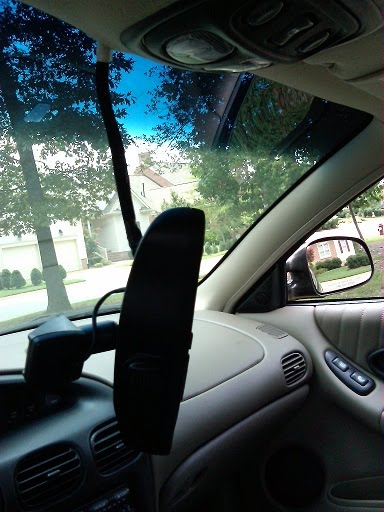
Last night was my last day at the bakery, my last day as a bread slinger, pie wrangler, and muffin maven. I was getting ready to leave and drive home a woman who lives near me, when told her tonight was going to be a fun ride home. Her initial thought was that I was going to be all giggly and buzzing because I was leaving. No, I told her, the ride home was going to be fun because my rearview mirror fell off my windshield and was dangling by its wires. It looked something like this:


She laughed and said it was a very appropriate malfunction because for my life right now, there is no looking back. "So if you're not looking back," she said, "Why would you need a rearview mirror?"
(I'm fairly certain the police wouldn't buy this logic if I got pulled over, but I was prepared to use this line if it should happen.)

Right now, I'm scared. And exhilarated. And not a little in shock.

Although my rearview mirror is now fixed (super glue, not duct tape, for once), there is still no looking back.

posted under , , , | 14 Comments

The demons of doubt

Today is my last day at the bakery, and I'm mostly excited to be able to focus full-time on my writing, I will miss many of my co-workers. Yesterday, I was discussing with another baker (let's call him "D") the essentials of writing the next Great American Zombie Apocalypse Novel. The book Pride and Prejudice and Zombies was a bestseller (seriously. Do you think I could make this stuff up?), and so we wanted to rewrite other books with a zombie twist. Such as "To Kill a Zombie Mockingbird" and "The Adventures of Huckleberry Zombie." I will miss conversations like this.

I will also miss the fact that my boss was trying to bribe me to stay by buying me iced coffees. It didn't work, but it was a nice perk! My boss is a complicated person, and sometimes I want to shake her, but we've also had our fair share of laughs*. We were talking last night as we cleaned the kitchen about how physically demanding the job was. I said that it was rather hilarious that all the customers were always wondering how I could work in the bakery and "stay so skinny!" when in reality my metabolic needs almost required large amounts of high-calorie goodies. My boss told me that she jokes with other people that she "eats like a 300 lb man" because she's so active.

If only she would have stopped there. Because the next thing out of her mouth was:

"Watch, now that you're no longer going to be with us, you're totally going to get fat."

I used my newly acquired interpersonal effectiveness skill of grunting, but inside, I panicked.

I know my boss knows nothing about my eating disorder history. I also know she was joking--she's just that kind of person. We tease each other and so on, and I'm not doubting for a second that she really didn't mean it (unlike my co-worker who jokingly--I think--called me "fatass." Am I sensing a theme here?). But I still worry about how/if quitting my bakery job will lead to weight gain.

It's an irrational fear, and I know it. The doubt, however, still nags at me. I am barely tolerating the weight I am at now, and I fear any sort of gain would throw me over the edge. I also don't want to go clothes shopping again. Like, ever again. Yet I know I can't let such a fear dictate my life and prevent me from chasing my dreams.

I know that being calm and rational is the way to get through this. So I've reminded myself of the following:

  • TNT monitors my weight and we can step in if there is an upward trend.
  • I can call my old dietitian and ask for support.
  • I didn't lose weight when I started and so I probably won't gain when I leave.
  • My weight stayed the same when I was out of town and not working for 3 weeks.
  • If my metabolism can adjust to the upward shift in activity, it can adjust to the downward shift.
In the meantime, I just think my boss totally owes me an iced coffee for that comment--don't you?

*For instance, when she got my iced coffee the first day, she asked how I liked me coffee. I said "Just how I like my men- deep tan and really sweet." She looked at me and said "I guess that means I like my men blond and bitter."

Sunday Smorgasbord

I have searched the web so that you don't have to, finding everything related (and not-so-related) to eating disorders from this past week.

Anorexia and Today's Society

Great recovery quotes

Self-Fulfilling Fakery: Feigning Mental Illness Is a Form of Self-Deception

The Science Behind "Having a Bad Day" (and How to Solve It)

Food-Related Aromas Trigger Brain's Reward Circuits During Hunger

Children of mothers who use food for soothing emotions eat more sweet foods in the absence of hunger

Vitamin Water (Coca-Cola) health claims' lawsuit goes to court

“I Know What I need to do BUT…”

The Willpower Paradox

The Best Neuroscience Study Guide Ever (Because It Has Cats!)

What does uncertainty mean to women with anorexia nervosa? An interpretative phenomenological analysis.

The use of a vodcast to support eating and reduce anxiety in people with eating disorder

posted under | 3 Comments
Newer Posts Older Posts Home

ED Bites on Facebook!

ED Bites is on Twitter!

Search ED Bites

People's HealthBlogger Awards 2009
People's HealthBlogger Awards 2009 - Best 100 Winner!
Wellsphere

About Me

My photo
I'm a science writer, a jewelry design artist, a bookworm, a complete geek, and mom to a wonderful kitty. I am also recovering from a decade-plus battle with anorexia nervosa. I believe that complete recovery is possible, and that the first step along that path is full nutrition.

Drop me a line!

Have any questions or comments about this blog? Feel free to email me at carrie@edbites.com


nour·ish: (v); to sustain with food or nutriment; supply with what is necessary for life, health, and growth; to cherish, foster, keep alive; to strengthen, build up, or promote


Archives

Popular Posts

Followers


Recent Comments