Showing posts with label weight loss. Show all posts

Practicing radical acceptance

Between my stressful week at work and then food poisoning, my weight has dropped some. I suppose I wasn't that shocked to hear it- even with just the illness, my eating hadn't been optimal for several days. I was, however, a little startled at how much (my therapist was rather cryptic, saying "more than a few." I have my guess at what that means, but still).

I suppose I could launch into a rehash of the potential reasons why. I could have pushed myself to try and eat more while sick. I could have been more careful while at my work conference. Coulda, woulda, shoulda. I'm not trying to wash my hands of my responsibility in what happened, nor am I trying to take on responsibility where none existed (though I am kicking myself for eating that damn hot dog that most likely got me sick).

I tried adding a little bit more to my normal meal plan, but that didn't do much. In fact, my weight dropped slightly more because my metabolism kicked in again. This led to a very frank discussion about What I Was Going To Do About This.

The difference--the massive, can't-be-overstated difference--was that I was able to fully participate in this discussion and follow through with what I promised. I don't like much of what I'm doing- Ensure Plus can go suck it, thank you very much. Ditto for the extra snack. Again, that's not the point.

I don't need to want to do this. I do, however, need to be willing.

Frankly, I do think my therapist is being just a tad alarmist about a single-digit weight loss. I didn't feel that I had lost weight. I'm not keen on going back to the chugging of the Ensure and the metabolic shift that once again leaves me burning through massive calories just watching TV.

But I could see it as necessary. I know enough that every relapse starts with "just a little" weight loss, however inadvertent (or, well, not) it might be. I know that good intentions don't save you. I know that promising to eat more is a long way from actually eating more. I know that recovery can be really f*cking inconvenient and you still have to do it anyway because an eating disorder is even more f*cking inconvenient.

So in the past few days, I have been eating foods I haven't touched for years: hot chocolate, Pop Tarts (not exactly a nutritional powerhouse, but sometimes it really is just about the calories), chips. It wasn't as bad as I thought. It helps that I know my metabolism is fierce at the moment and can "handle" the extra/sloppy intake. We'll see whether my weight changes this week. If it doesn't, well, we'll deal with that, too.

Down but not out

I'll be honest: the past few weeks have been rough, ED-wise.  Nothing catastrophic has happened (as in, people are talking in nervous whispers about "hospitalizations" and such), but my weight is down some and I've noticed an uptick in ED thoughts and behaviors.  I've been remanded to daily doses of Ensure Plus, which isn't my idea of a good time, as well as upping the food intake.

As a consequence, I've been unusually tired and wiped out, which probably explains the decrease in blog posts over the past few weeks.  Either I didn't know what to say, or I didn't have the energy with which to say it.

The fight for recovery is exhausting, and I just want the fight to end.  I want food to be food and not filled with doubts and terrors.  I want my own mind to cease being a minefield and my own worst enemy.  I want anxiety to stop snowballing into something bigger and more sinister.

It's frustrating mostly because I thought I was past the point where I thought something this serious could happen.  I knew that small slips and things were likely just because life is life.  But to have to go back to Ensure Plus?  Seriously?!?

Ouch.  It's a bit of an ego blow, I'll confess.

The good news is that I've learned from previous experience and I'm not in any medical danger, I'm still working to my usual capacity, and I'm not a suicidal basketcase.  I've gotten a handle (or at least started to address things) before they spiraled totally out of control and I lost my ability to fight the anorexia as an outpatient.  Because as bad of an ego blow as this is, it's not as bad as having to quit my job and/or move home and/or go back into treatment.

So.  That's where I'm at.  Down but not out.  I'm pulling myself together and getting back on the recovery bandwagon.

What's so different?

Other members of the Academy for Eating Disorders alerted me to this upsetting/appalling/annoying article in Bicycling Magazine.  It's so awful that I'm not going to link to it for any number of reasons: lots of height/weight stats, weight loss stats, and I also don't want to give the article any more traffic than it's already getting.


{{That said, if you're really interested or don't believe that I'm not making these things up, email me at carrie@edbites.com and I'll send you a link.}}

The article is about how pro cyclists Lost Weight! Blasted Off Fat! and Shed Pounds!  I don't read these stories,  mostly because they're really boring.  They follow the same story line.  They have the same generic advice.

But this article read more like a pro-ana selection or How To Have An Eating Disorder than your run-of-the-mill weight loss guide.

Some stellar clips from various cyclists:

[His] hard-core routine isn't for the faint of heart: He doesn't eat after 7 p.m., and he often does a 30- to 60-minute run, ride or hike before breakfast.

Even after a huge day of training, if I fueled properly throughout and after the ride, I can usually get away with eating just some salad or steamed or grilled vegetables with a small amount of lean protein.


Studies have shown that simply chewing your food longer--as many as 100 times per bite, in some research--results in reduced caloric intake. Hold also began chewing gum at the first craving for food. She says it gives her time to decide, "Am I really hungry or am I bored, nervous or stressed? I find in many cases, I just chew some gum and I don't really need food."


"As soon as I notice that I've gained a couple pounds, I immediately adjust what I'm eating and increase my exercise," he says.

Like I said, it sounds a lot like eating disordered behaviors to me.

Reading things like this really raises my hackles, even above and beyond the distribution of dangerous and potentially deadly advice.  It irritates me because other people's eating disordered behaviors are given the green light whereas mine are practically illegal.  Somehow, my psychiatric stamp of "ANOREXIC" makes a massive difference?

I get that these behaviors aren't healthy whether your psychiatric passport has an eating disorder stamp or not.  But I find our culture's very paradoxical attitude towards eating disorders frustrating.  On the one hand, the public is fascinated and horrified about people who spend their lives with their heads in the toilets or become emaciated.  And yet there's a general endorsement of the behaviors that result from an eating disorder.

So what gives?

The ED part of my brain is, I confess, a little jealous.  Why didn't my exercise regime get lauded?  Why can't I do these "wonderful" things that these cyclists are doing?  What makes them so different from me?

The answer is: not much.

Ultimately, these cyclists are playing with fire.  These regimes are dangerous, and promoting them even more so.  I hate that our society approves of so many disordered eating behaviors.  And not just approves, but encourages and promotes.  Then everyone wonders why eating disorders are so difficult to treat.  No, culture isn't the whole reason, but it is one massive hurdle.

What do you think? How do you counter society's messed-up messages about food and weight?

"I wouldn't want my kid to live like that"

An email from an ED colleague of mine (who shall remain anonymous) about the anti-obesity campaigns was just so spot-on and brilliant that I had to repost it here:

To me the most critical point is that weight is not a behavior. That's why anti-smoking campaigns are different from anti-obesity campaigns. Smoking is a very easily controlled behavior if you have not taken it up yet. You can most certainly decide not to start smoking but you can not simply decide not to be fat - you can do all the right things and still be fat. I have little nieces and nephews like that. They are active and energetic kids who eat healthy (more so than my kids!) so what else are they supposed to do? How does the message that they have the wrong kind of body that puts them at risk for health problems and earlier death serve them? To elaborate on Jon's point, should I raise my son to know that he is estimated to have a shorter lifespan than his sister? The only thing a kid needs to hear about his or her body is that it is precious and deserves good care.


Another thing that concerns me with our approach to obesity is that instead of normalizing behaviors, like we tend to do with other conditions, we push people into adopting abnormal lifestyles. When we see people with depression or anxiety or EDs, our goal is to normalize behaviors (e.g. that the person with depression be able to get out of bed and go to work, that a person with social phobia be able to go to social gatherings without distress, that a person with an ED be able to eat normally without compensatory behaviors). But in obesity treatment, our goal is to go beyond what we would consider normal. We want people to eat less than what a person who is not obese would eat, we want them to move more than we would expect of a person who is not obese, and we want them to be hypervigilant about their eating and weight - something that would concern us in a person who is not obese. Besides the obvious ethical questions involved in asking something of fat people that we would never ask of a thinner person, how many people are willing or able to go to such extremes?

From what we have seen, not many. The most optimistic reports of "long-term weight loss success" I have seen is around 20% ("long-term" defined as at least 1 y and "successful weight loss" defined as at least 10%). When we look at the behaviors of those successful at losing weight, described in the much-touted National Weight Control Registry, we see patterns resembling the habits of our patients: Low caloric intake, long hours of exercise, frequent weighings, and a constant vigilance - those who are most successful at maintaining their weight loss never stray from the dieting routine, no matter if it's Christmas, birthdays, vacations or what have you. I don't know about you but I wouldn't want my kid to live like that.

I wish more people wrote and thought like this!

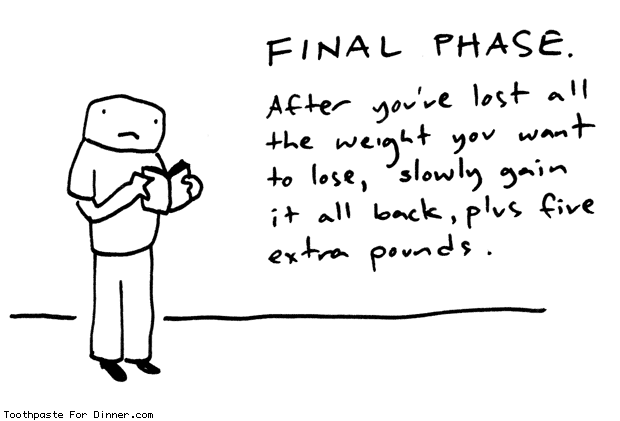
How diet books should really end...

I've never really read a weight-loss book, but I gather that the last chapter is all rah-rah, enjoy your new fantastic and skinny self, and your smaller ass will magically solve all of your life's problems.


The webcomic Toothpaste for Dinner has a great version of how a diet book really should end:

Thanks to the anonymous person who reminded me about this fab website.

On being weighed

I hate being weighed. It makes me freaky anxious and I just don't like it. I worry that I might have gained, which will make me hate myself. I worry that I might have lost and then everyone will freak out on me. The ED part of my brain still sees maintenance as some sort of abject failure because I should be losing weight, not maintaining it.

It probably sounds pretty paradoxical that I find the concept of being weighed at my therapist's office to be reassuring and helpful. Not because I take comfort in being weighed--I most certainly don't--but because I find it helpful to know my weight and know that it is staying where it needs to be.

My first therapist never weighed me, although it didn't really matter all that much because I was weighing myself 80 bazillion times a day anyway. I ended up in the hospital soon enough because my physical deterioration was making my low weight almost a secondary issue. My second therapist used to weigh me, back to the scale, each week and then she slowly phased that out. Ditto for my dietitian. That left me to my own devices for quite some time, and it wasn't pretty.

Not being weighed felt nice at first, because I really do hate being weighed. It's kind of embarrassing, like someone knows all of your dirty little secrets. The problem was that the ED had a field day. I couldn't self-regulate around food. I would overeat, and then restrict and overexercise. Whether this would have showed up in my weight is unclear, but the lack of weighing added one more way for me to hide the seriousness of my ongoing eating disorder.

With my relapse last year, it was back to the weekly ritual of being weighed. I was weighed with my back to the scale so that the weight gain wouldn't freak me out. This was no doubt a wise move, as I'm reasonably confident that I really couldn't handle knowing the number at that point in time. However, TNT has a very different philosophy about weighing (namely that it's just a number and there's a time when you have to get over it) and so I started actually knowing my weight. After an initial freak-out, the actual number ceased to be such a huge deal. I still detest that number, think I'm a whale, etc, but the number itself doesn't provoke as much anxiety as it once did.

Now that I am in recovery and doing well, I'm still weighed by TNT, although only every other week. It works out well- I get a respite from the grueling scale-induced anxiety attacks but TNT is still monitoring my weight closely enough that the ED can't really get out of hand. My parents and treatment team are (not surprisingly) more worried that I will start losing weight again. Since I have the eating disorder and am therefore not that rational about my weight, I mostly worry that I will once again start gaining. Seeing my weight stay exactly the same week in and week out gives me the reassurance that my body isn't going to flip the hell out at an extra cupcake, and it reassures my parents that I really am taking this whole recovery thing seriously.

There's another interesting variable that my weight gives TNT: an insight to my psychological state. Bouts of the stomach flu aside, usually a drop in my weight means an increase in anxiety and ED symptoms. There's no clear cause and effect (did the drop in weight increase the ED thoughts or did the ED thoughts cause the drop in weight? I think both are true) but the fact that my last therapist pushed for a higher weight and then insisted I stay there (despite me calling her a meanie and much, much worse) has given me much greater psychological stability. The slightly higher weight (5-10 pounds) is the price I have to pay for a hint of peace of mind. But the opposite would have been a Faustian bargain: a weight I "preferred" but an ongoing, never ending, ultimately losing battle against the ED. Seeing my weight every other week is a reminder of that icky number, but it's also a reminder of my renewed peace of mind.

I like the fact that someone is monitoring my weight even though I really do hate getting onto that scale. Waiting for the little slide weights to settle themselves is like waiting to hear a verdict: it's long and agonizing but it probably really takes no more than 10 seconds. I'm getting used to my new weight although I still don't like it. I prefer knowing the number to not knowing it because at least if I know it, I'm not imagining having reached a four-digit weight overnight. Which makes the entire situation one massive paradox: hating getting weighed, liking the security of being weighed; hating what I weigh, liking to know that awful number rather than leave it to the imagination.

Since when did an eating disorder ever make sense?

Pressure to be thin?

On Facebook today, I read a status update from a friend of mine who asked us to honor the memory of a girl who died from her eating disorder five years ago today. Which is tremendously sad, and I hope that her story will help others pursue the treatment they need and deserve. But that's not the point of my post. The point of my post is that my friend said the girl died from "the pressure to be thin."

No. She died from an eating disorder. Big difference.

I didn't comment on my friend's Facebook status because I didn't want to take away the importance of honoring this girl's memory, nor do I like Facebook arguments because I can't be concise. Also, even despite my friend's statements, we still remain friends and this hasn't changed that.

But "the pressure to be thin?" Seriously?

I'm not saying that the pressure to be thin is irrelevant to eating disorders because it does play a role in some people's triggers, and certainly in obstacles to recovery. But an eating disorder isn't a pathological and deadly response to the pressure to be thin; it's an actual mental illness that involves a life-threatening inability to self-regulate around food. Furthermore, by saying that an eating disorder is "caused" by the pressure to be thin, it excludes all of those with eating disorders who don't have body dysmorphia, those who developed EDs in cultures that didn't place a high value on thinness, and those who developed EDs long before there was a widespread cultural pressure to be thin.

So. Now that we've got that out of the way...

For most of the people I've talked to with eating disorders, being thin is usually the least of their motivators when in the thick of it. I did have a phobia of gaining weight (a massive phobia of weight gain, for that matter) but it wasn't a cultural pressure. It was me. It was from the eating disorder--I didn't feel that pressure before, and I don't really feel it now. I didn't decide to lose weight to look like a model. It was an attempt to eat better, exercise more, maybe lose 5 pounds and pull out of the awful depression I was in. Without my predisposition to anorexia, I'm fairly confident everything would have stopped there. But it didn't.

Did I use our culture's obsession with dieting and thinness as an excuse while in my eating disorder? Yes. And to some extent, it would have felt more sane to tell myself I just wanted to look like some famous waif than to actually understand that I was terrified of food and eating. I never thought of my eating disorder as just "being on a diet" or "trying to be skinny." It was just this single-minded obsession to eat less and exercise more that really had no explanation.

I did think that if I could lose enough weight then maybe I would stop hating what I saw in the mirror. And I'm not going to say that culture had nothing to do with that, but I was well aware that everyone else saw me as too thin. It was my own messed up standards that didn't really kick in until after I had already started walking down the yellow brick road to anorexia. In other words, the intense body hatred was as much a result of my eating disorder as it was a cause.

Saying this girl who died from "the pressure to be thin" minimizes the true, serious nature of eating disorders. It takes a very complicated issue--the interplay of nature and nurture--and so over-simplifies it that the truth is lost. Not that feeling pressure to be thin has nothing to do with eating disorders, but to say that this pressure to be thin is the same thing as an eating disorder is a rather big misstatement.

Small changes, big difference

Today's New York Times had an eye-opening article on small changes in diet and exercise and obesity. The hallmark of some of the most recent anti-obesity initiatives seem to be small changes. How many times have you heard that if you cut just 100 calories a day, you can lose 10 pounds in one year? I don't have enough fingers and toes to count how many times--and perhaps even more annoyingly, it's flat-out wrong.

The secret to weight loss, we are told, is that you have to burn more calories than you consume. Which is technically true, it's just that the body's metabolism doesn't use the kind of straightforward arithmetic that we learned in elementary school and that you'll find in calorie counters and on pedometers everywhere. It's more like ultra-advanced calculus, where there are numerous factors that go into how many calories we consume and how many we use.

From today's article by Tara Parker-Pope:

A person’s weight remains stable as long as the number of calories consumed doesn’t exceed the amount of calories the body spends, both on exercise and to maintain basic body functions. As the balance between calories going in and calories going out changes, we gain or lose weight.

But bodies don’t gain or lose weight indefinitely. Eventually, a cascade of biological changes kicks in to help the body maintain a new weight. As the JAMA article explains, a person who eats an extra cookie a day will gain some weight, but over time, an increasing proportion of the cookie’s calories also goes to taking care of the extra body weight. Eventually, the body adjusts and stops gaining weight, even if the person continues to eat the cookie.

Similar factors come into play when we skip the extra cookie. We may lose a little weight at first, but soon the body adjusts to the new weight and requires fewer calories.


That's not to say that doing small things is useless--they can have profound impacts on our health even if our weight doesn't budge one bit.

Writes Parker-Pope:

“There is a much bigger picture than parsing out the cookie a day or the Coke a day,” said Dr. Jeffrey M. Friedman, head of Rockefeller University’s molecular genetics lab, which first identified leptin, a hormonal signal made by the body’s fat cells that regulates food intake and energy expenditure...“I’m not saying throw up your hands and forget about it,” Dr. Friedman said. “Instead of focusing on weight or appearance, focus on people’s health. There are things people can do to improve their health significantly that don’t require normalizing your weight.”

Which pretty much hits the nail on the head. Weight is not a behavior we can change at will. I'm all for kids playing outside more and watching TV less, for them to eat wholesome foods and a variety of treats and sweets. Maybe no one's weight will change as a result of this, and that's just fine.

I've found small changes to be some of the hardest--and therefore most worthwhile--changes I've made in my recovery. Small things, such as getting rid of "low-fat" foods and working to get to bed at a reasonable hour, haven't budged my weight but have had a noticeable impact on my recovery.

What small change have you made that's helped (or hindered) your recovery?

True Nature of the Weight Loss Industry

Companies that are hawking diets and other weight loss products claim to be interested in your health. Really? They're interested in your wallet. Ditto for "reality shows" that feature competitive weight loss. And there is a growing awareness that these products and programs are futile at best and dangerous at worst.

A great editorial titled "Weight-loss industry masks its economic interests with bogus health concerns," writes about the realities of our thin-is-in culture, with a focus on the new academic field known as fat studies.

For several decades, scholars in the social sciences have shown that when it comes to people’s attitudes about weight in the United State, thin is good and fat is bad. Fat people suffer from harassment and discrimination; thin people live in fear that they will gain weight and lose status...Fat studies scholars ask why we oppress people who are fat and who benefits from that oppression, arguing that weight, like height, is a human characteristic that varies across any population. Fat studies, then, resembles other academic disciplines that question discriminatory practices based on race, ethnicity, gender or age.

Essays like this have helped open my eyes to the fact that most diets really aren't about health, they're a form of status-seeking. And this status-seeking can only exist if larger people are considered second-class citizens. It's no different than discrimination based on gender or skin color.

Of course, there's a lot of money to be made in keeping people as second class citizens, as long as they can strive to become like the "rest" of us. And one of the most onerous examples of this is the show "The Biggest Loser." I've never seen the show and have no real desire to see the show- I've lived it. Basically, the show is based on the notion of "competitive weight loss," and shaming and starving people into losing weight. A great article in the New York Times took a long, hard look at whether this show was endangering the health of the contestants.

The series also highlights the difference between the pursuit of engaging television and the sometimes frenzied efforts of contestants to win, perhaps at the risk of their own health. Doctors, nutritionists and physiologists not affiliated with “The Biggest Loser” express doubt about the program’s regimen of severe caloric restriction and up to six hours a day of strenuous exercise, which cause contestants to sometimes lose more than 15 pounds a week.

At least one other contestant has confessed to using dangerous weight-loss techniques, including self-induced dehydration. On the first episode of the current season, two contestants were sent to the hospital, one by airlift after collapsing from heat stroke during a one-mile race.

{snip}

Medical professionals generally advise against losing more than about two pounds a week. Rapid weight loss can cause many medical problems, including a weakening of the heart muscle, irregular heartbeat and dangerous reductions in potassium and electrolytes.

“I’m waiting for the first person to have a heart attack,” said Dr. Charles Burant, a professor of internal medicine at the University of Michigan Health System director of the Michigan Metabolomics and Obesity Center.

“I have had some patients who want to do the same thing, and I counsel them against it,” Dr. Burant said. “I think the show is so exploitative. They are taking poor people who have severe weight problems whose real focus is trying to win the quarter-million dollars.”

The contestants were also required to sign waivers that said "no warranty, representation or guarantee has been made as to the qualifications or credentials of the medical professionals who examine me or perform any procedures on me in connection with my participation in the series, or their ability to diagnose medical conditions that may affect my fitness to participate in the series."

What perhaps absolutely gobsmacked me (though really isn't that surprising, when you think about it) is how the show essentially muzzles any prior contestants who might criticize the show.

Shortly after a reporter started contacting former contestants to interview them about their experiences, a talent producer on the series sent an e-mail message to many former contestants reminding them that “serious consequences” could ensue if they ever talked to a reporter without the show’s permission.

To do so could subject them to a fine of $100,000 or $1 million, depending on the timing of the interview, according to the e-mail message, which was obtained by The New York Times. The show’s producers did provide an opportunity to interview several former contestants, but the interviews were conducted with an NBC publicist listening in.


I don't know about any of you, but this sure sounds like a cult to me. Each time we watch the show or buy the products, we're encouraging such insanity. And I think it's high time that we stopped.

Scared skinny?

This fantastic little tidbit titled "Scare yourself skinny" is almost inconceivably wrong. The blog is about pretty much what it sounds like: how anti-obesity campaigners can use fear to scare people thin. The idea comes from the use of warning labels on cigarette packets. Before the labels, cigarettes were cool and hip. Now, they're cancer sticks. The labels and warnings may very well have prevented me from starting smoking, but I'm not sure they would have been enough to get me to quit. It didn't work that way with my eating disorder, and I don't think it would work that way for smoking or weight.

Still, it's a popular tactic, as evidenced by the recent New York City Health Department campaign in favor of calorie counts on menus and subway posters titled "Pouring on the Pounds." (h/t VoiceinRecovery for pointing out the posters to me several weeks ago). You can even adopt a five pound piece of pet fat to help remind you of that icky icky fat you just don't want to have (all for only $149.95 plus shipping!). I personal prefer the little fuzzy adipose cell at Giant Microbes, and have adopted one myself to remind myself that fat isn't all bad.

There is the minor detail that fat molecules line all of our cells, and help conduct nerve impulses. It makes our hair and nails shiny and healthy. It provides padding against injury and daily wear and tear. It helps keep us warm. It's not all that bad.*

The author of the blog post cited several studies that showed how fear tactics can work to change behavior. And if you were just considering the short-term, I would tend to agree. But even I, Anxiety Freak Extraordinaire, become inured to risk and fear. Serious ED symptoms rapidly stopped frightening me. It was just the way things were. Fear tends not to change things long-term.

There's the small fact that people aren't fat just because they're not scared enough of it. Our culture is awash in this fear. I can't believe that people aren't aware of it. Then there's the fact that some people aren't fat because they drink too much Coke and too little "water, seltzer, or low-fat milk." Some people are just fat, and no amount of fear is going to make them lose weight.

Weight has an environmental element, true. So does height. Where, then, are the articles titled "Scare yourself tall"? Shouldn't you be scared of your decreased salary? Shouldn't you?

(EDITED TO ADD: I just found a great piece in Slate tackling the politics of the "soda tax" called The Growing Ambitions of the Food Police.)

*Yes, I'm trying to convince myself of this, too.

‘Phantom fat' and body image

I stumbled across a news article about how 'Phantom fat' can linger after weight loss when I was on Twitter (do you follow me on Twitter? Click here to start following ED Bites!) and I was struck by how much this seemed to describe what was going on in eating disorders. The article quoted a women who had lost a significant amount of weight over the past two years, and how

every morning when she looks in the mirror while getting ready for the day, she sees her former, heavier self. “My brain says, ‘Yep, still fat.’”

“It's been really hard to change my self-image,” says Hicks, 37, of Chesapeake, Va. “I still feel like I'm this enormous person who takes up tons of space.”

When I was in residential treatment the last time (in 2006), I groused about how fat I felt, how skinny all the other girls were, etc, etc. Standard AN kvetching and bitching. Still, the dietitian I was talking to made a good point: I had gained weight. Okay, not much, but I had, and I knew it and that's in part what I was there to do. My body was heavier than it had been. And considering I had been underweight for at least a solid year by the time I started treatment again (though my lowest weight was back in 2001), some of my physical feelings of fatness were not strictly ED-driven, but also might happen to anyone gaining weight. Or, in the context of the article, people losing weight as well.

I was oddly reminded of this conversation about a year ago, when I was riding the commuter train from DC to Baltimore, as I headed home from my summer internship. There was a 16-year-old boy (I'm guessing) and his family, and he was almost literally all limbs. He carried himself a bit awkwardly and--here's the really interesting bit--he kept banging his head against the overhead rack. He made a joke about his growth spurt, and it hit me: his perception of his body (known formally as proprioception) hadn't yet caught up with his new height! Cammy did a wonderful post about something similar right after this happened, which kind of cemented the incident in my head.

It makes sense that there would be a link between body image and proprioception, and researchers have found previously that the body image distortions in people with anorexia was linked to abnormal amygdala functioning and the fear response. So it makes sense that significant fluctuations in weight would be linked to both body image and proprioception, especially in people with a history of dieting like many of the women featured in the article.

“People who were formerly overweight often still carry that internal image, perception, with them,” says Elayne Daniels, a psychologist in Canton, Mass., who specializes in body-image issues. “They literally feel as if they’re in a large body still.”

Daniels and other experts suspect this may happen because the brain hasn’t “caught up” with the new, leaner body, particularly for people who were obese for many years and then experienced rapid weight loss.

“Body image is a lot harder to change than the actual physical body is,” Daniels says.

Amen to that, sister.

Psychologist Joshua Hrabosky found that women who were currently "overweight" or formerly "overweight" had a "dysfunctional appearance investment" and were more preccupied with weight that women who were never "overweight."

The findings suggest that “people who undergo major weight loss may experience improvements in satisfaction in appearance, though still not necessarily as much as someone who was never overweight,” Hrabosky explains. “But they are also still more invested or preoccupied with appearance than someone who was never overweight.”

It does make me wonder what dieting and food intake might have to do with weight perception and body image, as even healthy men in the Minnesota Starvation Study complained of "feeling fat" during the rehabilitation phase.

But the article raises some really good points about the psychology, too. When you've thought of yourself as fat for most of your life, it's really hard to change that thinking no matter how much weight you've lost or how much you understand the futility of dieting. I'm curious to see how this research will affect thinking on the body image distortions in eating disorders. We shall see.

A little bit of double talk

The advice is good, but oh the irony!


Watching this video, I just kind of shook my head. I mean, the advice is good ("love yourselves, ladies!") but the person from whom it springs might want to think about the other advice she gives, too. I mean, Jillian Michaels preaching body love? Not that I watch The Biggest Loser (I've lived it, I don't need to see more), but the segments that I've seen don't indicate that she's telling the contestants to accept their bodies.

Oh...that's right. Accept your body but only if you're not fat. And not until you've bought a Jillian Michaels exercise DVD. I get it.

Honey, your entire fortune is predicated on the fact that people don't like how they look. There's some lip service to health, but most "motivation" I hear is about appearance. If people suddenly accepted their bodies, you would be out of a job. At least admit it.

Are people really that disconnected from their own messages? Do the execs at Weight Watchers and Slim Fast really buy their own schtick ("we're not a diet, we're a Lifestyle Change!"), or do they know the rest of us are a bunch of suckers?

"Fat talk" in women serves a variety of purposes, but mainly as a bonding device, a way for women to connect. One of my therapists in treatment called similar things "bonding through bitching." Women don't dare bond through talk of their achievements, so they bond through their problems, body and otherwise. Bitching is okay; bitchy isn't. Saying how fat we are or how ginormous we feel makes us feel like one of the gang.

But you don't need to win The Biggest Loser in order to stop with the fat talk and start accepting yourself and your life and your accomplishments. Start now.

Share an accomplishment from today in the comments- no "it was just..." or "only..." and such. What did you accomplish today? I'll start: I went to the grocery store and got what I needed without a meltdown. Yeah!

Weight over health- we have it backwards

I was refreshingly surprised when I saw this AP news article last night: Worry over weight: Poll finds health disconnect. It summarized what I've realized since the days of the Big Fat Loser contest over a year and a half ago now, that women say they're trying to lose weight for health reasons, but it's really all about appearance.

There's a big disconnect between body image and true physical condition, an Associated Press-iVillage poll suggests. A lot of women say they're dieting despite somehow avoiding healthy fruits and veggies. Many others think they're fat when they're not.

"The priorities are flipped," says Dr. Molly Poag, chief of psychiatry at New York's Lennox Hill Hospital.

She points to women athletes as much better role models than supermodels: "There's an undervaluing of physical fitness and an overvaluing of absolute weight and appearance for women in our culture."

Half don't like their weight, even 26 percent of those whose body mass index or BMI — a measure of weight for height — is in the normal range. But just a third don't like their physical condition, even though being overweight and sedentary are big risk factors for Type 2 diabetes, heart disease and other ailments.

The poll found women putting in a median of 80 minutes of exercise a week, meaning half do even less. The average adult is supposed to get 2 1/2 hours of exercise a week for good health.

And just 8 percent of women ate the minimum recommended servings of fruits and vegetables — five a day. A staggering 28 percent admit they get that recommended serving once a week or less.

The ladies I worked with (and most dieters I've talked to) might say they want to lower their cholesterol or blood pressure, but what they use for "thinspiration" isn't an image of an unclogged artery or a blood pressure reading of 120/80. They look at models, those size 8 pants, that skinny chick who works in the cubicle down the hall. Commercials are now telling us to "get in shape for summer" because it's "bathing suit season!" The "get in shape" message is really in the name of looking hot in a bikini.

Eating disorders aside, normal-skinny doesn't automatically mean healthy, stresses University of Houston sociologist Samantha Kwan, who studies gender and body image.

"Someone who is fat or even overweight can be healthy if they have a balanced diet and are physically active," Kwan says. "Our culture really does put a lot of pressure on women to look a certain way," taking precedence over health measures.

If we really want to focus on health, maybe we should take weight loss out of the equation.

Defining insanity

The AA folks say that the definition of insanity is doing the same thing over and over and expecting different results.

This makes me wonder how I might define Oprah's response to her recent weight gain.

Frankly, I don't care how much Oprah weighs. In the grand scheme of things, it doesn't matter to me. It does, I am sure, matter to her.

Other people have written on this (here, here, and here) far more eloquently than I have, but I did want to toss out a few comments from the peanut gallery.

What seems to be happening is endless weight cycling: gain some, lose some, gain some, lose some. And the fact that people keep dieting--in spite of the evidence, scientific and personal, that it does not work--kind of exemplifies the AA definition of insanity. Really? It's not going to be different this time.

If Oprah, who can afford luxuries like a full-time chef and full-time personal trainer, as well as housekeepers and more money that some small countries in Africa, can't figure out a way to lose weight and keep it off, this should tell us something. Mother Nature is stronger than Oprah. If your genes want your weight to stay at a certain level, they will make sure you get there and stay there, and Bob Greene can go suck it.

Of course, I want people to take care of their health. But there's a lot of space between lettuce and plain grilled chicken and duct taping yourself to the couch with an endless supply of Ho-Ho's. The problem is that dieting takes away that middle ground, makes us forget what it's like to live there.* It made me very dismayed when Oprah said that the weight gain was because she "ate whatever [she] wanted" and this was a bad thing.

Eating whatever you want is NOT A BAD THING. After you've been dieting for the eleventy-billionth time, however, you can go overboard. Eating too much of whatever you want can be a bad thing.** It's the First Law of Dieting: Every diet is followed by and equal and opposite binge. I can't help but thing that maybe if Oprah had just eaten whatever the hell she wanted in the first place, her weight might be stable.

An interesting side note: my therapist said that she can kind of tell when Oprah is on a weight loss kick because her magazine focuses more on recipes and weight loss tips than before, when it was more about accepting yourself and work/life balance, etc.

I would love to see Oprah stand up and accept herself for who she is, whatever the size of her ass. It doesn't matter. She can still do amazing things and be an amazing person. I'm not super-hopeful, to be honest. I think she has a lot invested in dieting and being a weight she might not supposed to stay at. And de-investing in this would be a phenomenal thing for ALL of us. We put so much energy and effort into things that may not be sustainable long-term, and there's a grieving process when you realize that you're never gonna be thin and the only thing left to do is work with what you've got.

*For that matter, so does an eating disorder.
**And let's not forget: so can eating too little.

A lose/lose situation

A study published last year in the International Journal of Obesity found that yo-yo dieting (even just a gain/loss cycle of 5-10 pounds) led to "an association between weight fluctuations and cardiovascular disease and death."

In a Washington Post article, lead author on the paper had the following to say about the results:

"I agree that data on weight cycling are mixed, particularly on weight regain, decreased energy expenditure, etcetera," said lead author Dr. Jean-Pierre Montani, professor and chair of physiology at the University of Fribourg.

"However, there is increasing evidence that weight cycling may lead to cardiovascular and metabolic disorders," such as hypertension and diabetes, he added. "And the risk of complications of weight cycling seems greater in people with normal weight or slightly overweight than in obese people."

The obvious solution, then, would be to stop dieting.

Other experts, however, disagree. They think that weight cycling isn't as dangerous as staying overweight or obese, and that people should continue to try and lose weight.

And therein lies the conundrum: there are no known ways to help people lose weight and keep it off.

Some of the experts said that a person isn't "worse off due to trying to lose weight...There's no sign that losing the weight results in a worse final weight than in the control group," Dr. Michael L. Dansinger, an assistant professor of medicine and obesity researcher at Tufts-New England Medical Center in Boston, explained. But are they better off for having dieted and regained? What about the psychological effects of dieting? What about the monetary issues?

And do this: define "better off." I'm assuming he means weight, but well-being encompasses so much more than weight.

Of course, you could make "lifestyle changes" like cutting out soda instead of dieting, but I'm not exactly sure of the difference. And besides, there's no evidence that this works, either. Even winners of the Biggest Loser TV show gain back a lot of the weight they lost during the show- and they have a lot more scrutiny and motivation than the average dieter.*

This article, and line of research, leaves people trapped. Lose weight, they are told, and keep it off. But no one really knows how to do that on a large scale. We are advocating a method that is basically statistically impossible. And the obvious solution (stop dieting!) gets lost in the shuffle.

*Then again, they didn't always lose weight in a safe and healthy manner, either, so it's doubly to be expected.

85% of what?

One of the major diagnostic features of anorexia (and the one that sufferer's tend to obsess over most- I know I did!) is that the person weighs "less than 85% of expected body weight."

I'm sure I'm not the only one that wondered: so what could that possibly mean?

What is "expected body weight"? I would think this would be quite personal. People aren't charts, they aren't all going to fit on some nice little table with nice, neat boxes in which body weight and height are placed. Some people tend toward the lower side of these charts, and others toward the higher end.

Some ED professionals use this "100 lbs for 5 feet, plus 5 lbs for each inch over 5 feet." Let me tell you. I'm 5 foot 5. When I was at 125, my periods were gone and I was plunging into the completely batty zone- and it wasn't even that much under my usual weight. If that's 100%, then what must 85% have looked like?

Utter insanity is what it looked like.

There are also the MetLife Insurance tables, the "what's your BMI?" game, and the pin-the-tail-on-the-donkey approach. I'm not entirely sure how much I'm joking about the last one.

These approaches make a huge difference in both diagnosis and insurance coverage for treatment.

My other question is this: why 85% at all? In young children, this might not even work, since it tends to be lack of weight gain with height increase as opposed to general weight loss. And once you hit 86% in recovery (if you were below 85% to begin with!), are you suddenly not anorexic anymore?

Any sufferer, and any of the people who care about them, know that this is bunk. Your brain is still anorexic even if your body is beginning to heal.

I understand, as an epidemiologist, that you need specific percentages and cutoffs in order to measure the incidence and prevalence of a disease. You do. There's no way around it. Insurance companies need it so they can be miserly and annoying- as well as code for different things, etc. Clinicians like to diagnose with a yes/no, either/or, sick/healthy manner of thinking. Which works with pregnancy, and not necessarily a whole lot else.

But why are we just waiting for someone to lose MORE weight before we try to start giving them a real diagnosis? Or saying they're "better" when they're clearly not at 100% of their normal weight and normal functioning? I do get that there is the category of EDNOS, but it is usually considered to be "sub-clinical" by insurance companies, sufferers, and even professionals.

Things like this--these seemingly piddly crunching of numbers and gauging of math--are important. They can save lives.

Hunger, fullness, and the brain

Many of the neurochemical differences in people with anorexia seem to be related to changes in the brain circuitry that moderate hunger and satiety. It's more complex than that, but there's little doubt that this changes are hugely important in anorexia and ANY eating disorder.

Researchers at Duke University recently released a study about the relationship of a brain enzyme to appetite. This particular enzyme helped to make ghrelin, a hormone that signals fullness. When a mutation caused this pathway to be blocked, no ghrelin was produced and the mice at significantly less and, shocker of shockers, they lost weight.

The study was, of course, framed in the context of weight loss. To some extent, this makes sense; after all, weight loss was one of the primary results in the mice. But this is being touted as a new finding to "combat obesity." Indeed, the first sentence of the press release was:

Imagine being able to tone down appetite and promote weight loss, while improving the body's ability to handle blood sugar levels.

But appetite and weight regulation are likely more complex than this. I would ask several major questions should research be done in humans: is maintaining a lower weight than appropriate any better than being at a higher weight that has been determined by your genes? And what happens when you stop taking the pill that blocks the ghrelin pathway? I would think you would gain the weight back, but I'm sure the pharmaceutical industry would just love this fact.

One should also note the links to Duke's well-known weight loss center on the page with the press release.

What struck me, however, was the possible relationship with this gene mutation and anorexia. Abnormalities in levels of ghrelin and leptin (which functions as the opposite of ghrelin and stimulates fullness) have been found in people with anorexia. I've been asked a lot (usually with a tone of wonderment): how can you eat so little for such a long period?

Hell if I know. But maybe my brain does.

Certainly, people with eating disorders still feel hunger and fullness. Yet they might feel hunger less often and fullness faster once the chain of events gets started. Before my eating disorder started, I think I ate pretty normally. I had my quirks--one of my favorite snack was pretzels mixed with mini marshmallows--but I think I felt hunger and fullness just fine, thank you very much. But then the weight loss started. Just a little bit. And all of those abilities went a-flyin' out the window.

Of course, eating disorders are likely far too complicated for one gene or one enzyme. There's almost certainly much more going on than that. But finding these genetic differences may help determine who is at risk, and better ways to treat the illness.

Weighing In

There were two articles in this week's New York Times about weight and health.

Only two? you say. There were several articles about weight loss and health, but none of them looked at weight, period.

The first was interesting- a study I had read about over the weekend and never got around to blogging. Called "The Dreaded Weigh-In," the article looked at women not going to the doctor because they didn't want to be weighed.

“Weighing concern may make these women, particularly those who are overweight and already at risk for certain ailments, less likely to visit a doctor,” said lead author Andrew B. Geier, a doctoral candidate in the department of psychology in Penn’s School of Arts and Sciences. Mr. Geier said the solution for doctors is simple and inexpensive—weigh patients in private.


This quote addresses several issues, one of them being that overweight automatically puts you at risk for "certain ailments." Actually, it doesn't, though it's a moot point. The nexus of genetics and environment is so freaking complex that it's not always obvious what illnesses you are at risk for. Which means that regular check-ups are important, regardless of your weight. So if weighing people in private (a good thing, in my opinion) means that more people will get the health care they need and deserve, then great.

The problem is this: why are people so afraid to be weighed at the doctors'?

Many of the comments to the article said that obese people were in denial and didn't want to be confronted with the reality of how fat they were.

These people are obviously not fat. I'm not fat- and yet I don't know HOW you can be fat in today's day and age and not know it. By Hollywood's standards, I am plus-sized. I would be a behemoth next to most of today's celebrities. Well-meaning (or not) people love to comment on weight and shape. They love to hand out diet advice. I don't know any fat person who hasn't be ridiculed for their weight.

And that one word- ridicule- is the exact reason most people don't want to be weighed at the doctor's: they don't want to be shamed and ridiculed about their weight. Shame has never changed a person's behavior. It just drives it underground, makes a person secretive and fearful. If shaming fat people worked, there would BE no fat people. We would all be thin as Meme Roth would like.

My peers loved to tease me and shame me and hate me because of my weight when I was younger. I was about 90% weight as a child- and 90% height. Totally normal. Now, I track around 60% weight and 75% height. Shame didn't change that. Time did.

The other article looked at an interesting factor- not how much we weigh, but how much we think about what we weigh. The article was titled: Watch Your Weight, Sure, but Don’t Worry About It. It looked at a study by the CDC which asked people what they weighed, what they would like to weigh, and how many days in the past month they had felt "physically or mentally unhealthy." The percentage who felt unhealthy was higher in those who wanted to lose the most weight.

The real kicker in this study? It didn't matter what a person's weight was- the more they wanted to lose, the worse they felt.

My guess is that the people who wanted to lose the most weight were dieting or engaged in unhealthy weight loss behaviors. This makes you batshit crazy and weak and obsessed.

I think both of these articles illustrate the many problems Americans have with the weight and food and obesity obsession.

All broken up

Along with the eating disorders newsfeeds I subscribe to comes a lot of information about diet and weight loss. Most of it doesn't really register on my radar (I have far more important things to think about, such as my lingering, god-awful nasty cough and how to keep from drowning in my own snot), and I doubt I would have blogged on this subject had I need seen a tabloid headline in the supermarket check-out line today.

Kirstie Alley and Jenny Craig have called it quits. I know. Terribly tragic. The gist of it is that Alley wants to start her own weight-loss company, fueled no doubt by the immense following she has gotten as a spokeswoman for Jenny Craig. Her most spectacular comment on the subject was this:

“I want to create something new that will help millions of people end the
seemingly never ending fatty-roller coaster ride.”

How noble. Except that the only way to get off the dieting roller coaster is to -- holy crap, folks! Hold on tight! -- stop dieting and practice intuitive eating.* Only this solution really isn't that profitable for corporate America or Kirstie Alley.

The comments from the article I linked to above (from the San Diego Union-Tribune) are just bigoted and downright disturbing. One says "Once a fatty, always a fatty." His stunningly brilliant "weight lose [sic] plan" tells said fatties "1) put down the fork and spoon, 2) walk around the block five times, 3) repeat daily. " Merciful God in heaven- I never would have thought of that! You're brilliant! No wonder we're not all skinny- we actually have nutritional and metabolic needs!

First of all, skinny people eat, too. Second of all, if it were that simple, there wouldn't be weight loss programs.

There are also rumors that Alley was let go by Jenny Craig because she had started to gain back some of the weight she had lost. Personally, I think she would be a far better role model by just accepting her body as it is today. However, given that former body acceptance guru Queen Latifah is now a Jenny Craig spokeswoman, I'm not going to hold my breath.

Which brings me to the part about the supermarket tabloids. One of them had a picture of Alley on the front with headlines blaring about how she had "porked up" and gained all her weight back and how dare she! as a spokeswoman for Jenny Craig. What kind of example was she setting?

A realistic one, if you ask me.

There are plenty of tabloid headlines with prominent pictures of too-skinny celebrities, wondering if so and so has an eating disorder. "Friends and family are worried about her health," say the captions.

How different from the depictions of Alley. Although there is certainly plenty of blamemongering amongst people suffering from eating disorders (as in, "Why don't they just eat???"), it's not quite of the same mentality as it is for people who are fat. Fat people "let themselves go," they gave into temptation, got weak and gluttonous. This could happen to us if we're not careful, we are told. So we nod our heads in agreement and fear, and then go and join Jenny Craig.

People suspected of having an eating disorder are seen more as hapless victims of an appearance-crazy Hollywood. "The poor dears," people say. "No wonder they're anorexic- how could they not be." Which has an element of truth to it. Most eating disorders start with a nutritional imbalance that cause genetically susceptible people to keep going and going and going. So in an industry that basically forces women and men to starve themselves in order to be successful, there are bound to be plenty of eating disorders.

But they're not just victims of Hollywood. They're victims of a neuro-bio-psychological disease that few people really understand.

Yet when you compare the response given to fat people- the scathing condemnation- it's no wonder Kirstie Alley joined Jenny Craig. I don't know that I would have the fortitude to withstand that kind of criticism and scrutiny. It's your fault if you're fat; its everyone else's fault if you're too thin.

Maybe it's no one's "fault" either way. Maybe fat is just an adjective. Maybe the intricacies of weight are not very well understood. Maybe eating disorders aren't, either. Maybe people come in all shapes and sizes.

Kirstie could do a lot of good by helping people truly get off the "fatty roller coaster" by just being herself, at the weight her DNA intended her to be at.


*The book in the link ("Intuitive Eating") is absolutely wonderful. Some of it I didn't find personally applicable, as I didn't have a history of dieting- I just slammed right into a full blown eating disorder. Yet there are also plenty of parallels to the restrictive eating that accompanies many eating disorders.**

**Even binge eating. How many of us have restricted after a binge? Vowed to be good, to "make up for it," right the wrongs, do penance for our sins. Only a little while later, wham. Another bad one. Or we don't eat certain foods because we're scared we'll binge on them. I still get nervous when I have a carton of ice cream nearby.

Thinking like a thin person?

The tenant who was in my apartment right before me was an avid subscriber to magazines. I have already enjoyed several. Yesterday, I received Health Magazine. It's not a magazine I typically read, or even am really interested in, but it was there, so I started flipping through.

There is a new book out on dieting. Shocker, huh? It's by Judith Beck, a cognitive behavioral therapist, daughter of the creator of CBT, Aaron Beck. The title of the book is: The Beck Diet Solution Weight Loss Workbook: The 6-Week Plan to Train Your Brain to Think Like a Thin Person. I've heard of this book before- it was hyped in Oprah's magazine (as found in my therapist's waiting room). But this article went a little more in depth, which allowed me to be even more astounded than before.

Problem One: Thinking like a thin person.

Have there been any studies that have said that thin people actually think differently than not-thin people? I know lots of thin people who enjoy their food and don't give it a second thought after "What do I want to eat right now?" Is there a "fat brain circuit"?

Problem Two: Assuming that fat people are fat because of their thinking/eating patterns.

Um, apparently Dr. Beck is unaware that body size and shape are largely determined by genetics. Yes, there's a lifestyle portion to it as well, and I'm not saying you should neglect your health for any reason. If you binge eat for emotional reasons, it's not that you "thought your way fat." It's that there are underlying emotional issues to be resolved. Again, working on your emotions is quite different than "thinking your way thin."

Problem Three: Reasons to lose weight

The "official" anti-obesity propaganda says that being fat is a health risk. It rarely, if ever, says anything about fashion or appearance. However, losing weight in the popular culture is as much (if not more) appearance and self-esteem issue as it is a health one. Top weight loss comment? "You look great." Not "I bet your cholesterol levels really took a tumble, Betty!" The sample checklist given in the magazine is the following (I'm reading as I type so this is word for freaking word):

  • I'll look better and more attractive
  • I'll have more confidence
  • I'll be able to wear a smaller size
  • I won't feel so self-conscious
  • My blood pressure will go down
  • I'll have more energy
  • I'll make a better impression on people
  • My family won't remark on my weight or eating
  • I'll feel more in control
  • Add your own reasons below!

Get the idea? There's ONE health reason for losing weight. Here's a solution: your family comments on your food and weight? Tell them to stop it. That's their issue, not yours. Maybe Aunt Susie has good intentions, but you can tell her that you appreciate her concern but please knock it off. You don't have to lose weight.

Problem Four: Stick to "The Plan"

According to Beck, you can't screw up at all if you want to lose weight. Craving something? Suck it up, buttercup. You can't eat that. Screw the crummy boyfriend, house fire, hormones. No chocolate for you (like the Seinfeld soup Nazi). The cheese you were planning to eat turns moldy? Eat the cheese anyway. Or go without. But god forbid eat something similar. To quote, "It's not okay to eat something you didn't plan to eat. Don't rely on making up for it later. If you want to lose weight permanently, you have to learn to stick to your plan."

Problem Five: Sabotaging self-sabotaging

Another part of the plan is countering "sabotaging thoughts." I kind of see that part. Kind of. I know I self-sabotage sometimes. It's a real phenomenon. But these ones? Ha! "It's okay to skip exercising today. I'm too tired." I hate to break it to you, but you're going to continue to be tired unless you give yourself a freaking break. Besides, I don't want someone who's coughing 8 liters of crud out of their lungs working out next to me.

Or "It's okay to eat this food even though I hadn't planned to because everyone else is eating it." Your reply should be: No it's NOT okay to eat that because my goal is permanent weight loss. If that's the case, then your goal is also perpetual insanity. And continuing to feel self-conscious. I've been there, where everyone else is celebrating something, eating like real humans do, and I'm standing against the wall, drooling like a rabid skunk and sipping my Diet Coke. That's self-conscious.

Problem Six: What this diet does to your thinking.

At the end of the day, you don't think like a thin person. You think like a food-obsessed dieter. Here are some comments of successful losers:

"Every time I'm tempted to put something in my mouth that isn't planned, I feel like I have the option in that moment of getting stronger or weaker, not just heavier or thinner."

"I used to be a spontaneous eater, eating whenever and whatever I wanted. But being hungry is not an emergency. Dr. Beck taught me that I have to plan what I eat and stick to it if I want to be thin."

Talk about society at work there. Because fat people are weak and thin people are strong. Right. That's how it works.

Oh, and hunger is an emergency. So is thirst. Your body doesn't give you those signals for fun. It gives you those signals because it needs fuel, dammit. Believe me, hunger can be an emergency. Not being able to honor my hunger nearly killed me.

So, what I've learned from this book is that you may or may not be able to think like a thin person, but you definitely will be able to drive yourself completely insane.

Sorry, Dr. Beck. Save it for someone else. I have better things to do with my time and money.

Older Posts Home

ED Bites on Facebook!

ED Bites is on Twitter!

Search ED Bites

People's HealthBlogger Awards 2009
People's HealthBlogger Awards 2009 - Best 100 Winner!
Wellsphere

About Me

My photo
I'm a science writer, a jewelry design artist, a bookworm, a complete geek, and mom to a wonderful kitty. I am also recovering from a decade-plus battle with anorexia nervosa. I believe that complete recovery is possible, and that the first step along that path is full nutrition.

Drop me a line!

Have any questions or comments about this blog? Feel free to email me at carrie@edbites.com


nour·ish: (v); to sustain with food or nutriment; supply with what is necessary for life, health, and growth; to cherish, foster, keep alive; to strengthen, build up, or promote


Archives

Popular Posts

Followers


Recent Comments