Showing posts with label weight gain. Show all posts

The light at the end of the tunnel

Pulling myself out of this slip has been exhausting.  It's gotten harder over the past week or two, not because anything has necessarily changed, but because I'm getting burned out.  On the one hand, I can feel the subtle shifts happening; on the other hand, it's just the same old, same old.  It's one thing to push yourself to eat more for a short period because it's time-limited.  Eventually, the hell will be over.

I thought I would pull out of the slip much faster than I did.  Perhaps I misjudged exactly how many difficulties I was having. The other factor is that weight gain is going much more slowly even on more calories.  My life feels like a never ending assembly line of meal-snack-meal-snack-meal-snack.  Seriously?  Shoveling in this much food every day is exhausting.  Like I said, there has been progress, but there haven't been signs that the daily shit-ton of food is going to decrease anytime soon.

I had a bit of a meltdown about it the other day.  I was tired of all of the recovery work, tired of the food, tired of always feeling like the sick person.  I was about ready to throw in the towel.  But my therapist had reminded me of something: last week we had talked (briefly) that if I continued to progress weight- and behavior-wise, then we could talk about reintroducing some mild activity.

Apparently I have progressed, and now I am officially off exercise restrictions.  I get a few short walks during the week at this point.  The idea is to move up slowly so I don't just plunge back in head first and everything goes to pot. 

This event greatly improved my mood, and not primarily from the OMG--I can go back to exercise now! standpoint.  It was also that, for the first time, I could see the light at the end of the tunnel.  I don't know when it will be, but sometime soon I can transition from refeeding mode back to recovery mode.

It's been hard, too, because I generally don't get much feedback on how I'm doing.  I would know if I lost weight, and I don't really like being patted on the back for gaining, either.  It makes me feel horribly guilty.  So it was hard for me to judge exactly where I was along the path, which only added to my frustrations.  I don't want or need to be praised for every bite, but a little feedback would have been helpful.

There's still tons of work to be done, even when this phase is over.  I know that getting back to where I was still doesn't make me where I ultimately need to be in recovery.  For now, though, I'll take what I can get.

Anatomy of a hot flash

One of the most annoying parts of regaining lost pounds (even just a few!) is the hypermetabolism and accompanying hot flashes. I feel like a woman in menopause.

I've come to find the hot flashes appear on a regular schedule.  I eat, and then...wait for it...wait for it...I suddenly want to find an ice bath.  They only come after eating, usually within 15 or 20 minutes.  My therapist tells me it's a good sign, that my body is frantically burning up all of the calories (errr, nutrition) to repair itself. Personally, I just think it's the weight gluing itself to my ass really, really fast.

Which might be true, but it's annoying and frustrating to deal with several times a day.  I wish it would just stop.

And I'm kicking myself because I should have known better than to let the ED back in, even just a bit.  That I shouldn't have been this stupid.

I know that hot flashes will eventually pass.  That my body will adjust.  That (gulp) the pounds will go on, and the return to homeostasis is one of the benefits to weight gain/health/whatever positive spin you want to put on it.

Practicing radical acceptance

Thank you all for your kind and wonderful comments on yesterday's post.  They were really helpful for me.

What I've come to realize over thinking about this awful fatigue and hypermetabolism mess is that I need to practice some serious radical acceptance.  Not that I expect that this will eliminate my fatigue, but hopefully, I can scrape up a few scraps of energy that I was wasting on resisting and fighting the current state of events.

So what do I need to accept?  Several things:

  1. My need to eat a lot. My mom tells me most people would kill for my metabolism.  I tell her they don't need to bother, as I'm perfectly happy to give it away upon request.  But there's not much I can do about how much food I'm burning off right now.  It's just reality.  It's what I need to do to get better, it sucks, but there's also no real alternative.
  2. I'm not going to be as productive as I usually am. This one is really hard for me. I generally hate on myself if I'm not constantly busy. It's fine when I have the energy, am engaged in life, and can plan in some breaks.  That's not my current life.  Again, it's unavoidable.  I'm lucky in that my work schedule is pretty flexible, and a couple of short months financially aren't going to be the end of the world.
I still don't feel good about these things, but I feel a smidge better. 

It's hard for me to just "accept" something.  I generally try to fight it, or change it, or subvert the system if there's something I don't like.  I'm not naturally very zen.  I'm anxious and high-strung, I don't like to just "be," and I don't generally take things in stride.  So radical acceptance is a very new concept for me.  New, but helpful.

What's something you're looking to radically accept? Share in the comments section!

Real-life Fail Whale

I posted a few weeks ago that my weight had dropped a bit since my move, and although I've managed to stop the slide, I haven't been able to put any of the weight back on.  I got the smack down from my treatment team this week, and so I've been pushing the food over the past few days.  I can feel my body kicking into hypermetabolism (hot flashes, etc), but I also feel like Twitter's infamous "fail whale":


Yeah, that big.

I know the chances I've gained more than a pound or two in the past few days is probably miniscule.  So I can't really been significantly larger than I was a few days ago and feeling (relatively) normal.  But there you have it.

EDs aren't rational, and I suppose there's no point in trying to rationalize any of it.  I know the feeling will eventually pass, and I also know why I hate the weight gain process so damn much.  It's mentally and physically uncomfortable.  I'm functional, unlike other times I've had to gain weight, although I have significantly less weight to gain than before, which helps.

I know I shouldn't waste time kicking myself and thusly bruising my ass.  I had been doing a good job juggling many aspects of recovery, but keeping all of the recovery "balls" in the air was beyond my capability at the time.  Dr. H suggested that I come up with not only a food and exercise plan to keep me in recovery, but also to come up with a social plan.  When I'm more stable, I want to volunteer at a cat rescue or something.  I have a weekly crochet group and a monthly book club, which is good.  I also need lots of "me" time, so it's hard to balance both needs.

I know the fail whale feeling will pass, and that I will get back on my feet.  But in the meantime, it seriously sucks.

Negotiations

One of my readers, Renee, asked me this question:

I am just wondering what keeps you from trying to negotiate about your weight. I don't want to go back to where I used to be, scrawny and starving and cold, but there is about a 10 pound difference between where "they" want me to be and where I'd like to be. And I am finding it harder to keep on those last 10. I keep telling myself that this time will be different, I won't lose any more than 10. I am not stupid, I know this is all ED talking. But still, lately it's all I can hear. How do you stay so resolute, even though you feel "fat"?


It's a really good question, so i thought I would answer the question here.

And my honest answer is this: I still haven't stopped negotiating.  Seriously.  At my last session with TNT, I raged for more than a little while about how I wanted to lose weight, that I didn't need these extra pounds, blah blah blah.  And TNT said, basically, that losing weight was not an option, that maybe my weight would go down, maybe it wouldn't, but I wasn't to influence the process.

Here's the thing: It's not your job to stop negotiating.  Of course, yes, acceptance of a healthy weight comes with recovery.  Yes, one of the goals of recovery is to learn to fight these thoughts internally and squash or ignore them.  All of that is true.

It is your treatment team's job to stand firm in the face of your anxiety.  Your ultimate goal is to manage your anxiety about weight and weight gain.  But don't confuse your ultimate goal with staying healthy in the meantime.

A brief metaphor, perhaps.  The ultimate goal for a young kid would be to learn how to cross the street by herself.  But when they're two years old, it's the job of the adult to hold their hand and take them across the street.  As they get older, you teach her (slowly) how to get back and forth across the street as you walk next to them, as you watch, across a slow street, and finally across a busy street (I think it's fairly safe to assume she'll pick up jaywalking on her own).

You're the little girl, your treatment team is the grown-up.  A two-year-old will almost certainly insist that she can cross the street by herself, that she knows best.  There's no point in arguing with her, because she really truly believes she's fine.  That's just what two-year-olds do.

Your eating disorder is making you anxious about your weight.  Of course you're going to try and decrease your anxiety--it's normal.  It makes sense.  Yes, the anxiety does get better, but it can last for a really long time, just like it takes a long time to learn how to dash across a busy intersection.

I'm sure my therapist-readers will be thrilled to hear that I'm advocating being a little argumentative and pugnacious about this.  But by talking about it and being forthcoming and honest, it can help you learn how to better cope with your feelings and anxiety.

The demons of doubt

Today is my last day at the bakery, and I'm mostly excited to be able to focus full-time on my writing, I will miss many of my co-workers. Yesterday, I was discussing with another baker (let's call him "D") the essentials of writing the next Great American Zombie Apocalypse Novel. The book Pride and Prejudice and Zombies was a bestseller (seriously. Do you think I could make this stuff up?), and so we wanted to rewrite other books with a zombie twist. Such as "To Kill a Zombie Mockingbird" and "The Adventures of Huckleberry Zombie." I will miss conversations like this.

I will also miss the fact that my boss was trying to bribe me to stay by buying me iced coffees. It didn't work, but it was a nice perk! My boss is a complicated person, and sometimes I want to shake her, but we've also had our fair share of laughs*. We were talking last night as we cleaned the kitchen about how physically demanding the job was. I said that it was rather hilarious that all the customers were always wondering how I could work in the bakery and "stay so skinny!" when in reality my metabolic needs almost required large amounts of high-calorie goodies. My boss told me that she jokes with other people that she "eats like a 300 lb man" because she's so active.

If only she would have stopped there. Because the next thing out of her mouth was:

"Watch, now that you're no longer going to be with us, you're totally going to get fat."

I used my newly acquired interpersonal effectiveness skill of grunting, but inside, I panicked.

I know my boss knows nothing about my eating disorder history. I also know she was joking--she's just that kind of person. We tease each other and so on, and I'm not doubting for a second that she really didn't mean it (unlike my co-worker who jokingly--I think--called me "fatass." Am I sensing a theme here?). But I still worry about how/if quitting my bakery job will lead to weight gain.

It's an irrational fear, and I know it. The doubt, however, still nags at me. I am barely tolerating the weight I am at now, and I fear any sort of gain would throw me over the edge. I also don't want to go clothes shopping again. Like, ever again. Yet I know I can't let such a fear dictate my life and prevent me from chasing my dreams.

I know that being calm and rational is the way to get through this. So I've reminded myself of the following:

  • TNT monitors my weight and we can step in if there is an upward trend.
  • I can call my old dietitian and ask for support.
  • I didn't lose weight when I started and so I probably won't gain when I leave.
  • My weight stayed the same when I was out of town and not working for 3 weeks.
  • If my metabolism can adjust to the upward shift in activity, it can adjust to the downward shift.
In the meantime, I just think my boss totally owes me an iced coffee for that comment--don't you?

*For instance, when she got my iced coffee the first day, she asked how I liked me coffee. I said "Just how I like my men- deep tan and really sweet." She looked at me and said "I guess that means I like my men blond and bitter."

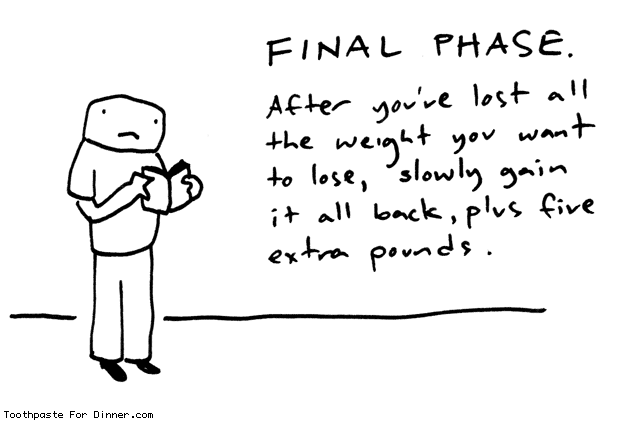
How diet books should really end...

I've never really read a weight-loss book, but I gather that the last chapter is all rah-rah, enjoy your new fantastic and skinny self, and your smaller ass will magically solve all of your life's problems.


The webcomic Toothpaste for Dinner has a great version of how a diet book really should end:

Thanks to the anonymous person who reminded me about this fab website.

The Noisy Brain

My brain is rather noisy- there's a cacophony of chatter always going on between that crack team of me, myself, and I. And here's the thing: this chatter never shuts up. Never. If I'm not fretting about something, then I'm trying to anticipate what I might need to do later, the order in which I need to run errands in order to use the least amount of gas, or just daydreaming about something or other. There is never any silence.

Starving myself didn't necessarily stop the chatter, although it did turn the volume down, especially on the self-loathing thoughts. Because as long as I was restricting and over-exercising, at least I could do something right. One of the many reasons that I found it so difficult to start eating on my own again was the fact that eating cranked the volume up on my ED-phones, and I really missed the (relative) peace that came when I was following my strictly limited diet.

At the 2010 Salzburg International Conference on Eating Disorders, Laura Hill from the Center for Balanced Living spoke at length about how recovery from an eating disorder makes the brain "noisier." This noise--this constant cacophony--drowns out almost every shred of sanity that remains.

Said Hill:

Silence doesn't come to anorexia patients if they're eating. When a person without AN eats, brain is relatively quiet. When a person with AN eats, they experience high anxiety, thought disturbance, and "noise." The noisy AN brain [has] layers of noise. The longer [they] delay eating, the lower the noise gets. Recovery doesn't mean that the noise goes away, it means you understand it and manage it better.

To some extent, you get used to the noise.

Ironicially, Hill said that the noise is at its worst just as you reach a healthy weight--something I can attest to rather well. I asked her what happened to the noise level as you maintain a healthy weight in spite of your brain shrieking that "YOU ARE A FAT F*CKING PIG!!!" I wanted to know (for my own selfish sanity!) whether the noise dropped.

Yes, she said. It did.

This one thing--the gap between when your body reaches a healthy weight and your brain begins to follow--is the most difficult, annoying, and frustrating thing in recovery. For all intents and purposes, you look well. You're eating. You don't cry in restaurants and dressing rooms (at least not every single time). But your brain is still deeply anorexic. This is when despair can take over. The noise is worse than ever and yet everyone thinks you're "fine."

At least when I was visibly sick, I thought, people knew I was suffering.

The noise goes down. This is what I've been telling myself. The noise goes down and I will adjust to eating and being at a higher weight than I've ever been and life will go on.

(Laura Hill's talk was so good, I have another segment for a blog post tomorrow!)

On being weighed

I hate being weighed. It makes me freaky anxious and I just don't like it. I worry that I might have gained, which will make me hate myself. I worry that I might have lost and then everyone will freak out on me. The ED part of my brain still sees maintenance as some sort of abject failure because I should be losing weight, not maintaining it.

It probably sounds pretty paradoxical that I find the concept of being weighed at my therapist's office to be reassuring and helpful. Not because I take comfort in being weighed--I most certainly don't--but because I find it helpful to know my weight and know that it is staying where it needs to be.

My first therapist never weighed me, although it didn't really matter all that much because I was weighing myself 80 bazillion times a day anyway. I ended up in the hospital soon enough because my physical deterioration was making my low weight almost a secondary issue. My second therapist used to weigh me, back to the scale, each week and then she slowly phased that out. Ditto for my dietitian. That left me to my own devices for quite some time, and it wasn't pretty.

Not being weighed felt nice at first, because I really do hate being weighed. It's kind of embarrassing, like someone knows all of your dirty little secrets. The problem was that the ED had a field day. I couldn't self-regulate around food. I would overeat, and then restrict and overexercise. Whether this would have showed up in my weight is unclear, but the lack of weighing added one more way for me to hide the seriousness of my ongoing eating disorder.

With my relapse last year, it was back to the weekly ritual of being weighed. I was weighed with my back to the scale so that the weight gain wouldn't freak me out. This was no doubt a wise move, as I'm reasonably confident that I really couldn't handle knowing the number at that point in time. However, TNT has a very different philosophy about weighing (namely that it's just a number and there's a time when you have to get over it) and so I started actually knowing my weight. After an initial freak-out, the actual number ceased to be such a huge deal. I still detest that number, think I'm a whale, etc, but the number itself doesn't provoke as much anxiety as it once did.

Now that I am in recovery and doing well, I'm still weighed by TNT, although only every other week. It works out well- I get a respite from the grueling scale-induced anxiety attacks but TNT is still monitoring my weight closely enough that the ED can't really get out of hand. My parents and treatment team are (not surprisingly) more worried that I will start losing weight again. Since I have the eating disorder and am therefore not that rational about my weight, I mostly worry that I will once again start gaining. Seeing my weight stay exactly the same week in and week out gives me the reassurance that my body isn't going to flip the hell out at an extra cupcake, and it reassures my parents that I really am taking this whole recovery thing seriously.

There's another interesting variable that my weight gives TNT: an insight to my psychological state. Bouts of the stomach flu aside, usually a drop in my weight means an increase in anxiety and ED symptoms. There's no clear cause and effect (did the drop in weight increase the ED thoughts or did the ED thoughts cause the drop in weight? I think both are true) but the fact that my last therapist pushed for a higher weight and then insisted I stay there (despite me calling her a meanie and much, much worse) has given me much greater psychological stability. The slightly higher weight (5-10 pounds) is the price I have to pay for a hint of peace of mind. But the opposite would have been a Faustian bargain: a weight I "preferred" but an ongoing, never ending, ultimately losing battle against the ED. Seeing my weight every other week is a reminder of that icky number, but it's also a reminder of my renewed peace of mind.

I like the fact that someone is monitoring my weight even though I really do hate getting onto that scale. Waiting for the little slide weights to settle themselves is like waiting to hear a verdict: it's long and agonizing but it probably really takes no more than 10 seconds. I'm getting used to my new weight although I still don't like it. I prefer knowing the number to not knowing it because at least if I know it, I'm not imagining having reached a four-digit weight overnight. Which makes the entire situation one massive paradox: hating getting weighed, liking the security of being weighed; hating what I weigh, liking to know that awful number rather than leave it to the imagination.

Since when did an eating disorder ever make sense?

The brain is a body part

This recent study, titled "Psychopathology in underweight and weight-recovered females with anorexia nervosa," beautifully articulates something that I've struggled to put into words. The study found that weight recovery in people with AN dramatically decreased psychopathology.

No, no--it's not that weight restoration cures everything! Because my life right now is an obvious example that this isn't exactly true. I would never say that weight gain isn't necessary, just that it's the necessary first step towards a meaningful recovery. If weight gain "cured" anorexia, then there wouldn't be the tremendously high rates of relapse that we see. The difficulty with weight gain is consequently keeping the weight on for long enough to get physically used to your new body and to begin the mental healing process.

But I digress.

The reason I find this article so incredibly interesting is how it managed to examine the relationship between somatic factors (ie, weight) and psychological factors (ie, ED psychopathology). Usually, the mind/body connection is seen as something very heebie-jeebie and New Age-ish, an idea sprung from the mind of a few pot-smoking hippies reeking of patchouli. But the brain was connected to the rest of the body- at least the last time I checked. The brain is an organ, just like your heart or your liver.

The mind/body separation in Western culture has been around for hundreds of years and has resulted in some rather interesting separations in medicine. The need for mental health parity is one of them, although that could also be interpreted the machinations of a bunch of cheap-ass insurance companies. With eating disorders, the assumption was that the ED thinking caused the behaviors that caused malnutrition and weight loss. It was a one way street. Although this is somewhat true (most people with AN don't start out malnourished no matter how catastrophically they end up that way), the opposite is also true. Low weight can cause ED thinking, which causes ED behaviors and a further increase in malnutrition, and I think that's what they call The Perfect Storm.

The body and mind aren't separate. Your brain uses approximately one quarter of the calories you eat (500/day) and is essentially a glucose hog. If you starve your body, you starve your brain. I managed to shrug many of the physical effects of anorexia off, but the cognitive effects really got to me. The knowledge that I can't preferentially shunt calories to my brain has helped me resist urges to restrict. I know I'm not the next Einstein, but my job requires a lot of intense, deep thinking, and anorexia would grind that to a halt. I don't miss being caught in the circular ED thinking, worry about what I ate, what I will eat, what I might eat, and exercise and fat grams and everything. If I delay my meals or snacks for any length of time, I notice a return of the anxiety and ED thinking, even if I don't notice a difference in my hunger levels.

It seems odd to think that something as simple (though fraught with challenges for those of us with ED) as eating could improve state of mind. It's not a cure, but it should stop being so surprising to so many people.

(An interesting note: the one area of psychopathology that didn't improve with weight gain was perfectionism, which emphasizes how this is a long-standing personality feature of many with EDs rather than limited to the time when one is acutely ill with ED.)

Body fat- it's not a bad thing

A new study confirms previous research that a higher percent body fat is associated with better outcomes for anorexia, and that lower body fat percentages are associated with relapse (Bodell and Mayer, 2010). The research isn't exactly groundbreaking, nor is the science--it's a pretty straightforward statistical analysis--but the results bear repeating.

For most of my treatment, I've had clinicians low-ball my weight. They'd use some sort of plug-n-chug formula and tell me what I needed to weigh. Only twice was I asked what I weighed before the eating disorder during these "What should healthy Carrie weigh?" conversations. The second time, I lied because that is what people with eating disorders do when they are terrified of gaining weight and want to avoid it at all costs. Nothing egregiously inaccurate, but still.

One dietitian told me a weight that was about 20 pounds below my pre-AN weight. Another treatment center let me pick what weight I wanted to end up at (I pulled a random number out of the air because I knew I was being discharged in 24 hours and didn't want to jeopardize that). A different treatment center told me my target weight down to the half pound. Even as deeply entrenched in my illness as I was at that point, I found it ludicrous. If drinking a bottle of water can cause the difference between "too thin" and "too fat" or even healthy and not, then your standards are seriously whacked. Not one of them looked at body fat percentage. Not one of them looked at growth charts. Not one of these treatment experiences resulted in a lasting recovery.

I was all too happy to be told these very low target weights because that meant I could keep a bit of the eating disorder. But I also remember this tremendous sense of betrayal, that the people I had hired and was paying my hard-earned money (dude, I was a college student! I'm not paying $100 per 50-minute hour because I have a bunch of spare change laying around that I don't know what to do with!) didn't really have my best interests in mind. I don't think these people were deliberately malicious--they thought they were doing right by me--but they were wrongheaded and rather harmful. Because what I heard when I was told these low weights was that "See, I really was fat. There really was something wrong with my weight. I was right to stop eating and start exercising." If my weight was fine before anorexia, then why wasn't that my goal weight? I was very healthy and athletic and, the depression and anxiety notwithstanding, relatively happy. And if all of these professionals were telling me I would be just fine at X pounds, then why should I struggle through and get back to Y pounds?

I'm not saying that we should be checking percentage body fat every time someone walks in the door. Frankly, I don't want to know my body fat percentage as it's just one more number to obsess over. But it makes no sense to be afraid of it, either. To buy into the ED deception that having a normal, healthy amount of fat on your body is something to be afraid of. It's a tool to help people towards recovery. We know that shooting too low on weights can leave a person very vulnerable to relapse, so I can't quite figure out why we keep doing it.

Determining Target Weights: An Evidence-Based Approach

I thought about including this piece of research in last week's smorgasbord, but I thought it was so important that I wanted to make sure it got its solo time in the limelight.

Determining target weights in people with eating disorders has never been easy. Many doctors lowball the weight so they don't scare off the patient. Which is nice (remember the phrase about the road to hell being paved with good intentions?) but it also really twists the sufferers mind and leaves them only 90% well. No one would settle for removing 90% of a tumor just to make a cancer patient feel better in the moment, so why people are very willing to tolerate sub-optimal target weights is beyond me.

This has been an issue with me because I'm fairly muscular, and I weigh more than I look like I do (a friend described me as small but solid). So the old formulaic 100-pounds-for-five-feet-and-five-pounds-for-every-inch-over left me at a weight where I had already lost my period on the way down. I was more than happy to stay at the inappropriately low weight, not the least because I got to skip out on the monthly tampon shopping sprees. It also left me deeply entrenched in the eating disorder.

There are also other treatment providers who would provide an accurate target weight if only they knew what it was. In younger children, in those who have been sick longer, and in those who don't have growth charts, even the best physician can be flummoxed. The organization FEAST has some good information on setting target weights, as does the Kartini Clinic, and although these methods are informed by science, they are still as much of an art as anything.

But we might have a new tool to help with this. A recent study from the European Eating Disorders Review found more objective ways to help determine target weight in a study titled "Predicting the weight gain required for recovery from anorexia nervosa with pelvic ultrasonography: An evidence-based approach."

The abstract of the study summarizes the outcome of the study rather well:

Transabdominal pelvic ultrasound scanning (U/S) offers a more objective method of ascertaining physical well being by the ability to determine reproductive maturity. This study aimed to explore the correlations between the maturity grading on pelvic U/S and weight for height (WfH) ratios and body mass index (BMI) percentiles. Ultrasound studies were performed in 72 female adolescents (aged 11-17 years at intake) with AN. Scans were graded for maturity using published parameters of pelvic maturity and compared with the patient's WfH ratio and BMI percentile. In our sample was a wide variation of WfH ratios and BMI percentiles at each grade of maturity. This supports the view that arbitrary targets for weight, WfH ratio or BMI percentile are likely to be unnecessarily high for some patients and too low for others. We recommend that targets be based upon baseline pelvic U/S grading and follow-up scanning.

This study will probably need to be replicated before it can become commonplace, but I am so glad that there are now evidence-based approaches for helping to determine target weight that are more effective than a coin toss or one-size-fits-all approach.

Improved insight

My therapy sessions this week were unusually productive, yielding several important insights. I spoke with my dietitian at length to start integrating "enjoyable activity" into my life, and I got the go-ahead to begin yoga and walking, so that's good. Along with that came the dreaded meal plan increase, which irritated me (more food? Seriously?) but not as much as it might have.

The food-related insight has several different parts. My food was increased not only in preparation for my increased activity, but also because I wasn't sleeping well. Before my appointment, I was attributing my rise in insomnia with caffeine carelessness or anxiety or whatever. I never thought I might not be sleeping well because I was, you know, hungry or something. Case in point: last night I was up late reading and then I couldn't fall asleep. I didn't really feel hungry, just that my brain wouldn't shut off. I went downstairs and had some mommy time, and then she suggested I get something to eat. Despite my protests that I was fine (and I seriously thought I was), my mom cut me a slice of zucchini bread. And as soon as I started nibbling at it, I realized: Oh. I was hungry. After, I didn't fall asleep right away, but I eventually drifted off.

So the one insight is that even non-perceived hunger can keep me awake. It's a sign that my body really does know what it needs. The other insight is that I'm trying to look at the food increase not as just more to eat, but as a tool to help me sleep better. I'm still not thrilled about it, but I guess that's okay. I don't need to like it in order to eat more.

The other insight came during my therapy session, as my therapist and I discussed my ongoing body image woes. I can't not see myself as anything more than a jiggling ball of lard. And all I can think about when I'm in public is that people are staring at and disgusted by) my quivering thighs. I mean, aren't they giving off aftershocks that can be measured on the Richter scale? And I also brought up how I still have no clue (subjective or objective) what I really look like, especially when it seems I'm constantly watching the National Skinny Person's Convention while I'm waiting to be crowned Miss Blubber. I understand, on some level, that the evidence for this is pretty negligible. I know that the size of my shorts and jeans (Size X) is well below the population average and only contains one digit. Ergo, I'm far from fat. But looking at myself or looking in a mirror, and Elvis and rationality have just left the building.

So my therapist turned the question around a bit. "What would you say if I told you to guess the approximate size of someone who is five foot five and wears a Size X?" Well, I'm five foot five, and my shorts were Size X that day. Yet when I heard it coming from someone else, someone who I know isn't going to bother me with BS, I was able to realize this: "I'd say that person was pretty thin."

And my therapist, bless her red-headed, caffeine-loving heart, said: That person is you.

Although I still have several pounds to go in terms of weight restoration, I am currently about the same size I was before I relapsed. The Size X shorts are still kind of loose, but not freakishly so. So that is me, at my normal healthy weight, and that's just fine. Anyone else would call me on the thin side of average. I've told myself before, "I wear a Size X and people who wear Size X are not fat," and it never seemed o hold much weight (uh, har har) in my brain. But evaluating myself the same way I would evaluate other people, I can better understand that I really don't see myself accurately.

The point of this insight is not Holy Revelation, Batman: Carrie is Thin! It's not so much that I'm seeing myself as thin that makes me feel better. It's that I have a concrete clue to hold onto that just may help me perceive my body accurately. Not that it always works (it doesn't), but it's a way to remind myself that objects in the mirror are smaller than they appear.

Ensure Connoisseur

Part of my current recovery plan involves drinking an Ensure Plus every day. I hated this idea. I felt guilty that they were so expensive. I felt guilty for drinking them. And I didn't particularly like the taste. The vanilla flavor was cloyingly sweet, my lips puckering with distaste as I drank. However much those animated commercials have tried to normalize the idea of drinking Ensure, every bottle I opened made me feel like a medical patient, that I was freakish and abnormal.

Except that I am a medical patient. I'm at home, but I'm still recovering from an actual illness.

I've learned that the Ensure Plus isn't all that bad. It's not all that good, but it's not bad. I tried different flavors- the strawberry and butter pecan taste much better than the vanilla (which is still gross to me). I worked with my dietitian to shift around my meal plan so that I could have an extra fruit along with my afternoon Ensure Plus, which my mom blends into a smoothie that almost lets me forget I'm having a supplement.

Logically, I know I need the extra calories. I'm having hot flashes from hell (hats off to all you menopausal women out there- you have my sympathy) because my metabolism has started to remember that my body will be fed regularly. I also know that with the amount I need to eat, having a supplement is much easier than eating the equivalent amount of food. It's also more convenient, considering life has been chaotic around here, to put it mildly.

I doubt I'll continue drinking the supplements even after I'm finished with weight restoration, largely because there are far tastier things I can think of to eat. But they're not that bad. And I know they're necessary. I can deal with that. It won't last forever and soon I will move on to bigger and better (tasting) things.

‘Phantom fat' and body image

I stumbled across a news article about how 'Phantom fat' can linger after weight loss when I was on Twitter (do you follow me on Twitter? Click here to start following ED Bites!) and I was struck by how much this seemed to describe what was going on in eating disorders. The article quoted a women who had lost a significant amount of weight over the past two years, and how

every morning when she looks in the mirror while getting ready for the day, she sees her former, heavier self. “My brain says, ‘Yep, still fat.’”

“It's been really hard to change my self-image,” says Hicks, 37, of Chesapeake, Va. “I still feel like I'm this enormous person who takes up tons of space.”

When I was in residential treatment the last time (in 2006), I groused about how fat I felt, how skinny all the other girls were, etc, etc. Standard AN kvetching and bitching. Still, the dietitian I was talking to made a good point: I had gained weight. Okay, not much, but I had, and I knew it and that's in part what I was there to do. My body was heavier than it had been. And considering I had been underweight for at least a solid year by the time I started treatment again (though my lowest weight was back in 2001), some of my physical feelings of fatness were not strictly ED-driven, but also might happen to anyone gaining weight. Or, in the context of the article, people losing weight as well.

I was oddly reminded of this conversation about a year ago, when I was riding the commuter train from DC to Baltimore, as I headed home from my summer internship. There was a 16-year-old boy (I'm guessing) and his family, and he was almost literally all limbs. He carried himself a bit awkwardly and--here's the really interesting bit--he kept banging his head against the overhead rack. He made a joke about his growth spurt, and it hit me: his perception of his body (known formally as proprioception) hadn't yet caught up with his new height! Cammy did a wonderful post about something similar right after this happened, which kind of cemented the incident in my head.

It makes sense that there would be a link between body image and proprioception, and researchers have found previously that the body image distortions in people with anorexia was linked to abnormal amygdala functioning and the fear response. So it makes sense that significant fluctuations in weight would be linked to both body image and proprioception, especially in people with a history of dieting like many of the women featured in the article.

“People who were formerly overweight often still carry that internal image, perception, with them,” says Elayne Daniels, a psychologist in Canton, Mass., who specializes in body-image issues. “They literally feel as if they’re in a large body still.”

Daniels and other experts suspect this may happen because the brain hasn’t “caught up” with the new, leaner body, particularly for people who were obese for many years and then experienced rapid weight loss.

“Body image is a lot harder to change than the actual physical body is,” Daniels says.

Amen to that, sister.

Psychologist Joshua Hrabosky found that women who were currently "overweight" or formerly "overweight" had a "dysfunctional appearance investment" and were more preccupied with weight that women who were never "overweight."

The findings suggest that “people who undergo major weight loss may experience improvements in satisfaction in appearance, though still not necessarily as much as someone who was never overweight,” Hrabosky explains. “But they are also still more invested or preoccupied with appearance than someone who was never overweight.”

It does make me wonder what dieting and food intake might have to do with weight perception and body image, as even healthy men in the Minnesota Starvation Study complained of "feeling fat" during the rehabilitation phase.

But the article raises some really good points about the psychology, too. When you've thought of yourself as fat for most of your life, it's really hard to change that thinking no matter how much weight you've lost or how much you understand the futility of dieting. I'm curious to see how this research will affect thinking on the body image distortions in eating disorders. We shall see.

"How to be Healthy and Beautiful"- from 1902

Today's Los Angeles Times had an article from 1902 titled "How to be Healthy and Beautiful," with the subtitle Putting Symmetrical Curves Upon the Weak, Emaciated Figure of a Worrying Woman.

Though the text itself is hard to read (click on the image of the full article to pull up the jpeg and zoom in), much of the advice in the article seems familiar to what we might hear today:

A famous French doctor once said to me: "The only way to successfully treat emaciation is to search for the mental cause and abolish it." It is not difficult to discover the explanation of a bony woman, if one makes a study of the subject. But it is quite a different matter to supplant the angles with curves.

Sound like the standard lines from ED treatment providers? Thankfully, we have some better treatments now.

And this paragraph comparing obesity and emaciation:

Feminine beauty is not compatible with either extreme stoutness or emaciation. The fat woman is repellant because all the contours of beauty are gone; the hollow-cheeked, angular, flat-chested woman cannot be really physically lovely either, but the grossness of obesity is certainly more to be deplored than the cadaverous condition of emaciation.

The big difference, of course, is that the article is advice on how to gain weight--something you would never see in today's papers.

Among other things (there are recipes for homemade cold cream, an eyelash/eyebrow grower, and a cream to "reduce fleshy breasts"), the author provides techniques, pictured below, to help the poor worried woman add some pounds. In this case, just lay on your back with a weight on your stomach!

It's a fascinating look at weight from 100 years ago, and an eye-opener into what has changed, and what really hasn't.

More on hypermetabolism

I had mentioned about a week or two ago that I was going to begin a blog series on the biology of eating disorders. I wanted to start with something about the causes of EDs or something like that, but I think this topic is extremely relevant and so we can just call this the first post in the series.

I did some more research tonight into the biology and etiology of hypermetabolism. So let's start with a basic definition from Wikipedia:

Hypermetabolism is the physiological state of increased rate of metabolic activity. The impact of the hypermetabolic state on patient nutritional requirements is often understated or overlooked. Hypermetabolism typically occurs after significant insult to the body. In hospitals and institutions, the most common causes are infections, sepsis, burns, multiple trauma, fever, long-bone fractures, hyperthyroidism, prolonged steroid therapy, surgery and bone marrow transplants.

And, yes, eating disorders. Specifically anorexia. As someone falls deeper and deeper into anorexia, their metabolic rate slows dramatically. During the Minnesota Starvation Study, resting energy expenditure (also known as basal metabolic rate- the amount of calories needed just to keep your body functioning and doesn't include ANY physical activity) fell by about one-third. The book "Introduction to Clinical Nutrition" says that

Starvation involves metabolic alterations that enhance the chance of survival by increasing the use of body fat stores, by sparing the use of glucose, by minimizing nitrogen loss, and by decreasing energy expenditure.

But when the ill person begins eating again, their metabolism kicks into high gear. Body temperature rises. A person can experience night sweats, which may also be related to hormone function returning to normal.

Why? It seems a remarkably inefficient use of resources. And indeed, hypermetabolism may not be entirely adaptive from an evolutionary standpoint as the body's use of food becomes remarkably inefficient. Even so, the body needs tremendous amounts of energy to replace lost fat and muscles stores, depleted organs, bone mass, hair, nails, you name it. No organ system is spared during an eating disorder.

The amount of calories needed for people with anorexia to return to a healthy weight can vary by illness severity (a lower BMI means more calories, as well as duration of illness), and by illness subtype. One study found that those with the binge-purge subtype of anorexia needed significantly fewer calories than those with the restricting subtype; another study found that calories were about the same. Other variants include your metabolic rate before illness onset. I've known several good friends curse their fast metabolisms quire vociferously during refeeing.

When looking at the phase after weight restoration, caloric needs between people with anorexia nervosa and those with bulimia nervosa turn out to be quite different. One study found that people with AN needed more calories per kilogram of body weight than normal controls, while those with BN needed fewer. It appears that people with a current diagnoses of BN but a history of AN require more calories than those with BN alone. Further, people with the restricting type of AN needed more calories than those with the binge-purge type, both of which were greater than patients with BN (some of the studies cited above show that, for weight maintenance, caloric needs are basically the same for any patient with a current diagnosis of AN).

Some of these differences may rest in premorbid differences in metabolic rate. It makes intuitive sense that a person who finds it easy to lose weight would have a faster innate metabolism. Other reasons calorie needs may remain unusually high for a person even after weight restoration is the sheer amount of rebuilding the body needs to perform. Bulimia is violently destructive to the body, and I would never say differently. However, some of the damage done by anorexia is slightly different, and the body must rebuild and repair essentially every organ in the body. My psychiatrist told me that the nerves continue to repair themselves for up to two years after weight restoration. This can hardly be the only organ system taking a long time to recover.

How long hypermetabolism lasts will probably vary from person to person, and depends on how long you were sick, how your body responded to the damage from your eating disorder, your activity levels, among others. There's no real way to be sure. If your caloric needs are unusually high--even for hypermetabolism--you can have body composition analysis and resting energy expenditure testing done. Personally, I think this is best left to extreme cases since so many of us have a tendency to fixate on numbers.

I hope this helps explain hypermetabolism just a little bit. I can't answer every question, as it's been a long time since my college biochemistry days, but I can always look things up.

Scared into gaining weight?

On my last post about my upcoming series on the biology of EDs, Susie asked this:

i'd certainly be interested in medical complications. you never know, i may read something that shocks/scares me into gaining weight.

To be honest (and bluntness is a character fault of mine, so I do apologize if I sound harsh), there are two answers to your question. The short answer and the long answer.

The short answer? Nothing will scare you into gaining weight.

The long answer? Unfortunately, the more you read, the more convinced you become that you can escape the consequences. Or, for me, the longer I was sick, the more I began to experience these medical consequences. And so where I was originally faced with a list of problems A through F that could arise from my ED behaviors, I found that A, B, and C had happened and I had lived to tell the tale. Ergo, I wasn't that sick. So D, E, and F really couldn't be that big of a deal. Then D, E, and F happened and I was still sick and unable to see that I was sick and then I learned about G and H.

You get the drift.

The fact that you have an eating disorder prevents you from understanding the full extent of your illness. It's called anosognosia- a lack of insight into illness. It's not a character flaw, it's just the way starvation monkeys with the brain.

Furthermore, fear doesn't change behavior. It just doesn't. Lasting behavior change really needs positive reinforcement, not negative. Because if fear worked, there would be a lot fewer smokers in the world. And the obesity hysteria certainly has people all worked up over the possible dangers of fat- yet most people tend to weigh about the same. Heroin addicts shoot up despite risks of HIV and Hepatitis C. People gamble knowing they could lose their house.

There are many positive reasons to get into recovery. But your brain needs to heal from malnutrition first, before you can really focus on that. Right now, when you're underweight, you're like a heroin addict, high as a freaking kite. You need to detox (ie, gain back to a healthy weight), and then you can try to find positive ways to stay healthy.

Find someone to help coach you back to a healthy weight. Reading about the medical complications that can happen if you don't probably won't help, though.

Defining insanity

The AA folks say that the definition of insanity is doing the same thing over and over and expecting different results.

This makes me wonder how I might define Oprah's response to her recent weight gain.

Frankly, I don't care how much Oprah weighs. In the grand scheme of things, it doesn't matter to me. It does, I am sure, matter to her.

Other people have written on this (here, here, and here) far more eloquently than I have, but I did want to toss out a few comments from the peanut gallery.

What seems to be happening is endless weight cycling: gain some, lose some, gain some, lose some. And the fact that people keep dieting--in spite of the evidence, scientific and personal, that it does not work--kind of exemplifies the AA definition of insanity. Really? It's not going to be different this time.

If Oprah, who can afford luxuries like a full-time chef and full-time personal trainer, as well as housekeepers and more money that some small countries in Africa, can't figure out a way to lose weight and keep it off, this should tell us something. Mother Nature is stronger than Oprah. If your genes want your weight to stay at a certain level, they will make sure you get there and stay there, and Bob Greene can go suck it.

Of course, I want people to take care of their health. But there's a lot of space between lettuce and plain grilled chicken and duct taping yourself to the couch with an endless supply of Ho-Ho's. The problem is that dieting takes away that middle ground, makes us forget what it's like to live there.* It made me very dismayed when Oprah said that the weight gain was because she "ate whatever [she] wanted" and this was a bad thing.

Eating whatever you want is NOT A BAD THING. After you've been dieting for the eleventy-billionth time, however, you can go overboard. Eating too much of whatever you want can be a bad thing.** It's the First Law of Dieting: Every diet is followed by and equal and opposite binge. I can't help but thing that maybe if Oprah had just eaten whatever the hell she wanted in the first place, her weight might be stable.

An interesting side note: my therapist said that she can kind of tell when Oprah is on a weight loss kick because her magazine focuses more on recipes and weight loss tips than before, when it was more about accepting yourself and work/life balance, etc.

I would love to see Oprah stand up and accept herself for who she is, whatever the size of her ass. It doesn't matter. She can still do amazing things and be an amazing person. I'm not super-hopeful, to be honest. I think she has a lot invested in dieting and being a weight she might not supposed to stay at. And de-investing in this would be a phenomenal thing for ALL of us. We put so much energy and effort into things that may not be sustainable long-term, and there's a grieving process when you realize that you're never gonna be thin and the only thing left to do is work with what you've got.

*For that matter, so does an eating disorder.
**And let's not forget: so can eating too little.

A lose/lose situation

A study published last year in the International Journal of Obesity found that yo-yo dieting (even just a gain/loss cycle of 5-10 pounds) led to "an association between weight fluctuations and cardiovascular disease and death."

In a Washington Post article, lead author on the paper had the following to say about the results:

"I agree that data on weight cycling are mixed, particularly on weight regain, decreased energy expenditure, etcetera," said lead author Dr. Jean-Pierre Montani, professor and chair of physiology at the University of Fribourg.

"However, there is increasing evidence that weight cycling may lead to cardiovascular and metabolic disorders," such as hypertension and diabetes, he added. "And the risk of complications of weight cycling seems greater in people with normal weight or slightly overweight than in obese people."

The obvious solution, then, would be to stop dieting.

Other experts, however, disagree. They think that weight cycling isn't as dangerous as staying overweight or obese, and that people should continue to try and lose weight.

And therein lies the conundrum: there are no known ways to help people lose weight and keep it off.

Some of the experts said that a person isn't "worse off due to trying to lose weight...There's no sign that losing the weight results in a worse final weight than in the control group," Dr. Michael L. Dansinger, an assistant professor of medicine and obesity researcher at Tufts-New England Medical Center in Boston, explained. But are they better off for having dieted and regained? What about the psychological effects of dieting? What about the monetary issues?

And do this: define "better off." I'm assuming he means weight, but well-being encompasses so much more than weight.

Of course, you could make "lifestyle changes" like cutting out soda instead of dieting, but I'm not exactly sure of the difference. And besides, there's no evidence that this works, either. Even winners of the Biggest Loser TV show gain back a lot of the weight they lost during the show- and they have a lot more scrutiny and motivation than the average dieter.*

This article, and line of research, leaves people trapped. Lose weight, they are told, and keep it off. But no one really knows how to do that on a large scale. We are advocating a method that is basically statistically impossible. And the obvious solution (stop dieting!) gets lost in the shuffle.

*Then again, they didn't always lose weight in a safe and healthy manner, either, so it's doubly to be expected.

Older Posts Home

ED Bites on Facebook!

ED Bites is on Twitter!

Search ED Bites

People's HealthBlogger Awards 2009
People's HealthBlogger Awards 2009 - Best 100 Winner!
Wellsphere

About Me

My photo
I'm a science writer, a jewelry design artist, a bookworm, a complete geek, and mom to a wonderful kitty. I am also recovering from a decade-plus battle with anorexia nervosa. I believe that complete recovery is possible, and that the first step along that path is full nutrition.

Drop me a line!

Have any questions or comments about this blog? Feel free to email me at carrie@edbites.com


nour·ish: (v); to sustain with food or nutriment; supply with what is necessary for life, health, and growth; to cherish, foster, keep alive; to strengthen, build up, or promote


Archives

Popular Posts

Followers


Recent Comments