Showing posts with label dieting. Show all posts

'Tis the Season

...for dieting, that is.

Most of us learned about the four seasons when we were younger, about spring, summer, autumn, and winter. Considering I grew up in Michigan, there were really two seasons: winter and three months of bad sledding. Now that I'm an adult, and living south of the Mason-Dixon line, there are many more seasons than I experienced as a kid in Michigan. To everything, there is a season, and to every season, there is a reason to diet.

Winter: It's your New Year's Resolution to have a Totally New You by developing those Buns of Steel. (I'd settle for buns of cinnamon, but then, that's me.)

Spring: It's going to be Bathing Suit Season soon, and you had better fit in that Itsy Bitsy Teeny Weeny Yellow Polka Dot Bikini you wore when you were three. So it looks like a thong. So what. I hear they're popular these days!

Summer: It's Bathing Suit Season and EVERYONE IS GOING TO SEE YOUR FAT ASS IN THAT BATHING SUIT SO YOU BETTER STOP EATING, YOU FAT PIG.

Autumn: Do NOT gain weight over the holidays, and here's how (you can start by not celebrating the holidays at all).

Ta-da! The year in dieting. Winter season is the worst, and right now about all I seem to hear commercials for are end-of-the-year car sales, cigarette cessation aids, and diet products. It makes me almost pity the poor guy who's trying to hawk replacement windows so that people can get their tax credit.

Almost.

Jeopardy!, the game show for grandmas and geeks like me, Jeopardy! for crap's sake, is now sponsored in part by a colon cleanser (aka, an overpriced laxative that just really dehydrates you and then you take a drink of water and bloat from here to Timbuktu. Trust me, kids, don't try this at home).

The Diet Survivor's Group blog has a list of alternate dieting headlines for magazines to use. Start with these examples and then you might just have a fun game to play in the checkout aisle at the grocery store.

Self Magazine:
The Food Lover's Diet - 31 Tiny Tricks That Peel Off Major Pounds
My Edit:
The Food Lover's Diet - Eat What You Love and Savor Every Bite

Allure:
The Easiest Diet Ever: Drop 600 Calories A Day Without Feeling Hungry
My Edit:
The Easiest Diet Ever: Eat When You Are Hungry And You'll Never Feel Hungry (duh!)

Shape:
How We Lost 477 Pounds Together: 6 Women Share The Diet Secrets That Worked For Them
My Edit:
How We Raised Our Consciousness Together : 6 Women Share Their Wisdom And Empower Each Other

Fitness:
Your Best Body Ever
My Edit:
Your Body Is The Best Body Ever

O Magazine:
How To Get What You Really Want This Year: Weight Loss That Sticks - Dr. Oz's Simple Secrets For Keeping The Pounds Off
My Edit:
Keep Working Toward Getting What You Really Want This Year: Body Satisfaction That Sticks - Dr. Oz's Simple Secret Is That There Is No Secret For Keeping The Pounds Off.

Seventeen
Total Body Confidence - Great Abs, Butt & Legs By New Year's
My Edit: (I got kind of hopeful with the first part...)
Total Body Confidence - Enjoy Your Body In Its Fullness All Year Long

Us:
The Biggest Loser - How I Did It!
My Edit:
The Biggest Winner - How I Did It! Tips To Love, Respect, And Honor Yourself
Woman's World:Break Through Ohio State University BELLY FAT CURE! Discovery - Two Spoonfuls Of This Oil Will Block Fat Storage! Melt 5" Of Belly Fat - No Diet Required!
My Edit:
Woman's World Announces Bankruptcy As Readers Boycott Magazine Due To Outrageous Claims!


I guess this game beats hibernating...

{{brought to you from the archives...}}

What's so different?

Other members of the Academy for Eating Disorders alerted me to this upsetting/appalling/annoying article in Bicycling Magazine.  It's so awful that I'm not going to link to it for any number of reasons: lots of height/weight stats, weight loss stats, and I also don't want to give the article any more traffic than it's already getting.


{{That said, if you're really interested or don't believe that I'm not making these things up, email me at carrie@edbites.com and I'll send you a link.}}

The article is about how pro cyclists Lost Weight! Blasted Off Fat! and Shed Pounds!  I don't read these stories,  mostly because they're really boring.  They follow the same story line.  They have the same generic advice.

But this article read more like a pro-ana selection or How To Have An Eating Disorder than your run-of-the-mill weight loss guide.

Some stellar clips from various cyclists:

[His] hard-core routine isn't for the faint of heart: He doesn't eat after 7 p.m., and he often does a 30- to 60-minute run, ride or hike before breakfast.

Even after a huge day of training, if I fueled properly throughout and after the ride, I can usually get away with eating just some salad or steamed or grilled vegetables with a small amount of lean protein.


Studies have shown that simply chewing your food longer--as many as 100 times per bite, in some research--results in reduced caloric intake. Hold also began chewing gum at the first craving for food. She says it gives her time to decide, "Am I really hungry or am I bored, nervous or stressed? I find in many cases, I just chew some gum and I don't really need food."


"As soon as I notice that I've gained a couple pounds, I immediately adjust what I'm eating and increase my exercise," he says.

Like I said, it sounds a lot like eating disordered behaviors to me.

Reading things like this really raises my hackles, even above and beyond the distribution of dangerous and potentially deadly advice.  It irritates me because other people's eating disordered behaviors are given the green light whereas mine are practically illegal.  Somehow, my psychiatric stamp of "ANOREXIC" makes a massive difference?

I get that these behaviors aren't healthy whether your psychiatric passport has an eating disorder stamp or not.  But I find our culture's very paradoxical attitude towards eating disorders frustrating.  On the one hand, the public is fascinated and horrified about people who spend their lives with their heads in the toilets or become emaciated.  And yet there's a general endorsement of the behaviors that result from an eating disorder.

So what gives?

The ED part of my brain is, I confess, a little jealous.  Why didn't my exercise regime get lauded?  Why can't I do these "wonderful" things that these cyclists are doing?  What makes them so different from me?

The answer is: not much.

Ultimately, these cyclists are playing with fire.  These regimes are dangerous, and promoting them even more so.  I hate that our society approves of so many disordered eating behaviors.  And not just approves, but encourages and promotes.  Then everyone wonders why eating disorders are so difficult to treat.  No, culture isn't the whole reason, but it is one massive hurdle.

What do you think? How do you counter society's messed-up messages about food and weight?

Anorexia isn't an art

I read many news stories about eating disorders every week--most of them are okay.  I don't feel that they've turned the world upside down with great knowledge, but they also aren't heinous.

Then there are the heinous stories, about which I need to splutter in verbose dismay because I can't think of anything else to do.

Let's start with the title, shall we?

Addictions & Answers: Behind the insideous 'art' of anorexia

Okay, just to clear up any misconceptions here: ANOREXIA ISN'T ART.  It's not pretty.  It's not insightful.  It doesn't bring value to the world.  Watching your hair fall out in chunks, watching your skin turn yellow and gray, watching your kidneys stop working--this has nothing to do with art.

Being so afraid of eating, or the consequences of eating, isn't art.  It's an illness.  We don't call cancer or diabetes or mesothelioma an "art."  We seem to reserve that concept for eating disorders.  Stop making eating disorders into something they're not.  This so-called "art" kills thousands of people, and precious few people take it seriously.  We need a lot less art concepts and a lot more illness concepts.

I love metaphors, and I have used metaphors a lot to try and explain my own experience of having anorexia.  But there's a difference between using a metaphor to describe something ("It was like being trapped in a burning building") and actually using that something as a metaphor ("The burning building is like our society").  Frankly, I find it insulting and demeaning.  Anorexia-as-art smacks of vanity, of something less than serious, that maybe I huffed a few too many turpentine fumes on my way out the door.  Nuh-uh.

Onto the actual article...An excerpt is below:

BILL: Can't these people just look in the mirror and see something is radically wrong?


DR. DAVE: That's like saying to a meth addict, 'Can't you see you're killing yourself, why don't just stop?'


BILL: Dave, not the same. The meth addict is out-of-his-mind high. The alcoholic who dies in a one car crash or even the gambler who suicides in a deep depression rather than face his creditors—these are things our readers can understand. The closest I can come to understanding anorexia was when someone called it "the art of starvation."


DR. DAVE: Exactly: People like Isabelle Caro and Jeremy Gillitzer are addicted to view starvation as a kind of body image art.


BILL: An art they can totally control.


DR. DAVE: When the 87-pound anorexic loved one is genuinely horrified about how a stick-thin arm is "too fat," and pushes away the plate, barely touched, their families are baffled.


BILL: I can see how easy it is for parents to miss anorexic behavior. Aren't they in the midst of their own post-Christmas diet rituals --Jenny Craig "personal counselors," the new Weight Watchers "Points Plus" programs, and the rest? OK, Doc -- how does a parent or lover intervene to end this addiction?

"Body image art?"  So having anorexia is like getting a tattoo?  My only response to that is WTF, buddy?

The drunk, the meth addict, the gambler are all out of their minds, but someone with anorexia--a diagnosable mental illness--is somehow perfectly sane?  It's not just a bad choice.  The chaotic eating patterns in any eating disorder mean that the brain is painfully, thoroughly affected.  Someone with an eating disorder is exactly like a meth addict or someone as drunk as a skunk.  Their brain isn't working properly.  They need to detox before they can start behaving rationally.  Most starving people aren't completely rational--the men in Keys' Minnesota Starvation Study showed that rather well.

The last thing that really irked me is the comparison of anorexia and dieting.  An eating disorder is not an "extreme" diet or a diet gone overboard.  It's not uncommon for an eating disorder to start as a diet, but that doesn't mean that an eating disorder is a diet.  A suicidal person is often depressed and in a bad mood (trust me on this one).  Suicide isn't just a really rotten mood.  It isn't something you deal with by watching a funny movie and hoping it will go away.

One of the best things about the Internet is that everyone has a voice.  One of the most frustrating things about the Internet is that everyone has a voice.  Some people--especially these two--shouldn't have microphones.  It's one thing to peddle your whackjob theories on your own personal blog, but to have an official "stamp of approval" from a news organization is ridiculous.

How diet books should really end...

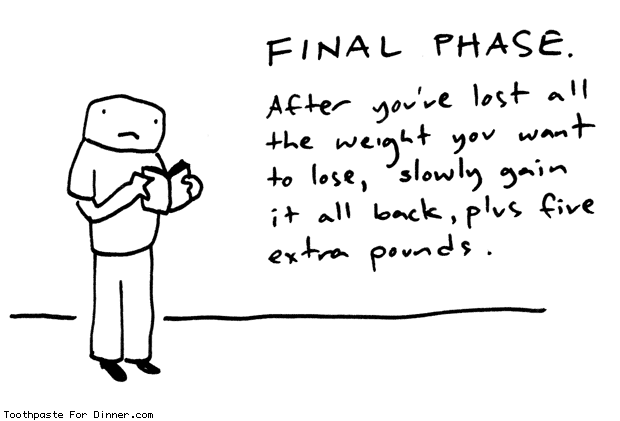
I've never really read a weight-loss book, but I gather that the last chapter is all rah-rah, enjoy your new fantastic and skinny self, and your smaller ass will magically solve all of your life's problems.


The webcomic Toothpaste for Dinner has a great version of how a diet book really should end:

Thanks to the anonymous person who reminded me about this fab website.

Just desserts

Many of the conversations I have with customers in the bakery are repetitive and predictable. Most of this is pretty expected: we have quite a number of items, but not that many. You can only ask for so many things. But part of the repetitive nature of the conversation has to do with people (mainly women) commenting about how fattening everything is, how can I be skinny and work in a bakery?!?, and how what they're buying is for "someone else."

I just want to shake some of them* and say "I don't care. Really. I'm not judging you for buying a sweet treat. I really don't care. What's more, I'm kind of glad you indulge your overpriced sweet tooth because it means I have a job. And it's not my dream job, but I do rather like getting a paycheck."

What these people are really doing is apologizing for buying something "fattening" and "tempting." I have plenty of issues with apologizing, to be sure, but the cultural mea culpa when it comes to eating is something else. I want to say "You are buying food in a grocery store- there's nothing to be ashamed of!"

A woman yesterday bought an eclair and said it was for her husband. She had just started Weight Watchers and wanted to "be good" so she was going to watch him eat it, "with tears running down my cheeks." All I could think was: and I'm the one with the eating disorder? Why must everyone else be so conflicted about something that my treatment team has been telling me for years is a good and necessary part of life?

More than that, it's really boring. I am so incredibly sick of thinking about food and weight and good and bad and should I or shouldn't I. To have these thoughts echoed in the people around me is just annoying. And so I want to say (to them and to me):

It's just food.
Really.
That's all.
You don't have to feel guilty
or ashamed
for eating food you like.
There's nothing wrong.
I'm not judging you.
It's just dessert.
Enjoy it.
And then move on.

*Not the least of which was the old lady who yelled at me for mislabeling the pecan cinnamon rolls as our regular cinnamon rolls. I told her that wasn't pecans on top, just streusel. She said no, it was pecans. I said it was streusel and grabbed several other boxes to show her. She got angrier and angrier, saying No, it's PECANS, until I finally convinced her that it was streusel by showing her the pecan rolls. And she said "Well, how can I see that without my glasses?"

Small changes, big difference

Today's New York Times had an eye-opening article on small changes in diet and exercise and obesity. The hallmark of some of the most recent anti-obesity initiatives seem to be small changes. How many times have you heard that if you cut just 100 calories a day, you can lose 10 pounds in one year? I don't have enough fingers and toes to count how many times--and perhaps even more annoyingly, it's flat-out wrong.

The secret to weight loss, we are told, is that you have to burn more calories than you consume. Which is technically true, it's just that the body's metabolism doesn't use the kind of straightforward arithmetic that we learned in elementary school and that you'll find in calorie counters and on pedometers everywhere. It's more like ultra-advanced calculus, where there are numerous factors that go into how many calories we consume and how many we use.

From today's article by Tara Parker-Pope:

A person’s weight remains stable as long as the number of calories consumed doesn’t exceed the amount of calories the body spends, both on exercise and to maintain basic body functions. As the balance between calories going in and calories going out changes, we gain or lose weight.

But bodies don’t gain or lose weight indefinitely. Eventually, a cascade of biological changes kicks in to help the body maintain a new weight. As the JAMA article explains, a person who eats an extra cookie a day will gain some weight, but over time, an increasing proportion of the cookie’s calories also goes to taking care of the extra body weight. Eventually, the body adjusts and stops gaining weight, even if the person continues to eat the cookie.

Similar factors come into play when we skip the extra cookie. We may lose a little weight at first, but soon the body adjusts to the new weight and requires fewer calories.


That's not to say that doing small things is useless--they can have profound impacts on our health even if our weight doesn't budge one bit.

Writes Parker-Pope:

“There is a much bigger picture than parsing out the cookie a day or the Coke a day,” said Dr. Jeffrey M. Friedman, head of Rockefeller University’s molecular genetics lab, which first identified leptin, a hormonal signal made by the body’s fat cells that regulates food intake and energy expenditure...“I’m not saying throw up your hands and forget about it,” Dr. Friedman said. “Instead of focusing on weight or appearance, focus on people’s health. There are things people can do to improve their health significantly that don’t require normalizing your weight.”

Which pretty much hits the nail on the head. Weight is not a behavior we can change at will. I'm all for kids playing outside more and watching TV less, for them to eat wholesome foods and a variety of treats and sweets. Maybe no one's weight will change as a result of this, and that's just fine.

I've found small changes to be some of the hardest--and therefore most worthwhile--changes I've made in my recovery. Small things, such as getting rid of "low-fat" foods and working to get to bed at a reasonable hour, haven't budged my weight but have had a noticeable impact on my recovery.

What small change have you made that's helped (or hindered) your recovery?

Pot, Kettle, Black

I'm sorry, but my irony-meter (ironometer?) just dinged so loud I was practically deafened:

Weight Watchers Sues Jenny Craig Over Deceptive Advertising

To me, any weight loss program advertisement is pretty deceptive--if you are mandated to have "*results not typical" in small print, you can pretty much guess that what you are hawking is worthless. I mean, Weight Watchers portrays your hunger as a little fuzzy square-shaped monster, which isn't exactly accurate. ABC's Good Morning America* has more on the story here:

"Jenny's delicious cuisine and the support of your personal consultant make all the difference," Bertinelli, who lost 49 pounds on Jenny Craig, says in the commercial. "Jenny Craig clients lost, on average, over twice as much weight as those on the largest weight loss program."

Those claims have Weight Watchers fighting mad. The company says Jenny Craig's so-called science is a big fat lie.

"The claims that they are using in that advertising was just patently deceptive," said David Kirchhoff, the president of Weight Watchers International.

And now Weight Watchers is taking the fight to court.

"They compared a study they did this year, for one purpose, to a study we did 10 years ago," Kirchhoff said.

The Jenny Craig ads never mention Weight Watchers by name, but Kirchhoff says "everybody knew. You say the world's leading weight loss company; everybody knows who you are talking about."

Jenny Craig stands behind its message, and their science.
The real irony is, of course, that science supports neither of these companies' weight loss programs. An independent study from UCLA shows that diets don't work. Despite the assurances from corporate big wigs that these programs aren't a diet ("They're a lifestyle change!"), um, they're a diet. You're restricting your food to try and lose weight--if that's not a diet, then I don't know what is.

Still, the legal issues brought up in this lawsuit--"whether the ad claim is false, or misleading to the point of being the functional equivalent of false, and whether or not an ordinary person would be impacted by the ad's claims"--are both relevant and important. I'm curious to see where it ends up; the chuckles I get from my off-the-charts ironometer are merely a bonus.

*Holy leaping Freudian slip, Batman! I initially typed "Food Morning America."

posted under , | 5 Comments

'Tis the Season

...for dieting, that is.

Most of us learned about the four seasons when we were younger, about spring, summer, autumn, and winter. Considering I grew up in Michigan, there were really two seasons: winter and three months of bad sledding. Now that I'm an adult, and living south of the Mason-Dixon line, there are many more seasons than I experienced as a kid in Michigan. To everything, there is a season, and to every season, there is a reason to diet.

Winter: It's your New Year's Resolution to have a Totally New You by developing those Buns of Steel. (I'd settle for buns of cinnamon, but then, that's me.)

Spring: It's going to be Bathing Suit Season soon, and you had better fit in that Itsy Bitsy Teeny Weeny Yellow Polka Dot Bikini you wore when you were three. So it looks like a thong. So what. I hear they're popular these days!

Summer: It's Bathing Suit Season and EVERYONE IS GOING TO SEE YOUR FAT ASS IN THAT BATHING SUIT SO YOU BETTER STOP EATING, YOU FAT PIG.

Autumn: Do NOT gain weight over the holidays, and here's how (you can start by not celebrating the holidays at all).

Ta-da! The year in dieting. Winter season is the worst, and right now about all I seem to hear commercials for are end-of-the-year car sales, cigarette cessation aids, and diet products. It makes me almost pity the poor guy who's trying to hawk replacement windows so that people can get their tax credit.

Almost.

Jeopardy!, the game show for grandmas and geeks like me, Jeopardy! for crap's sake, is now sponsored in part by a colon cleanser (aka, an overpriced laxative that just really dehydrates you and then you take a drink of water and bloat from here to Timbuktu. Trust me, kids, don't try this at home).

The Diet Survivor's Group blog has a list of alternate dieting headlines for magazines to use. Start with these examples and then you might just have a fun game to play in the checkout aisle at the grocery store.

Self Magazine:
The Food Lover's Diet - 31 Tiny Tricks That Peel Off Major Pounds
My Edit:
The Food Lover's Diet - Eat What You Love and Savor Every Bite

Allure:
The Easiest Diet Ever: Drop 600 Calories A Day Without Feeling Hungry
My Edit:
The Easiest Diet Ever: Eat When You Are Hungry And You'll Never Feel Hungry (duh!)

Shape:
How We Lost 477 Pounds Together: 6 Women Share The Diet Secrets That Worked For Them
My Edit:
How We Raised Our Consciousness Together : 6 Women Share Their Wisdom And Empower Each Other

Fitness:
Your Best Body Ever
My Edit:
Your Body Is The Best Body Ever

O Magazine:
How To Get What You Really Want This Year: Weight Loss That Sticks - Dr. Oz's Simple Secrets For Keeping The Pounds Off
My Edit:
Keep Working Toward Getting What You Really Want This Year: Body Satisfaction That Sticks - Dr. Oz's Simple Secret Is That There Is No Secret For Keeping The Pounds Off.

Seventeen
Total Body Confidence - Great Abs, Butt & Legs By New Year's
My Edit: (I got kind of hopeful with the first part...)
Total Body Confidence - Enjoy Your Body In Its Fullness All Year Long

Us:
The Biggest Loser - How I Did It!
My Edit:
The Biggest Winner - How I Did It! Tips To Love, Respect, And Honor Yourself
Woman's World:Break Through Ohio State University BELLY FAT CURE! Discovery - Two Spoonfuls Of This Oil Will Block Fat Storage! Melt 5" Of Belly Fat - No Diet Required!
My Edit:
Woman's World Announces Bankruptcy As Readers Boycott Magazine Due To Outrageous Claims!

I guess this game beats hibernating...

The Kate Moss Issue

Most of you know by now that a few weeks ago, Kate Moss said that "nothing tastes as good as skinny feels." Moss got spanked by many in the press--and rightly so--for this comment. I didn't blog about it initially, because a statement of a person in the fashion industry that advocates weight loss isn't especially newsworthy to me. There's the occasional zinger, but mostly I ignore it.

The fallout over the Kate Moss comment has been considerable, and it was annoying me a little bit. Kind of like the itch directly in the center of your back that you can't reach very well. And all you want to do is scratch. Well, I figured out what was bothering me, and this post is the equivalent of scratching an itch.

That the media reported on a famous person saying something that made them look like a goon really didn't bother me. It was a really stupid statement, she said it in an interview (which Moss would have well known is "on the record"), and she doesn't have the best reputation for promoting healthy body image anyway. I rolled my eyes and sighed when I read the quote (remember, I worked in an office where a similar phrase was posted all over), but I was neither surprised nor particularly outraged. Annoyed and irritated, yes, but I have grown almost to expect it in some arenas.

What irritated me was the coverage that had headlines like "British model Kate Moss accused of encouraging anorexia and bulimia with 'skinny' comment" and "Kate Moss accused of encouraging anorexia among teens." Certainly her comments were vexing and troubling, and do NOT make recovery from an eating disorder any easier. When so many other people have a disordered eating mindset, you have to ask: whose disorder is it anyway? And these comments do nothing to dispel the serious nature of eating disorders. But these comments, while stupid and idiotic and just flat-out WRONG, don't really encourage anorexia.

People have been saying "cleanliness is next to godliness" for centuries. There are celebrities who market their own line of non-toxic cleaners so you don't poison your family by using the "regular" stuff. Um, hello OCD. I have struggled with both compulsive hand-washing and compulsive cleaning, but I was never encouraged to boycott Purell or a line of cleaning products because they promoted unhealthy images of cleanliness. Did navigating our germ-phobic society make challenging my OCD thoughts any easier? Nope. Did it have anything to do with my OCD? Not at all.

Yet we also know that no matter how much a celebrity says that several showers a day makes them feel "good," it's not going to lead to a spike in OCD cases. Or that uncovering the illegal wiretapping from the Bush administration is going to cause a spike in schizophrenia cases because the people paranoid about others' listening in on their thoughts could actually be right. We get that distinction between our messed-up environment and a biologically-based mental illness for many other things, but we don't get it for eating disorders. Instead, we have quotes from Kate Moss' publicist saying "For the record, Kate does not support this as a lifestyle choice."

Lifestyle choice?!? That's almost more harmful than the initial comment.

Part of the problem stems from how our society admires the symptoms of anorexia, namely the weight loss. Considering that anorexia is egosyntonic, many sufferers don't initially recognize that they are suffering from an actual disorder instead of being really good at losing weight. Since sufferers don't usually recognize the ED thoughts as being unwelcome or intrusive (at least at first), it's easy to see how sufferers can use statements like Moss' to justify their actions. It is incredibly sad that it is so easy to justify the behaviors of a mental illness because our culture is just that screwed up.

Because the "nothing tastes as good as thin feels" line is commonly used in the pro-anorexia world, I can see how Moss' comment might be taken to be an endorsement of this. However, most of the "pro-ana" slogans have actually been adopted from generalized dieting mottoes. Our culture gave it to them, not the other way around. If this comment is used to justify ED behaviors, it's not really any different than people hiding behind the latest diet or food trend that's been hyped. Of course we would be better off if we didn't fetishize the anorexic body, and if we were able to get rid of the inaccurate equation that thin = happy. Her comment was neither accurate nor helpful.

And, for the record, I've tasted "skinny" when I was anorexic. It's called ketosis, and if you can imagine the constant taste of rotting and fermenting apples in your mouth, then you'll know what I mean. Skinny feels uncomfortable. You're always cold, you can't sit down because your ass is too bony, and your fingernails are blue. There's plenty of food that tastes better than this.

True Nature of the Weight Loss Industry

Companies that are hawking diets and other weight loss products claim to be interested in your health. Really? They're interested in your wallet. Ditto for "reality shows" that feature competitive weight loss. And there is a growing awareness that these products and programs are futile at best and dangerous at worst.

A great editorial titled "Weight-loss industry masks its economic interests with bogus health concerns," writes about the realities of our thin-is-in culture, with a focus on the new academic field known as fat studies.

For several decades, scholars in the social sciences have shown that when it comes to people’s attitudes about weight in the United State, thin is good and fat is bad. Fat people suffer from harassment and discrimination; thin people live in fear that they will gain weight and lose status...Fat studies scholars ask why we oppress people who are fat and who benefits from that oppression, arguing that weight, like height, is a human characteristic that varies across any population. Fat studies, then, resembles other academic disciplines that question discriminatory practices based on race, ethnicity, gender or age.

Essays like this have helped open my eyes to the fact that most diets really aren't about health, they're a form of status-seeking. And this status-seeking can only exist if larger people are considered second-class citizens. It's no different than discrimination based on gender or skin color.

Of course, there's a lot of money to be made in keeping people as second class citizens, as long as they can strive to become like the "rest" of us. And one of the most onerous examples of this is the show "The Biggest Loser." I've never seen the show and have no real desire to see the show- I've lived it. Basically, the show is based on the notion of "competitive weight loss," and shaming and starving people into losing weight. A great article in the New York Times took a long, hard look at whether this show was endangering the health of the contestants.

The series also highlights the difference between the pursuit of engaging television and the sometimes frenzied efforts of contestants to win, perhaps at the risk of their own health. Doctors, nutritionists and physiologists not affiliated with “The Biggest Loser” express doubt about the program’s regimen of severe caloric restriction and up to six hours a day of strenuous exercise, which cause contestants to sometimes lose more than 15 pounds a week.

At least one other contestant has confessed to using dangerous weight-loss techniques, including self-induced dehydration. On the first episode of the current season, two contestants were sent to the hospital, one by airlift after collapsing from heat stroke during a one-mile race.

{snip}

Medical professionals generally advise against losing more than about two pounds a week. Rapid weight loss can cause many medical problems, including a weakening of the heart muscle, irregular heartbeat and dangerous reductions in potassium and electrolytes.

“I’m waiting for the first person to have a heart attack,” said Dr. Charles Burant, a professor of internal medicine at the University of Michigan Health System director of the Michigan Metabolomics and Obesity Center.

“I have had some patients who want to do the same thing, and I counsel them against it,” Dr. Burant said. “I think the show is so exploitative. They are taking poor people who have severe weight problems whose real focus is trying to win the quarter-million dollars.”

The contestants were also required to sign waivers that said "no warranty, representation or guarantee has been made as to the qualifications or credentials of the medical professionals who examine me or perform any procedures on me in connection with my participation in the series, or their ability to diagnose medical conditions that may affect my fitness to participate in the series."

What perhaps absolutely gobsmacked me (though really isn't that surprising, when you think about it) is how the show essentially muzzles any prior contestants who might criticize the show.

Shortly after a reporter started contacting former contestants to interview them about their experiences, a talent producer on the series sent an e-mail message to many former contestants reminding them that “serious consequences” could ensue if they ever talked to a reporter without the show’s permission.

To do so could subject them to a fine of $100,000 or $1 million, depending on the timing of the interview, according to the e-mail message, which was obtained by The New York Times. The show’s producers did provide an opportunity to interview several former contestants, but the interviews were conducted with an NBC publicist listening in.


I don't know about any of you, but this sure sounds like a cult to me. Each time we watch the show or buy the products, we're encouraging such insanity. And I think it's high time that we stopped.

Hold the guilt, please

I was listening to the radio in the car today, something I usually don't do. For one, I haven't yet found a station that plays the songs I like (seeing as it would have a listenership of, like, me, I'm not exactly surprised), and two, I hate the ads. I have developed quite a music collection over the years and spent hours downloading my CDs to my iPod. Today, however, I was in my mom's car and lacked the high-tech paraphernalia I usually use. So radio it was.

This experience- about 30 minutes of radio in total- just confirmed my distaste for radio in general and ads in particular. Not just any ads, you see, but food ads. Specifically ads for foods that are considered the stereotypical female diet foods. Foods like yogurt.

This particular ad was for Kroger's lowfat yogurt, yogurt that was not just advertised as "lowfat." No, this yogurt was called "Kroger's Guilt No! Delicious Yes! Lowfat Yogurt." Which would have been bad enough, but, of course, it wasn't. I didn't get to write down the entire copy, but I did scribble down the line that absolutely had my jaw on the floor:

If you don't know that delicious comes with a serving of guilt, you're not a woman with a waistline!

Holy leaping stereotypes, Batman! I tried to analyze how many stereotypes were in that one little tag line, but I lost count. Just totally lost count.

I didn't know that one little ad--one thirty second slot of time--could so smashingly capture everything that is wrong with how food is advertised and conceived of in this country. Clearly, I was wrong.

Instead, I will leave you with my absolute favorite video segment on women and yogurt by Sarah Haskins. You will never (and I do mean never) think of yogurt the same way again.

Does this toga make my gluteus maximus look fat?

The pressure to be thin is usually considered a fairly 'modern' phenomenon, but an interesting 2000 letter to the Journal of the American Academy of Child and Adolescent Psychiatry demonstrates that even women in ancient Rome felt the pressure to diet and lose weight.

The pressure to be thin on adolescent girls in ancient Rome is a relatively short letter, and I've copied the text here:

Garner et al. (1985) wrote about the present “unprecedented emphasis on thinness and dieting” which is one factor responsible for the increase in anorexic and bulimic disorders. It is generally believed that dieting in pursuit of a thinner shape and slimness as a standard for feminine beauty are modern attitudes. However, a clear account can be found in the ancient comedy Terence’s Eunuchus.

Terence (Publius Terentius Afer) (c. 190–159 BC) was a Roman comic poet. His 6 surviving comedies are Greek in origin but describe the contemporary Roman society. Eunuchus was probably presented in 161 BC. In this comedy, a young man named Chaerea declares his love for a 16-year-old girl whom he depicts as looking different from other girls and he protests against the contemporary emphasis on thinness: “haud similis uirgost uirginum nostrarum quas matres student demissis umeris esse, uincto pectore, ut gracilae sient. si quaest habitior paullo, pugilem esse aiunt, deducunt cibum; tam etsi bonast natura, reddunt curatura iunceam. itaque ergo amantur.” (She is a girl who doesn’t look like the girls of our day whose mothers strive to make them have sloping shoulders, a squeezed chest so that they look slim. If one is a little plumper, they say she is a boxer and they reduce her diet. Though she is well endowed by nature, this treatment makes her as thin as a bulrush. And men love them for that!) Then he describes the girl he loves: “noua figura oris . . . color uerus, corpus solidum et suci plenum” (unusual looks . . . a natural complexion, a plump and firm body, full of vitality). So he opposes vividly the typical thinness of the girls of these times to the blossomed body of the girl he loves.

This Roman pressure on girls to diet to meet the social expectations for thinness represents a clear precedent for the current emphasis on thinness. It is clear that in Ancient Rome, as in today’s society, there were multiple factors related to the development of body image concerns which today are often a precursor to eating disorders. These include cultural pressures to strive to develop and maintain a particular body shape in order to be considered attractive and then valued as a woman. Here, Terence mentions Chaerea’s preference for a plumper girl, while mothers usually wished their daughters to be thinner. Although the media influences that today are critical in influencing images of a perfect body were not present in Ancient Rome, it is clear from this part of the text that pressures concerning appearance existed long before the 20th century.


Of course, this little tidbit is making my epidemiologist's mind whirr. Was Terence's assessment of the thin-is-in culture in ancient Rome a universal female thing, or was it restricted to those in the upper classes, or those in urban areas? What were the rates of eating disorders during that time? What, if anything, is the relation between the pressure to be thin and the rate of eating disorders? Did those who developed an eating disorder have the same kind of personality traits that researchers so often find in today's sufferers? What does this say about how cultures in different times and places view women and women's bodies?

What a fascinating little tidbit!

via Mind Hacks

posted under , | 12 Comments

Dieting girls, then and now

In January 1986, a group of fourth-graders were asked a simple question by a reporter for the Wall Street Journal: are you on a diet? And more than three-quarters said yes. Many of them had no medical reason to lose weight, but still thought they weighed too much and were taking steps to lose weight.

I was in kindergarten at the time, and four years later, when I was in fourth grade, I, too, thought I was too big and weighed too much. Was I dieting? No. Was I distressed? Yes.

Almost 25 years later, the original WSJ reporter followed up with some of these women to ask them about how pressures about weight have changed since they were young. Their answer was simple- the pressures have only gotten worse.

In 1986, weight loss efforts for suburban Chicago girls consisted mainly of Diet Coke and Jane Fonda exercise videos. Today, these now-grown women note, girls can look online at pro-anorexia forums, at any number of magazines, and numerous videos on YouTube. There are sites with diet advice, online calorie counters, and online diets. It's all their and all in your face, even in pre-teens.

I'm guessing that girls who look at pro-ana sites and are "attracted" to them are probably more likely to be vulnerable to EDs in the first place. Although, truth be told, many girls visit them for weight loss tips, or with the desire to "become anorexic." I was always enthralled by stories of eating disorders when I was younger, long before I ever started exercising and "eating healthy." But EDs existed long before the advent of supermodels and Photoshop and bulletin boards, and so these pressures serve as triggers, as one more thing that moves the Tipping Point of a full blown eating disorder ever closer to people.

Researcher Kerry Cave noted that

"A preoccupation with body image is now showing up in children as young as age five, and it can be exacerbated by our culture's increased awareness of obesity, which leaves many non-overweight kids stressed about their bodies. This dieting by children can stunt growth and brain development."

And these preoccupations can ultimately lead to eating disorders. None of the women in the study, it should be said, developed an eating disorder, although most suffered from body image woes throughout their lives. And maybe that's the really sad part: how many lives have been blunted by these preoccupation of ours, even if it never reaches the point of formal diagnosis.

Link to the original 1986 article: Fourth Grade Girls These Days Ponder Weighty Matters

The misunderstanding that captures it all

Virtually all eating disorders begin with a diet. And chronic or pathological dieting can easily progress into an eating disorder. I would never really dispute this, as the research supporting it is quite established and quite solid. A period of inadequate nutrition tends to be the last straw that pushes someone from being "at risk of developing an eating disorder" into "actually having an eating disorder."

This does not mean that an ED is just a really big diet.

Which is why this article has me more than a little tweaked: Too much dieting could be anorexia

Anorexia and strict dieting can look the same from the outside, and can even start off the same: food restriction, eating "healthy," reading food labels, exercising more, becoming obsessed with food and cooking. Some of these are sympoms of malnutrition, some of them are just common links. But that's where the similarities end.

Dieting is a choice.
Anorexia is a brain disease.

Dieting is choosing to eat less.
Anorexia is the inability to eat enough due to a fear of food.

Big difference.

So yes, dieting can look like anorexia, and people with anorexia often claim they are dieting or eating healthy. People with anorexia can often think that they are just dieting or eating healthy. A diet can turn into anorexia. But dieting has an element of voluntary choice that's simply not there with anorexia and other eating disorders. No, it's not that simple to just stop dieting, but there is some amount of control over your food-related behaviors. With eating disorders, that virtually disappears.

Not that remedying this misunderstanding will fix everything that's wrong in the ED world, but this seems as good a place as any to start. Once we stop looking at EDs as a bunch of wacky diets undertaken by vain little girls, and start accepting them as a brain disease that needs urgent, immediate treatment, the better off we'll all be.

The article itself didn't arouse too much ire in me, but the headline sure did! So I'm asking you yet again: journalists, please try harder.

posted under , , | 22 Comments

A little bit of double talk

The advice is good, but oh the irony!


Watching this video, I just kind of shook my head. I mean, the advice is good ("love yourselves, ladies!") but the person from whom it springs might want to think about the other advice she gives, too. I mean, Jillian Michaels preaching body love? Not that I watch The Biggest Loser (I've lived it, I don't need to see more), but the segments that I've seen don't indicate that she's telling the contestants to accept their bodies.

Oh...that's right. Accept your body but only if you're not fat. And not until you've bought a Jillian Michaels exercise DVD. I get it.

Honey, your entire fortune is predicated on the fact that people don't like how they look. There's some lip service to health, but most "motivation" I hear is about appearance. If people suddenly accepted their bodies, you would be out of a job. At least admit it.

Are people really that disconnected from their own messages? Do the execs at Weight Watchers and Slim Fast really buy their own schtick ("we're not a diet, we're a Lifestyle Change!"), or do they know the rest of us are a bunch of suckers?

"Fat talk" in women serves a variety of purposes, but mainly as a bonding device, a way for women to connect. One of my therapists in treatment called similar things "bonding through bitching." Women don't dare bond through talk of their achievements, so they bond through their problems, body and otherwise. Bitching is okay; bitchy isn't. Saying how fat we are or how ginormous we feel makes us feel like one of the gang.

But you don't need to win The Biggest Loser in order to stop with the fat talk and start accepting yourself and your life and your accomplishments. Start now.

Share an accomplishment from today in the comments- no "it was just..." or "only..." and such. What did you accomplish today? I'll start: I went to the grocery store and got what I needed without a meltdown. Yeah!

Weight over health- we have it backwards

I was refreshingly surprised when I saw this AP news article last night: Worry over weight: Poll finds health disconnect. It summarized what I've realized since the days of the Big Fat Loser contest over a year and a half ago now, that women say they're trying to lose weight for health reasons, but it's really all about appearance.

There's a big disconnect between body image and true physical condition, an Associated Press-iVillage poll suggests. A lot of women say they're dieting despite somehow avoiding healthy fruits and veggies. Many others think they're fat when they're not.

"The priorities are flipped," says Dr. Molly Poag, chief of psychiatry at New York's Lennox Hill Hospital.

She points to women athletes as much better role models than supermodels: "There's an undervaluing of physical fitness and an overvaluing of absolute weight and appearance for women in our culture."

Half don't like their weight, even 26 percent of those whose body mass index or BMI — a measure of weight for height — is in the normal range. But just a third don't like their physical condition, even though being overweight and sedentary are big risk factors for Type 2 diabetes, heart disease and other ailments.

The poll found women putting in a median of 80 minutes of exercise a week, meaning half do even less. The average adult is supposed to get 2 1/2 hours of exercise a week for good health.

And just 8 percent of women ate the minimum recommended servings of fruits and vegetables — five a day. A staggering 28 percent admit they get that recommended serving once a week or less.

The ladies I worked with (and most dieters I've talked to) might say they want to lower their cholesterol or blood pressure, but what they use for "thinspiration" isn't an image of an unclogged artery or a blood pressure reading of 120/80. They look at models, those size 8 pants, that skinny chick who works in the cubicle down the hall. Commercials are now telling us to "get in shape for summer" because it's "bathing suit season!" The "get in shape" message is really in the name of looking hot in a bikini.

Eating disorders aside, normal-skinny doesn't automatically mean healthy, stresses University of Houston sociologist Samantha Kwan, who studies gender and body image.

"Someone who is fat or even overweight can be healthy if they have a balanced diet and are physically active," Kwan says. "Our culture really does put a lot of pressure on women to look a certain way," taking precedence over health measures.

If we really want to focus on health, maybe we should take weight loss out of the equation.

Self-control and weight: reading between the lines

I first read this article, titled "Mechanisms of Self-control Pinpointed in Brain," after seeing some people mention it on Twitter (are you on Twitter? Click here to follow ED Bites!). Of course, given the population both of who I follow on Twitter and the popular connotations of "self-control," I knew the article would be about obesity and weight loss.

I was right.

The actual science of the research was interesting. The study participants--all self-reported dieters--were asked to rate 50 foods on how good they would taste, and the health benefits of the foods. The researchers selected an "index food," which fell midway on both the tastiness and health benefits scale, and picked one of the other 50 foods at random. The dieters, situated in an fMRI scanner, had to then select and eat either the index food or the random item. According to a press release,

...the researchers were able to pick out 19 volunteers who showed a significant amount of dietary self-control in their choices, picking mostly healthy foods, regardless of taste. They were also able to identify 18 additional volunteers who showed very little self-control, picking what they believed to be the tastier food most of the time, regardless of its nutritional value.

Previous studies have shown that value-based decisions--like what kind of food to eat--are reflected in the activity of a region in the brain called the ventromedial prefrontal cortex, or vmPFC. If activity in the vmPFC goes down, explains Todd Hare, a postdoctoral scholar in neuroeconomics and the first author on the Science paper, "it means the person is probably going to say no to that item; if it goes up, they're likely to choose that item."

In the non-self-controllers, Rangel notes, the vmPFC seemed to only take the taste of the food into consideration in making a decision. "In the case of good self-controllers, however, another area of the brain--called the dorsolateral prefrontal cortex [DLPFC]--becomes active, and modulates the basic value signals so that the self-controllers can also incorporate health considerations into their decisions," he explains. In other words, the DLPFC allows the vmPFC to weigh both taste and health benefits at the same time.

(the links were my addition)

Which, okay, fine. Even aside from the obesity hysteria angle, I do find this idea quite intriguing. I think it would also be very interesting to see how people with eating disorders (clinical and so-called subclinical, recovered and actively ill) would act in this study, whether this "self-control" region would be activated or a fear region or something else entirely.

BUT...

Holy leaping assumptions, Scooby!

First of all, there's the idea that it takes self-control to choose "healthy" foods. The idea that fruits and veggies are gross is typically an idea that accompanies dieting. Some veggies, of course, I wouldn't touch with a ten foot pole (cauliflower). Others, however, are absolutely yummy if cooked right.

Then, there's the idea that people who lose weight have more self-control than people who can't. Conversely, fat people must have no self control at all. Which is total crap. Most dieters desperately want to lose weight, even if they don't want to be a Size Zero. I highly recommend Gina Kolata's book Rethinking Thin to learn more about this. Eye-opening and chock-full of good science and humanity.

There's also the simple fact that humans generally suck at self-control, and that we have a limited amount of self-control to work with. This is likely why dieters exhibit a range of impulsive behaviors that you don't normally see when they aren't dieting.

Lastly, there's the idea that you're "supposed" to ignore how a food tastes when deciding what to eat. I mean, if you eat something because it tastes good, you don't have any self-control (according to the researchers' conclusions). But if you can relax and let go of those values you have attached to foods (Snickers=bad, lettuce=good), perhaps deciding what to eat won't be a matter of self-control. It will be a matter of what tastes good and what does my body need? There are days when I sometimes feel like a candy bar for lunch. But I know this isn't the nutritionally balanced lunch my body needs, so I have something else with it. Or I eat the Snickers as a snack. If you constantly deny your taste buds, there will be hell to pay.

posted under , , | 4 Comments

Diets change your brain: evidence from Gitmo

The New York Times' Well blog picked up on Rachel's excellent coverage of the use of diets as a torture technique by the Bush administration. Huffington Post blogger Sam Stein wrote that:

In a footnote to a May 10, 2005, memorandum from the Office of Legal Council, the Bush attorney general’s office argued that restricting the caloric intake of terrorist suspects to 1000 calories a day was medically safe because people in the United States were dieting along those lines voluntarily.

“While detainees subject to dietary manipulation are obviously situated differently from individuals who voluntarily engage in commercial weight-loss programs, we note that widely available commercial weight-loss programs in the United States employ diets of 1000 kcal/day for sustain periods of weeks or longer without requiring medical supervision,” read the footnote. “While we do not equate commercial weight loss programs and this interrogation technique, the fact that these calorie levels are used in the weight-loss programs, in our view, is instructive in evaluating the medical safety of the interrogation technique.”

Rachel had this to say in the "comments" section of her post:

The overall point is the same for terrorist or woman: Wean their caloric intake down so far to keep them alive, but in a state where they’re body’s defenses kick in and all they think about is food. They will then be more docile and retractable so that you can gain — and sustain — power over them.

And this is, I think, where so many seemingly "average" Americans are likely to miss the point: dieting changes brain chemistry. It's not free of side effects and the potential for harm. Sure, once all of your bones are sticking out, people might tell you to knock it off--but some will also ask you for diet tips.*

People dramatically underestimate the effects that dieting and even mild malnutrition have on the brain. Many women and men cut their calories to levels even below that of the detainees. In the Minnesota Starvation Study, where the men at about 1500 calories each day, they essentially went nuts. They obsessed about food, lost interest in women and sex, became depressed and anxious. One man even chopped some of his fingers off.

Food restricting changes neurochemistry. Some people survive a diet okay. Some get trapped. It's no more safe whether it's "approved" by Jenny Craig, an ex-president, or a doctor. It's no more safe whether it's imposed upon a prisoner or embarked upon by a teen. Dieting can be risky. It changes your brain.

Remember that.

*No joke. The day before I was hospitalized for AN back in 2001, a girl asked me how I did it because she was having "a little trouble with Atkins." I was practically at death's door, with blue fingernails and covered in fur and she wanted to know how I did it.

posted under | 4 Comments

Losing "control"

I did something fairly unusual for me last week: I went out to lunch. I had a coupon for a buy one get one free item at a casual sit-down chain restaurant that sells (essentially) sandwiches, salads, and soup. So I asked my co-worker and we had a nice lunch. Both of us ordered entree salads.

We were sitting and eating when he made a comment that really stuck with me:

I feel so virtuous when I get a salad. It makes me want to go home and do something not-so-virtuous this evening.

I'm kicking myself for not asking: like what? I'm assuming he doesn't mean decapitating a small animal, as he doesn't strike me as the type. To many people, especially dieters, this kind of thinking can lead to eating a package of cookies in the evening because you were "good" at lunch.

Except neither my coworker or I were "virtuous" or "good" at lunch. We just ate a salad.

At the heart of these kinds of statements, aside from the good/bad food issue, is self-control. And self-control typically doesn't come natural to humans. You exerted "control" at lunch, so you can let loose later. If you feel you overate last night, you can show your "self-control" today and eat lettuce. Or so say the diet/nutrition columnists, anyway. In an obvious irony, I have problems with self-control of my self-control, letting my controlling behaviors run amok.

Some have proposed teaching kids better self-control as a way to prevent obesity. Researchers found that those kids who could wait for a longer period of time before obtaining a food reward had higher BMIs. Maybe it's a problem with self-control, or maybe these kids were just hungry. We don't know.

I find it ironic that the solution to supposed "lack of control" around food (as if that could be the only reason that anyone had a BMI above 25!) involves more self-control, when we know that humans, as a rule, suck at this. When we also know that imposing self-control leads to out-of-control behaviors later. Why not remove the "control" aspect entirely? No one over-consumes oxygen. Outside of obvious medical pathology, people really don't berate themselves for producing too much urine. It might be a trifle inconvenient, but no one measures their self-worth or self-control by how much they do or don't pee.

It is the human intervention and need to control that people start dieting, which typically ends in net weight gain, not weight loss. People can and do self-regulate around food. No really. They do. Our environment doesn't like to give them that chance. There's too much money to be made on diet products, obesity prevention and the health scare du jour.

But the healthiest eaters I know are the ones that don't show deliberate self-control around food. A salad lunch doesn't lead to a doughnut binge later on. They eat when they're hungry and stop when they're full. The rest takes care of itself.

Guilt is the new normal

The more I read, and the more I think, the more I'm becoming aware that the things I'm striving towards in recovery--a normalized, healthy relationship with food--don't exactly exist in our culture. Sure, they exist here and there, the occasional glimpse that temporarily restores my faith in the idea that such a thing is even possible.

But then I read articles that talk about Frito-Lay's new ad campaign geared at women,* I pause and begin to doubt that I have a chance.

Though Frito-Lay had often tried advertising snacks as guilt-free, this led to the conclusion that “we’re not going to alleviate her guilt,” Ms. Nykoliation said. “This is something in her life. So the question for us was, how do we not trip her guilt?”

Part of the strategy was to follow the success of SunChips by toning down the packaging and showing off healthy ingredients in the snacks.

“She wants a reminder that she’s eating something better for her,” Mr. Jones said.

So basically, the new premise in food advertising is this: our foods will make you feel less guilty for eating. What's next: an oxygen tank to make you feel less guilty for breathing? A toilet that makes you feel less guilty for taking a leak? What this tells me is that people (women in particular, since this is the segment of the population at whom the campaign is directed) are expected to feel guilty about eating. It's standard. Normal.

This has literally become normalized eating- and it's not my goal. I've lived this life for too long, and it SUCKS.

Jezebel had this to say about the new Fling candy bar, marketed as a low-calorie (well, lower anyway) indulgence, just for women. And in case you missed the girlie stuff, the package is pink and the bar contains sparkles**.

What the candy companies don't quite understand is that for those of us who truly love candy, we don't see it as gender-specific. And for every bar like the "Fling," which CandyAddict.com described as "a wanna-be Twix, minus the caramel," that arrives, the idea that candy is something women should feel guilty or careful about is perpetuated, leading to a public perception that some things are "bad" and "good" for women to eat. It's already happened with frozen dinners: you never see a man sitting down to eat a Lean Cuisine in a commercial; the men are always marketed a Hungry Man dinner, complete with "one pound of food!"

Even kids are being sucked into this madness, as highlighted by a wonderful NY Times article today titled "What's eating our kids? Fears about 'bad' foods," featuring our very own Laura Collins. With the health and obesity hysteria that's being promulgated just about, well, everywhere, kids are picking up on the messages and some of them take it to extremes.

Part of it has to do with cognitive maturity: young kids think in black and white. They haven't yet developed the brain functioning to discern between shades of gray. The other part has to do with the way some kids' brains are wired. Some kids will obsess about every detail, fearful of doing something "wrong," of being "unhealthy." Because unhealthy and fat are bad.

“We’re seeing a lot of anxiety in these kids,” said Cynthia Bulik, the director of the eating disorders program at the University of North Carolina at Chapel Hill. “They go to birthday parties, and if it’s not a granola cake they feel like they can’t eat it. The culture has led both them and their parents to take the public health messages to an extreme.”

On a side note, the article does an excellent job looking at orthorexia, and whether it's a type of obsessive-compulsive disorder, or it's an eating disorder.

We've truly lost our grip on what's healthy. I would easily argue that a steady diet of fast food isn't healthy- you're missing fruits and vegetables that are very tasty and have lots of good vitamins and minerals. I'm not saying Ho-Ho's for breakfast every day. But jeez, if you wake up with a hankering for cold pizza and chocolate milk, remember, it's just food.

From Jezebel again (a different article this time, on servers being conspiratorial about dessert):

I choose to believe it's of a piece with the unhealthy relationship our society has cultivated between women and food, where matter-of-fact enjoyment has no place at the dining table. This is not the fault of any server - most of whom are not even guilty of conspiring - but rather of centuries of creepy marketing, a pernicious diet industry, and six seasons of Sex and the City. In answer to your question, yes, I will have that piece of pie. A la mode. And without a side of knowing winks.

Eating is not a crime. It's not a moral issue. It's normal. It's enjoyable. It just is.

*h/t Sarah for the link
**Okay, ew? Sparkles? Really? It might be safe and all, but still...
***But I bet I could get a 10 year old boy to try it and check to see if his poo is sparkly later.

Older Posts Home

ED Bites on Facebook!

ED Bites is on Twitter!

Search ED Bites

People's HealthBlogger Awards 2009
People's HealthBlogger Awards 2009 - Best 100 Winner!
Wellsphere

About Me

My photo
I'm a science writer, a jewelry design artist, a bookworm, a complete geek, and mom to a wonderful kitty. I am also recovering from a decade-plus battle with anorexia nervosa. I believe that complete recovery is possible, and that the first step along that path is full nutrition.

Drop me a line!

Have any questions or comments about this blog? Feel free to email me at carrie@edbites.com


nour·ish: (v); to sustain with food or nutriment; supply with what is necessary for life, health, and growth; to cherish, foster, keep alive; to strengthen, build up, or promote


Archives

Popular Posts

Followers


Recent Comments