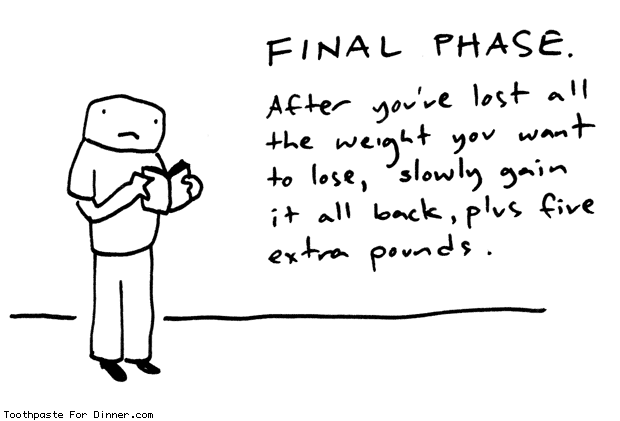
How diet books should really end...

I've never really read a weight-loss book, but I gather that the last chapter is all rah-rah, enjoy your new fantastic and skinny self, and your smaller ass will magically solve all of your life's problems.


The webcomic Toothpaste for Dinner has a great version of how a diet book really should end:

Thanks to the anonymous person who reminded me about this fab website.

Life on autopilot

When I drive to TNT's office each week, I have to turn the opposite way on the road that I usually take to my job at the bakery. This past Saturday, my appointment was earlier than usual and I was running late, so I had many different things on my mind, the least of which was the roads I needed to be driving to TNT's.

I'm guessing you can tell what happened next: I took a wrong turn. Already late, I kept driving like I was going to work instead of to my therapy appointment. I realized my mistake right as I had committed to the wrong turn, but by then, it was too late. I had to keep driving until I could get to a place to turn around. Which I did, and with a little help from my lead foot, I arrived to my appointment with TNT on time.

The moral of the story isn't driving directions and how I shouldn't be trusted to follow them, the moral of the story is about when habits get ingrained. Of course, we all have habits, and habits can make life more livable. If we had to think about every single decision we made, all we would do is sit around and make decisions. (And by "we," I mean the royal we, as in me, myself, and I. You should know better than to let someone with OCD make a decision.) So we have habits and operate on autopilot. This, in and of itself, is not a problem. The problem is knowing when to stop living on autopilot.

One of the really good times to stop living on autopilot is when you're doing something completely different than what your autopilot is used to doing. Such as driving to therapy instead of work. Or eating lunch instead of exercising. Autopilot says "Turn right!" and "Go for a run!" Okay, fine. No big deal. But if I'm not aware I'm operating on autopilot, I'm going to go ahead and turn right and go for that run when I should be turning left and having a sandwich.

When I was driving to see TNT, I wasn't aware that I was driving on autopilot. I don't always consciously think about where I'm going, but I also don't think that I'm not actually thinking about where I'm going, either. On Saturday, clearly I wasn't thinking about where I was going. I was just driving. If I had been headed to work, there wouldn't have been a problem. This past Saturday, though, I was doing something a little out of the ordinary and I should have paid attention to where I was going.

What I've come to realize in recovery that it's not the presence of ED thoughts that gets me in trouble. My problem is when I stop paying attention to whether these ED thoughts are subtlely influencing my behavior. Of course, this can lead to hours of rumination and perseveration on "is-this-ED-or-is-this-me," but I also can't be deliberately unaware of it, either.

A lot of the inspirational and self-help literature says to live life with intention, and I don't disagree with that. But sometimes, you just need to get from point A to point B and autopilot is just fine for that. When you're trying to find your way out of a tropical jungle with no compass and no map, however, it might be a good thing to start paying attention.

Regaining control

I ran across this study in PubMed today and posted it to the ED Bites Facebook page:

"Low perception of control as a cognitive factor of eating disorders. Its independent effects on measures of eating disorders and its interactive effects with perfectionism and self-esteem."

I (obviously) found it fascinating, and I think it explains a lot about risk factors for EDs. Psychologist Herbert Lefcourt defined perception of control as "a generalised expectancy for internal as opposed to external control of reinforcements." Basically, your perception of control has to do with how much you feel you can effect the course of your life and what happens to you. Aside from the existential question of how much control do you have over your life anyway, I think a low perception of control is linked to factors like perfectionism and anxiety.

Low perception of control can help explain some of the environmental influences on EDs. For some people, events in their life can lead to a low perception of control. For example: will Dad be drunk today? Will the kids at school make fun of me? For me, I don't remember any events that led to a low perception of control, but I always had this nagging doubt that one day everyone would find out I was quite a bit more flawed that everyone thought I was. I attributed all the good things that happened in my life (getting an A on a test, having fun with friends) to something that was entirely outside of my control. The teacher just "happened" to ask questions that I had studied for. Things like that. But I blamed all of the bad stuff on me. I feared it was only a matter of time until everyone found out just how inadequate I really was.

Some people who have a low perception of control develop a "f*ck it" attitude. It doesn't seem to matter whether you try or what you do, because it won't change anything. However, my low perception of control was combined with a high need for control, which meant I went in the opposite direction. Lacking a sense of control over what might happen to me, I felt the need to "make up for it" by trying to control myself and everything around me as much as possible. I became constantly vigilant over what might go wrong. Ultimately, my anxiety systems just kept going up and up, and I found that not eating was a good release, both in terms of biology (starvation-as-emotional-novocaine) and in terms of psychology.

My pseudo-control of food became all-important to me, and soon I came to feel that as long as I could maintain an iron grip on what I ate and how much I exercised, everything would be okay. When you add perfectionism and low self-esteem to the mix, you have a recipe for disaster.

The study's authors concluded:

"EDs are associated with a tendency to worry about mistakes, a low sense of self-esteem, and a low perception of control over internal feelings and external events. Perception of control and self-esteem seems to moderate the predictive power of concern mistakes on symptoms of ED. The results suggest that a low perception of control is an important cognitive factor in ED."

Some of the most important parts of my recovery have been relaxing that need for control, realizing the areas of my life over which I do have control, and making peace with the large number of aspects of my life I legitimately don't have control over.

When life gets in the way

The past few days have been tremendously busy for me in terms of my writing gigs. I have several deadlines and I'm attending a conference where I'm busily attending talks, reading articles, and interviewing scientists. To make a long story short, I really haven't had time for my eating disordered thoughts. This isn't to say that the thoughts are gone--wouldn't that be nice if they were!--just that their pull has been noticeably diminished.

The hard part is not letting life get in the way of my recovery. It's hard for me to have so much to do and still budget time for meals and snacks, especially when skipping is such an easy and convenient option. And I'm all giddy that I'm no longer overwhelmed with ED thoughts that I think "I can be normal!" Well, no, not exactly.

I am phenomenally stressed not just because of all I need to get done, but also because all I need to get done is interfering with my rituals (some ED, some not). I have had to shift my schedule to try and get everything done, and I worry about how to fit in my exercise and other stuff. What helps is having something else to focus on, something else that I find just as important as maintaining the status quo. It gives my brain something more interesting to crunch on and distracts me from the endless ED thoughts.

I am busy, I am exhausted, I am stressed, but for once, it has nothing to do with the eating disorder.

posted under | 3 Comments

Sunday Smorgasbord

Yet again, your weekly Sunday Smorgasbord for your pleasure and enjoyment. This was a pretty light week for ED-related news and research, so the smorgasbord has been adjusted accordingly.

A woman on a starvation diet gets sick and starts gaining weight back. This is shocking and newsworthy how? And her body telling her to eat more is a "setback" because why?

Sweet preference, sugar addiction and the familial history of alcohol dependence: shared neural pathways and genes

The Rub with Greasy Grub: Is Fast Food the New F Word?

Tracking the National Mood Through Twitter. Nope, nothing to do with eating disorders, but I thought it was pretty fun!

Relationship between color and emotion: a study of college students

You Vs. Perfectionism: 3 Little Secrets to Overcoming this Demon

Highly Sensitive People in a Highly Insensitive World

New Eating Disorder Council in Missouri to oversee ED education & identify whether adequate treatment is available

The endocannabinoid system and its relevance for nutrition

posted under | 6 Comments

The Contest

As a card-carrying perfectionist (and the card must be replaced if the card gets dirty or bent), I have often viewed life as a competition. There is The Best, and there is everyone else. My lifelong goal has been to be The Best at whatever it was--not out of a healthy sense of competition, but more because I viewed myself as a failure if I wasn't The Best. My constant striving was fueled by a desire to stop hating myself and finally feel like I could measure up to everyone else.

The anorexia only amplified this thinking process. Losing weight, conquering my need for food, rest, sleep, and affection, was the way I found to "win" the competition. Anorexia made me feel special. It was my trump card. Giving up my eating disorder meant giving up this one way I had of feeling special, of being The Best. As long as I ate less, weighed less, and exercised more, then at least I could be The Best at that. Right? Too bad this contest is so tremendously self-destructive.

Although I've learned in the past few years that this is a very distorted and disordered way of thinking--a way of thinking that preceded the eating disorder by decades--it's still very much there and very much present. Reading my college's alumni magazine is an exercise in self-loathing. The accomplishments of my classmates make me almost feel ill when I look at my life. Now, I can't even say "Well, at least I'm eating less then they are!" Because I'm almost certainly not.

My metabolism has once again gone through the roof. It calmed down somewhat during my Europe trip and yet again with my stomach bug, but now that I'm back in my work routine at the bakery, my metabolic rate has gone into overdrive. It seems I am hungry all the time. Adding an Ensure Plus each day is starting to seem like a good idea (it's quick, easy, and convenient). All of this means I am eating more than anyone I know.

This brings me right back to the contest, and how I defined being The Best for so long as eating the least. Now, I seem to be The Worst, which is pretty much a living hell for someone who has perfectionism. I feel like a failure because I cannot seem to resist my hunger and I feel like I should. I don't want to restrict as much as I just don't want to eat more than my minimum meal plan. Of course, eating less than what my body needs is restricting, but I never said an eating disorder was logical.

I don't always want to feel I need to participate in the contest--after all, Lily Allen said that whoever wins the rat race is still a rat--but I don't know how else to feel okay with myself without these concrete measures. I have no sense of myself except in relation to others. I only know I'm smart because people tell me I'm smart, not because I have an innate sense of my intelligence. It goes along with my body dysmorphia, and how I'm always comparing my size to others', in large part because I really don't have a sense of what size I am and what my body looks like. I can't do that with my life, either. I always have this profound sense of inadequacy, and this was mediated, temporarily, by the eating disorder. It quelled the anxieties of not measuring up, of not being good enough.

I know that I need to stop defining myself in relation to others. And not just any "others," but those who have achieved the most and done the most and make me feel like utter crap when I think about what my life is and what it has done. I know I need to compare me to, well, ME and to hell with everyone else. I'm following my dream to be a writer, which I know darn well isn't going to put me on a financial par with most of my classmates (although I've never been much worried about the financial yardstick, thankfully). I'm starting from scratch and busting my buns, and I need to start giving myself credit for overcoming a difficult and lethal illness.

The question is: how? How and where do I start?

Not even wrong

A recent editorial titled "A Western illness best forgotten" is so off-base and so incorrect, that it can't even be classified as wrong.

And because there's no real way to paraphrase such insanity, I'll let the author speak for himself:

Of course, the desire to have the state influence how satisfied or unsatisfied we are with our bodies is totalitarian, but I had assumed it was essentially harmless - Melbourne University churns out a lot of arts graduates who have studied feminist and cultural studies and these people need to be employed somewhere.

The chances of the Government succeeding in influencing how attractive we find fat or skinny people to be are of course almost nil, but if it keeps a few Labor and Greens voters happily employed, then that's fine by me.

True, some people have questioned whether it is wise for the most overweight societies in human history to be spending money making its fatties feel better about themselves.

They have wondered whether the Government may not be better off spending our money telling us that if we have a negative body image it is because we are lardarses who need to eat less and exercise more.

...In the West, anorexia is most likely to strike urban girls from middle-class families who are often high achievers. The few anorexics in Hong Kong tended to come from poor rural villages where the influence of Western culture, with its adoration of the young and skinny, was weak.

The strangest thing Dr Lee found though, was that the anorexics he saw had none of the self-delusion about their body size that Western anorexics do.

Asked to draw themselves, these anorexics correctly pictured themselves as dangerously thin, whereas Western anorexics will usually draw themselves as overweight.

The Hong Kong anorexics attributed their failure to eat to physical factors such a bloated stomach or blockages in their digestive tracts rather than a desire to be thin.

When he investigated the history of the disease, Dr Lee found that the earliest Western descriptions of the disease from the 1820s more closely matched the patients he was seeing than the textbook definition of anorexia.

In the early 19th century the disease was so rare that it wasn't until 1873 that medicine could even agree on a name for it. In that year a French doctor delivered a paper that sparked widespread interest and understanding of the existence of the disease.

The really interesting thing is what happened next. Though in the 1850s anorexia was a rare disease, by the end of the century it was commonplace. The growth was so marked that it could not be explained away as the result of doctors finally picking up on a disease that had always existed, but of which they had been previously unaware.

In other words, the widespread knowledge of the existence of the disease was responsible for spreading it.

Watters then catalogues the way in which the Western form of anorexia developed in Hong Kong after the media there highlighted a schoolgirl who died of the disease. Within a few years Hong Kong went from having almost no anorexics to being full of them.


Apparently James Campbell missed the first lesson in Epidemiology 101: correlation doesn't equal causation. He doesn't account for the fact that increased awareness of an illness can lead to increased diagnosis, not increased incidence. Maybe I'm off-base, but it seems that increasing diagnosis and treatment of an illness was a good thing.

Furthermore, most people with anorexia don't deliberately try to end up that way. They either eat less or cut out sweets or try to lose a few pounds and then they find themselves stuck in an anorexic hell. Anorexia is ego-syntonic; that means that sufferers don't see the illness as a problem, and that the outcome of the illness (weight loss) is a good thing. As the Western cultural ideals of weight loss and thinness have spread, it doesn't seem unusual that someone with an ego-syntonic illness would latch onto these as a justification for thoughts and behaviors that seem pretty bizarre. With more people dieting, you would naturally expect to have more eating disorders triggered.

I honestly believe that the body dysmorphia is a culturally mediated aspect of anorexia. Culturally-mediated doesn't mean that there's no biological basis, just that you only see these symptoms in certain cultures. Biology helps explain why not everyone in this culture has the symptoms/illness, but the body dysmorphia in anorexia does seem to be pretty consistent with modern, Western cultures (it is much less prevalent in young children with anorexia). But that in and of itself isn't anorexia. It's just one aspect of the illness.

Anorexia is NOT a Western illness. It exists in China, Ghana, and Curacao, at rates that are roughly comparable to the US and Western Europe. Say it with me in a sing-song voice now: someone didn't do his research...

Then there's the issue that if we pay attention to eating disorders, they will go away. To me, this smacks of the larger write-off that many people with eating disorders get, which is: "They're just doing this for attention! If you ignore it, they'll stop!" One must wonder, then, why people with EDs go to such extreme lengths to hide their symptoms if what they really want is attention.

BP ignored the problems in their oil well, and we all know how smashingly that one turned out. As a culture, we've tried to put blinders on to issues like teen pregnancy, homosexuality, and environmental decay, hoping that they will just "go away" and that one day, we will all laugh at how teens used to get pregnant, people were attracted to someone of the same sex, and we honestly thought the world was going to hell. If it worked, it would be convenient. But it doesn't work.

Rates of some cancers have increased over the years, and we don't blame the War on Cancer. When heart disease rates go up, we don't boycott the American Heart Association for trying to help. Anorexia isn't just biology--culture is important. But ignoring a problem to make it go away? It's a short-term solution to a long term problem.
I am a quitter

I took a deep breath, and I did it. I quit my job at the bakery. I gave my two week notice this afternoon, and I will no longer be an employee of the bakery as of August 5th. My boss took it surprisingly well. She knew the second I pulled her aside and asked "Do you have a minute?" that I was going to leave. Bless her (occasionally flaky) little heart, she gave me a big bear bug and told me she was really happy for me.

So I guess that's it. I guess I really have committed myself to writing full-time.

I think I'm still in shock. It doesn't seem quite real yet. I have never really done the brave, adventurous thing in my life. I've done plenty of things that are interesting and unusual, but I've never sort of leaped off the cliff and figured I'd learn how to fly before I hit the bottom. I'm harm avoidant. I don't like doing things unless I know how they're going to turn out and that I'm going to succeed (keep in mind, this is a perfectionist's definition of success, too!). I was lucky in that I did many things well enough that I could stay safe and be fairly successful. With my writing, I tested the waters while still saying "safe" and ensconced within my very predictable little world. Although I loved writing and--more importantly--being a writer, I felt compelled to remain on terra firma. Where I was safe, but in high school guidance counselor speak, was "not living up to my full potential."

Have I mentioned that I both hate heights and the sensation of freefall? Both make me want to puke. Kind of ironic for someone in recovery that so many metaphors for what I just did are leaping into the unknown.

I always loved this quote by Anais Nin: "And the day came when the risk to remain tight in a bud was more painful than the risk it took to blossom." My therapist back in Michigan loved that quote, and we often discussed it in the context of recovery. After all, one of the factors prodding me forward was the realization that staying in the ED was more painful than facing my fears of getting better and all it required.

Now, however, I'm realizing that this quote is even more appropriate for what I'm feeling now. I'm still the same harm-avoidant person I always was. It's just that I'm seeing the harm in not going for it, in not following my dreams, as well as the harm in falling kersplat on my face and looking like an idiot. There's risk in both. But my harm-avoidant self recognizes more harm in not taking the leap than in staying safe and predictable.

It's quite an interesting change for me. One that is probably going to require lots of Dramamine.

Untouchable?

Those of you who are friends with me on Facebook have read updates on my quest to transition to full-time freelance science writing. The major hindrance to going full-time is health insurance. My eating disorder (and accompanying medical issues, such as osteoporosis, epilepsy, a herniated disc in my back, GI issues, etc) would all be considered "pre-existing conditions" and thus not eligible for coverage. Hence my almost too ironic job at the bakery: a group plan under an employer would render me eligible for coverage, even of my pre-existing conditions (after a 6 month waiting period). This fact also tethers me to having some sort of full-time-ish job, which is rather irritating for someone who wants to spend their time freelancing and not slinging bread, wrangling pies, and frosting cupcakes.

Thankfully, my parents have a fantastic insurance agent whose office is right across the street from the bakery and I talked to him about what the possibilities were for me. Presciently enough, on July 1, Virginia adopted the federal high-risk pool insurance program for people with pre-existing conditions that were otherwise uninsurable. The key is that your pre-existing condition cannot be covered under a policy for 6 months. What we came up with was a short-term medical plan that would not cover my pre-existing conditions and a special hospital income protection policy if something catastrophic happened. At the end of those 6 months, I would go into the federal high-risk pool. Since mental health parity also took effect on July 1, I should--fingers crossed--be okay.

What shook me, however, was the agent's comment that without Virginia's adoption of the high-risk pool, I would be uninsurable. That would mean my dreams of freelance science writing were essentially dead in the water. My eating disorder had effectively rendered me untouchable.

That's what breaks my heart: that some bureaucrat somewhere could so quickly and efficiently kill my dream because I have an eating disorder. I realize that paying out more in benefits than you take in with premiums isn't a good business model. I get that. I also get that eating disorders aren't cheap to treat. But to have an eating disorder diagnosis render me unable to get a health insurance policy for the rest of my life? It's depressing.

I feel like I have worked so hard in recovery to try and bring back a semblance of normality and health to my life. Many of my hopes are pinned to the wish that, one day, the spectre of my eating disorder will no longer haunt my every move. Finding health insurance is a stark reminder that some people never forget. I know some of my family members have been unable to forgive me for getting ill, and I had attributed that to human emotionality and fear and frustration. But this cold, calculated move makes me wonder if I'm permanently broken. If a whole, healthy me will ever emerge from the wreckage of anorexia.

I don't want to dwell on this, as I know insurance companies know precisely diddly squat about life. They were, after all, the ones who denied almost all my claims relating to the eating disorder, when I was sick enough that even I knew I would die without immediate treatment.

Although I have some issues with the health care reform bill that finally passed through Congress earlier this year, it has allowed me the chance to live my dream, and for that, I am grateful.

Summer of my discontent

I'm exhausted these days. From the outside, it looks like I am unencumbered by my eating disorder. Although I am certainly less encumbered than I used to be, I am by no means free of my eating disorder. Little things that other people take for granted--things like getting dressed, deciding what to pack for lunch, and keeping everything organized--suck so much energy out of me because I think about them so intensely.

I have made peace with my need for meal planning (my friend with no eating disorder but with 3 girls under the age of four is quite possibly the most consummate meal planner I know and quite frequently puts me to utter shame), although I wish it didn't suck so much emotional energy out of me. I have to meet my nutritional requirements using ingredients on hand in combinations that are both tasty and non-repetitive. I constantly second-guess myself, wondering if I'm eating too much, if the ED is slipping back in when I feel full before I'm finished eating. This basically means my brain sucks up a lot of energy. When you combine that with a physically demanding job that also requires mental energy not to bitch slap people for whining about their thighs and the bakery goodies, followed by trying to work on freelance writing stuff, I'm beat.

I know I've blogged about this before, about how I kind of want someone to recognize how much energy and effort recovery takes, even after all this time, and yet I'm embarrassed that I want other people to notice and understand when I'm crotchety or yawning (or both). Yes, recovery has gotten easier. There's no doubt about that. It doesn't consume every waking thought and I am learning some rudimentary flexibility around food and eating. But at this point in time, my recovery still demands much time and energy, and I start feeling sorry for myself and rather jealous of all those people who don't have to think about their basic needs so damn much.

There was a wise quote I read a long time ago that said: "Everyone is entitled to a little pity. Just don't treat it like an all-you-can-eat salad bar." I don't like to whine too much on this blog because it's not all that productive. My life doesn't suck, on the whole. And recovery is definitely worth it.

It helps to remind myself that we all have our struggles and difficulties, and that other things that come rather easily to me may not be simple for others. It also helps to remind myself that I'm allowed to think that recovery sucks sometimes and to acknowledge my resentment so that I don't marinate in it. In my more Zen moments, I can say that I will use this discontent to keep pushing forward in recovery so that one day, I won't have to think about recovery so much. In my more usual moments, I just whinge that this f*cking sucks and it's not fair.

It isn't fair. It fundamentally isn't. But what really is?

I think, perhaps, what I'm really frustrated about is how my internal experience (still struggling with ED thoughts) doesn't really match the external experience (I look healthy). This is the part that they don't prepare you for: the long stretch of time where your body looks normal but your mind is still seriously messed up. People might tell you it will happen, but they don't prepare you for the sheer amount of disconnect, or how long it lasts, or when it will end.

Others who have recovered tell me that it will end, and sometimes, that's what keeps me going.

Sunday Smorgasbord

Here is my collection of links from this week's news and published research on eating disorders, food, mental illness, and the occasional other topic I find interesting. I hope you enjoy this week's selection.

From the always awesome Mike Anestis at Psychotherapy Brown Bag: A Defense of Mental Illness Diagnosis and Treating the soul? That's not psychotherapy.

The coporate influence in school cafeterias. Will government ever do anything about it?

Traits from the happiest countries

More Mentally Ill Persons Are in Jails and Prisons Than Hospitals: A Survey of the States

Adult anorexia: the forgotten tragedy of lives lost to illness. This article features my very good friend June Alexander.

A teaser and trailer for Harriet Brown's upcoming book Brave Girl Eating.

Great article on the realities of body dysmorphia. Yes, it is real, and no, it has nothing to do with vanity. If only they didn't always place these articles in the "Lifestyle" section...

The risky business of hunger

Effects of body image therapy on the activation of the extrastriate body area in anorexia nervosa: An fMRI study.

Treating children with eating disorders

Perfectionism: Adaptation or Pathology?

Filmmaker starves himself for three months to raise awareness of eating disorders and ultimately only shows his own ignorance on the subject.

Stomach vs. Brain: Discovering Why Some People Can Resist Dessert While Others Can't

Shaming & blaming obesity public health campaigns do not work

How many energy drinks would it take to kill you? A handy online calculator by brand.

He ain't heavy, he's my doctor: Motivating weight loss moves in mysterious ways. The article is much more interesting if you substitute "ED recovery" or "not chewing my nails" for weight loss.

Support the Quebec Charter for Healthy and Diverse Body Image

Hospitalization trends in Spanish children and adolescents with eating disorders (1998-2007).

Exploring weight gain in year before treatment for binge eating disorder: A different context for interpreting limited weight losses in treatment studies.

Acute and chronic suppression of the central ghrelin signaling system reveals a role in food anticipatory activity.

posted under | 4 Comments

Not what I thought it would be

So I have just about finished my first full day as a 30-year-old, and all I can think is: this is not what I thought my life would look like. When I was in my teens, before the ED struck, I was set on being a scientist. I was going to go to college, then get my PhD, do a post-doc, be a research scientist, etc. I thought eating disorders were for vain, vapid idiots (to be really honest), and I loved my independence and never thought that I would return home. I never conceived of myself as a writer.

Now that I'm looking back at this past decade, I realize that my expectations were almost hilariously ironic. The love of science and All Things Geeky hasn't left me, but I don't have a PhD, am not doing research, have learned a heck of a lot about eating disorders, and think of myself as a writer almost as much as I think of myself as a scientist. And I can tell you that for sure--for sure--I never thought I would be living with my parents, trying to be a freelance writer.

Sometimes when I think back to what I had expected from my life, I get bitter and angry. One of my therapists (from my time at Hopkins) told me I should get angry at the eating disorder, at the illness that stole so much from me. Despite knowing that I did not choose anorexia, that I could not have chosen anorexia, I still direct that anger inwards at my own stupidity for thinking not eating would make me feel better. The problem wasn't that not eating didn't make me feel better; the problem was that it did. And I didn't realize that I would get stuck.

Despite all this, the eating disorder stripped me of all previous expectations of what my life would look like and gave me the freedom to reinvent myself and create a meaningful life. Losing everything has given me the courage to risk everything to follow my dream.

I am committing myself to freelancing full-time over the next year to see if making a living as a freelance science writer is a viable option for me. I could fail miserably, and I'm going into this experiment knowing full well that this is a possibility. The pre-anorexia Carrie never would have done anything if she knew she might fail. It's why I didn't apply to super-competitive colleges in high school--I didn't want to not get in or, just as bad, get in and be a little fish in a pond full of sharks. So I played it safe.

Being stripped of everything I had anticipated in my life has ultimately given me the courage to put it all on the line. Nothing in my life right now is what I thought it would be so it's not like I'm really losing anything. I still feel bitterness and regret towards what might have been. I still am trying to let go of old goals and ambitions, even as I develop new ones.

posted under , | 9 Comments

Happy birthday...I think

Today I get to say farewell to my 20s. That's right, kids, this blogger is now the big three-oh.

All I can say is: at least I'll never have to relive that decade again.

I'm not freaking out over being OMG-30! (although it would be nice if the zits would stop now), I'm just relieved that my decade is one more thing related to anorexia that I can put behind me. It's a relief, really, to have my 20s over and done with. I thought the same thing about my teens when I turned twenty--ten years of near perpetual awkward turtles will do that to you--but what I felt then compared to now is such a hilarious understatement that the two almost don't compare.

These past ten years just knocked me down and beat me up, and I'm still trying to recover.

posted under , | 17 Comments

Relapse Prevention: Creating a fulfilling life

I know, it's cheesy, but I've found the best form of relapse prevention is simply living a fulfilling life outside my eating disorder. This doesn't mean that relapse is impossible, or that slips won't ever happen, because that's not quite true, but what it does mean is this: I have something to lose by giving in to the anorexia. Even last spring when I was relapsing hard-core and was finally aware of it, I didn't care enough to stop. Not eating was the only thing that mattered. If I screwed myself over professionally, so what. I had no real motivation to fight the anorexic thoughts and so I found it so much simpler just to give in.

Part of the reason I was able to hold onto recovery during my year in grad school in Baltimore was that I found my program so remarkably fulfilling. I had found what I wanted to do with my life. I felt reassured that after so much floundering and searching, I had found the perfect profession for me. Not that my time in grad school was ED-free, not by a long shot. I struggled immensely to stay on track, often barely clinging to recovery and the bottom end of my minimum healthy weight. Yet my numerous and rather regular lapses and returns to ED behavior didn't turn into a full-blown relapse, either. I kept my demons in check. I had a fighting chance.

However, as I became disillusioned with my first job out of grad school, the eating disorder crept back in even more. The life I thought I was going to be living turned out to be quite a bit different than I thought it would be, and I began to lose my motivation to fight. Giving into the ED behaviors became the rule rather than the exception, and I slid into utter despair. My life was both still dominated by the eating disorder and anything but fulfilling.

Part of what this last relapse did for me, by being so spectacularly dramatic, awful, and life-shattering, was that it gave me the freedom to start over. I truly had nothing left to lose. My career had already flopped several times--what was one more? I was unable to hold down a regular full-time job (I was living in Michigan and so I knew I wasn't going to find a job, either), I didn't need to pay rent, and I had already screwed up my life so horribly that one more screw up would hardly be the straw that broke the camel's back. With nothing left to lose, I took a chance: I decided to pursue freelance science writing as my full-time career.

What ultimately saved me during my past relapse was my cat. I promised her I would never go away and leave her again, and I was determined to keep that promise. It didn't stop my relapse, but it did keep me alive. Now, when I have ED thoughts or feel tempted to engage in ED behaviors, I know that a relapse would be incompatible with the life I want to live as a writer. I do slip and inadvertently or deliberately restrict or indulge my exercise compulsion or debate about buying laxatives to have on hand "just in case." When I step on the scale at TNT's office, I still hope I have magically lost weight. I body check in the mirror frequently. Writing hasn't made me recovered, but it has helped me keep my eating disorder tightly confined. I want to be a science writer more than I want the comfort of anorexia, of skin and bones, of starvation and compulsion and, ultimately, death.

Recovery and relapse prevention are, as Emily Troscianko writes, not only about stopping starving but also about starting living. It's both the goal and the route to that goal.

Relapse Prevention: The Signs You Aren't Looking For

So I've gone through my Prelapse Signs, and my red light, yellow light, and green light signs. Although I think it's invaluable to know areas that are likely to trip you up, it's also important to be aware of (to paraphrase Donald Rumsfeld) the things we don't know we don't know are going to sideswipe us.

Case in point: when I was in Europe last month to attend the AED Salzburg meeting and then tool around Austria for a week or two, I got a nasty stomach bug. This meant intense nausea, being unable to eat, and other fun symptoms that I'll leave to your imaginations. As a result, my eating was dramatically diminished for several days and dwindled to apple juice and some pretzels on one day. My mom was, not surprisingly, freaking out until she got what I had and we were both puking.

My mom's concern was that this not eating would make the ED thoughts come roaring back. I vaguely scoffed--the ED thoughts had been no worse than usual during the trip, and I'm doing better than I ever have, recovery-wise--and for much of the time, it was a moot point. I couldn't have eaten anyway. However, as the nausea started to diminish, I was at first very hesitant to start eating more simply because a) I was enjoying the novelty of no nausea and b) I was afraid it would aggrivate my stomach. Then the pushback started to take on a life of its own, and I just didn't want to eat. I started thinking that maybe this would be the perfect opportunity to lose some weight, and...

Yep. I was totally gobsmacked. I was back into full-blown ED thoughts and it seemed there was no "real" trigger. Except that bit about not eating.

Stomach bugs are inevitable, and so (almost certainly) is an inadvertantly missed meal or snack. Here's the thing: before I left treatment, I was warned about all sorts of relapse triggers, such as family problems, reading fashion magazines, hearing people talk about their diets, or other stressors. What no one mentioned was that being unable to eat (whether it was due to a virus, being stuck on a tarmac for 8 hours, whatever) for any period of time could also be a trigger. I never thought it would be such a potent trigger, either. You'll notice most of my relapse prevention plans don't really have much to do with these situations. Some of that is I can't really prevent many of these situations, and the other is that I really don't like that I'm so sensitive to changes in food intake. It really pisses me off! It seems so much less rational than an actual event to set off the ED.

Yet there you have it- the ED is the ED and my triggers are my triggers. It's not like one is "better" or "worse" than any other, and it's not that one trigger will only set off a benign relapse and another will be an utterly wretched relapse. So much of my relapse prevention planning has been coming to learn what my triggers are and accept them at face value, without judgement.

Sunday Smorgasbord

Another Sunday, another smorgasbord. I traveled far and wide around the internet to bring you some yummy nibbles and interesting articles, research, news, and factoids from around the world of eating disorders. As always, if you have any suggestions for smorgasbord articles, email me at carrie@edbites.com or post it on the ED Bites Facebook page. I will happily credit you with the idea (or leave you anonymous if you prefer). If you email me, be sure to put "smorgasbord" or "ED Bites" in the subject line in case it gets lumped in with my spam- I usually check, but I don't want to miss anything!

Yoga-Based Eating Disorder Treatment Programs. They sound good, but as my friend M pointed out, we don't know how effective they are in the long run. Yoga has been shown to be an effective component of ED treatment, but I would love to see rigorous outcome studies from these programs.

Great post by Dr. Samantha Thomas about body image hypocracy.

Scientists say Weight Watchers does help people lose weight. But if it helped them keep it off, their business model would be pretty much kaput.

Cognitive Behavior Therapy: Myths and Realities

The Dark Side of Perfectionism Revealed. Interesting article on different types of perfectionism and how they affect health. Clearly, I'm a perfectionist because I thought, "Obviously, my problem is that I'm not good enough at managing stress!"

Open access article on "Serum glutamine, set-shifting ability, and anorexia nervosa."

What goes on inside your brain when you exercise? New studies tease out how exercise remolds the brain. (h/t Jen)

Normality Is an Endangered Species: Psychiatric Fads and Overdiagnosis.

Study Compares 'Competing To Win' And 'Competing To Excel' In Adolescents I would imagine some of the difference lies in how adolescents feel when they compete and don't win/excel, and the motivations driving the competition.

Why Thought Stopping Doesn’t Work

Attachment insecurity, personality, and body dissatisfaction in eating disorders.

Old school 'cranium' images in the National Museum of Health and Medicine archives

The use of a parent support group in the outpatient treatment of children and adolescents with eating disorders.

Forbidden Thinking: why we all experience those dark thoughts and why some people become fixated.

Eating Disorders and Mental Health Parity.

posted under | 3 Comments

I'm, like, totally legit!

Since I turned freelance full-time, I've written several science stories that have been published. Two of them didn't appear online, so that makes it hard to really share them (although I can send you the text if you're really curious about geology...). These magazine stories were interesting and fun and great experience, but not in the most widely circulated of publications--like I said, they were for a geology magazine.

However, I also wrote a story for Scientific American Mind that is finally--finally!!--up and online.

Two Sides of the Same Coin

I was hoping for a longer article, but I nevertheless broke into a very prestigious magazine. I like how the story turned out, and it is so thrilling to add Scientific American to my list of bylines.

I often wondered if anything would give me the same "high" as restricting and over-exercise, and I have to say that seeing my byline comes pretty close. Although the mind-altering qualities of seeing my byline might not quite be the same as one of my marathon exercise sessions on an empty stomach, it is a high that I can share. A high that doesn't destroy me body, mind, and spirit. A high that makes me laugh and smile. A high that gives me an income and a living and a vocation.

Here's to many more bylines to come!

Relapse Prevention: Red Light Signs

Even the best relapse prevention plans might not prevent a full-blown relapse. Maybe you miss the signs, or maybe you can't figure out how to stop the relapse yourself and you end up in trouble. The point is to identify concrete, specific criteria that will spur you into action. The point of identifying red light signs isn't to identify when you're back in so deep with the eating disorder that you're severely medically compromised. The point of red light signs is to know when you have to STOP whatever you're doing because you're in trouble. It means that a relapse is clearly underway and needs to be addressed NOW. Not in five weeks now, not in five days now, NOW.

When I created my list of red light signs several years ago, they were really rather far beyond red light signs. I said that I would get worried if I dropped below X pounds. In reality, X pounds usually has me deep in the throes of ED and so far gone that I can't pull myself back out without very intensive, 24/7 support. Yes, the ED was helping me write my relapse prevention list. The other issue was that I was too afraid of creating a big deal out of nothing. I didn't want to send in the proverbial troops because I was deeply ashamed of the possibility of struggling again.

What I've learned is that ignoring the signs of relapse doesn't make relapse any less likely. I've had to (ahem) eat a large slice of humble pie and realize that my predisposition to AN isn't going away, and (to quote Mad Eye Moody from Harry Potter) the price of freedom is eternal vigilance. It means risking crying wolf when I find myself struggling and it's really not all that bad. It means empowering my parents and other support people to speak up when they see certain signs, and taking appropriate action. It means not believing everything I think (i.e., it's not that big of a deal, I've weighed/eaten less, I'm not hungry/don't like that food). It means being open to others' feedback because I'm not always the best judge of when I'm in trouble.


Now that I've gotten that out of the way...here are my Red Light Signs:

  • not adding milk to my coffee
  • avoiding mealtimes
  • hiding food
  • exercising in secret
  • not taking a day off from exercise
  • lying about what I've eaten (yes, even little white lies count!)
  • ongoing insomnia (it might be the ED, it might be something else, but lack of sleep is one of my big triggers!)
  • counting calories
  • visiting calorie count and/or diet websites looking for tips/information
  • purging
  • subsituting candy for more nutritious food
  • drinking calorie-free beverages instead of eating
  • deliberately limiting calorie intake
  • feeling cold
  • extreme surge in anxiety and depression in conjunction with any other red light sign
  • extreme fatigue (again, it might not be the ED, but it does need to be looked at)
  • mentality of "I can't recover so why bother"
I still use a meal plan to help me maintain my weight, and I've worked in enough flexibility to use it more as a guide. Which makes sticking to my meal plan either a good sign or a bad sign. The bad sign is obvious: more rigidity and anxiety around food. But returning to closely following my meal plan could also be a good sign: it provides accountability against relapse. I know that if I follow my meal plan to the letter, I won't gain OR lose weight. By measuring things, it forces me to be more aware of where I may be cutting corners, and ensure that I am eating enough.

What to do with red light signs will probably vary depending on the sign and how many of them there are. It might mean an immediate phone call to my therapist and dietician asking for support. It might mean asking a friend to meet me for breakfast/lunch/dinner to help me stay accountable. It might also mean asking my mom to serve me all my meals and snacks for a few days until I'm feeling more steady.

Tomorrow's post is going to be interesting: relapse signs you probably aren't looking for (but should be!)

Reinforcement of self-expectations

There are many reasons why I blog, but an email from a family friend really captured much of why I have found blogging so rewarding. We connected via LinkedIn and he found my blog website on my profile. He kindly sent me the following email:

Keep giving and you will benefit from the giver's gain in all ways, as you are surely already aware. Speaking loudly and clearly in testimony reinforces your own behaviors and self expectations. Notice how the Mormons send all their youth out into the world clad in white-shirt-tie mounted on bike back? I suspect it’s not so much a function of “convert the word”, as it that aforementioned reinforcement of self expectations.


This blog has helped me self-identify as a person in recovery, as an actual writer, as someone who has something to give to this world. It's very different than thinking of myself as Carrie the Weight Loss Wonder Goddess. It's something that means something to me and to others. It's not unimportant for me to be able to use my writings and my experiences to help people, but that alone doesn't keep me blogging. Knowing that I can't help people if I relapse is very helpful, however.

Nonetheless, this blog has been a tremendous reinforcement of my own recovery.

Relapse Prevention: Yellow Light Signs

Technically when you're driving and you see the light turn from green to yellow, you're supposed to slow down and then stop. Yeah right. I don't know about you, but many times when I see a yellow light, I hit the gas and try to cruise through before the light turns red.

For most of my eating disorder, this was how I operated. I saw the warning signs of relapse and I just hit the gas on the eating disorder. Some of this was rooted in the basic neuropsychology of an eating disorder--that whole viscious cycle thing. But some of it was the fact that I really did think I could squeak by the need for more intensive treatment and recovery work if I just timed everything right (and drank enough water before weigh-ins).

Clearly, that hasn't worked out very well.

When I wrote my previous relapse prevention plan and identified my yellow light signs, I was still rather ambivalent about recovery. So my yellow light signs should have been my red light signs and my red light signs should have been flashing lights and sirens. Besides the ambivalence about recovery, I was also a little unprepared for how easily, quickly, and strongly the eating disorder can take over. I (not very wisely) thought I knew enough about eating disorders that I didn't need to be all that worried, right?

A false sense of security is one of the EDs greatest weapons.

Yellow light signs are different than prelapse signs because they have more to do specifically with the ED. Not that they deal solely with ED behaviors, but for me, most of the upticks in ED behaviors come after a time of increased anxiety/depression (although it took me years to figure out that the uptick was in response to this increased anxiety/depression). Not always, which makes the increased anxiety more of a "prelapse" than an actual sign of relapse.

The yellow light signs are, for me, a sign I need to slow down and take a good, hard look at what is going on. They're signs that the ED is returning. If you'll forgive another car analogy, they're like the "check engine light." Your car might be running just fine, but the light is usually an indicator that something is about to go rather wrong.

My Yellow Light Signs are:

  • increased paranoia about food (not trusting what others give me, etc)
  • looking up nutritional information on the internet
  • feeling like everyone is watching every bite I take
  • exaggerating what I ate
  • rigidity around exercise
  • need for precision with measuring food
  • extreme irritability
  • gnawing doubts about my ability to recover (this is a precursor to the "F*ck recovery!" stage)
  • procrastinating on returning messages
  • desire to run away and/or hide from life
  • urges to purge or hide food
What I found hard with identifying these signs is that my relapses tend to simply leap straight from 0 to 100 with nary a stop in between. I can go from green light signs to red light signs in less than a week. So identifying the yellow light signs is both tricky and crucial. The other issue I struggle with is identifying and acting on the warning signs. Often, I tend to downplay the seriousness of the problem even in my own mind, and so I delude myself into thinking that it will go away or that I can handle it on my own. It's hard. It's damn hard, and I'm not always super-confident in my abilities and judgement on the subject. Which means I am having to accept a big dose of humility in learning how to manage my ongoing recovery.

Relapse Prevention: Prelapse Signs

On Saturday, I shared some of my recovery green light signs, which was a list of thoughts, behaviors, etc, that were indicating my recovery was going along well. I am going to share my yellow light signs (warning signs of relapse) and red light signs (take action now, do not pass go, do not collect $200). But somewhere in between green light and yellow light are the signs of prelapse. If yellow light are the signs preceding a relapse, then prelapse consists of the signs before the signs.

I realize I haven't really defined some terms, so that we all know we're referring to the same idea, here are some (brief) definitions:

lapse: a one-time return to ED behaviors. It means you purged once, or skipped a meal, and so on.

relapse: an ongoing return to ED behaviors.

prelapse: the indication that you might be be heading for a lapse or at high risk for a lapse. It doesn't mean a return to ED behaviors.

Some of my prelapse signs are very related to the eating disorder (urges to skip meals, increase in body dysmorphia) but many of them aren't. Although I'm not sure that eating disorders have nothing to do with food, many of my vulnerabilities to anorexia and to returning to anorexia have nothing to do with food.

Here is my list of prelapse signs:

  • preoccupied with food/eating
  • avoiding friends and family
  • urges/compulsions to overexercise
  • increased rigidity in life and activities
  • thoughts/urges to skip meals
  • increased preoccupation with body image
  • lingering sadness and depression
  • feelings of restlessness
  • return of OCD behaviors
  • difficulties sleeping
  • intense feelings of guilt and worthlessness
Many of the things on my list of strategies to deal with these prelapse signs are similar to what I wrote in an earlier post on identifying your triggers.

  • deep breathing
  • reduce stress
  • ensure adequate sleep
  • make plans with friends and family even if I don't feel like it
  • snuggle with Aria
  • work on creative projects (crochet, jewelry, etc)
  • practice opposite action (watch a funny movie when I'm feeling down)
  • eat several tablespoons of peanut butter before bed
  • practice self-compassion
  • increase appointments with treatment team
  • BE HONEST about urges
Please share some of your prelapse signs in the comments section!

Sunday Smorgasbord

Another Sunday, another smorgasbord. I hope you enjoy this week's selection of ED-related (and occasionally not) tasty tidbits from around the web.

Dear Eating Disorder

What the heck is self-talk?

Virtual reality food could be used in therapy for eating disorders

Impulsive, weak-willed or just too much dopamine? Brain study highlights role of dopamine in impulsive behavior

"The errant behavior of addicts" in the Frontal Cortex. (I'm curious to research synaptic plasticity in EDs as well)

Estimates of 3-year remission rates in eating disorders varies widely depending on criteria used

How hunger affects our financial risk taking

Clinical utility of DSM-IV eating disorder criteria at a residential ED treatment center

Understanding Mental Disorders: No Easy Answers

Check out the Binge Eating Disorder Association's new blog: BEDAdvocate

Body acceptance and facing photos of yourself

The Then-Now Continuum (by Finding Melissa)

Adolescents dieting because of psychological distress have high risk of developing an eating disorder

Quality of life, course and predictors of outcomes in community women with EDNOS and common eating disorders

Perceived expressed emotion in anorexia nervosa, bulimia nervosa, and binge-eating disorder

And a thought-provoking quote for the 4th of July:

"Just the other day, I was in my neighborhood Starbucks, waiting for the post office to open. I was enjoying a chocolately caffe mocha when it occurred to me that to drink a mocha is to gulp down the entire history of the New World. From the Spanish exportation of Aztec cacao, and the Dutch invention of the chemical process for making cocoa, on down to the capitalist empire of Hershey, PA, and the lifestyle marketing of Seattle’s Starbucks, the modern mocha is a bittersweet concoction of imperialism, genocide, invention, and consumerism served with whipped cream on top." --Sarah Vowell

posted under | 4 Comments

Relapse Prevention: Green Light Signs

My therapist back in Michigan had me create a "traffic light" list for signs of relapse. "Green light" means signs of ongoing recovery. "Yellow light" means signs that things are starting to get rough and trending towards relapse. "Red light" means signs of actual, full-blown relapse. The next four posts will consist of making these lists and learning where your particular threshold lies for returning to different ED behaviors.

Four posts, you might ask? There are only 3 colors. How can you get 4 posts out of 3 colors? Sit tight my little ducklings, because on Monday (tomorrow is Sunday and that means a Smorgasbord!) we are going to look at signs between green lights and yellow lights. Informally called a "prelapse," these are the things that can precede yellow light thoughts and behaviors but often aren't exactly green light, either. Because the "prelapse" can be the most effective time to intervene and also the hardest thing to identify, I want to spend some extra time on them.

So. Onto green light signs.

Of all of the different lights that my old therapist had me identify, finding the green light ones were the hardest. Why? I had never really experienced ongoing recovery, and the years preceding the anorexia were clouded (we're talking thunderheads here, not those fluffy cumulous clouds) by anxiety, OCD, and depression. So my frame of reference was pretty much blank. I had no idea what a normal, healthy life would look like.


I did the next best thing: I guessed.

I know what my life is like when the eating disorder isn't as strong, and I think I know what I would like my life to look like. I'm guessing that many people reading this blog will have a hard time remembering what life was like before ED, or not liking the life you were leading before ED. Instead, draw upon what you see your recovery and your life looking like. Solicit information from friends and family for all of your different light colors- I know I'm not always the best at recognizing when trouble is brewing.

Here is my Green Light list:

  • flexible about meals (quantities, portions, etc)
  • minimal anxiety eating at restaurants
  • in regular contact with friends and family
  • exercise no more than X days per week (I don't want to trigger anyone, so I edited the number)
  • not spending hours doing grocery shopping
  • not letting body dysmorphia unduly influence clothes choice
  • able to eat without knowing precise calorie counts
  • no body checking
  • experimenting in the kitchen
  • engaged in reading, other activities
  • minimal ED thoughts, no strong urges to engage in behaviors
  • tracking my food intake via my meal plan (NOT counting calories, fat grams, fiber, sugar, etc)
  • normalized consumption of sweets
I realize that there are many green light signs that are simply the absence of ED stuff, which I'm aware isn't optimal. However, often with recovery I notice that the dwindling of ED symptoms are often the most noticeable part (i.e., "I had pasta and didn't freak out one bit!") rather than noticing that I'm comfortable around food. If that makes any sense whatsoever.

Share your green light signs in the comments section!

Relapse Prevention: Build Your Emergency Kit

Part of any good relapse prevention plan should be some ideas for alternate behaviors or activities for when you feel the urges to engage in ED behaviors. Over the years, I've come to realize that this list isn't always enough. When I'm really struggling with urges, some of the suggestions on the list can seem asinine--feel like purging? Knit a scarf. There ya go.--and sometimes you would be happy to knit a scarf if only you had some yarn and a pattern. But you don't.

Enter the Emergency Kit.

My kit is an old shoebox that I decoupaged in treatment and inside I keep my list of alternate behaviors, and I also keep some supplies for these alternate behaviors. Some of these supplies include a bottle of bubbles, a skein of funky yarn, a rubber ducky, some meaningful mementos, phone numbers of friends/family, and a $5 Starbucks gift card. I also have a really hard jigsaw puzzle, but that's in my closet, not the box. When I'm really wanting to act out on the eating disorder, it's all well and good to think that standing on the back deck and blowing bubbles would make you feel better, but you also need to know where those bubbles are and (this is just as important) have them available for easy access. At these times, I have minimal frustration tolerance, and rooting through drawers and boxes is not going to be helpful. Hence the Emergency Kit. Everything is all together and easily accessible.

My list of alternate behaviors includes the following:

  • crochet
  • blogging
  • sudoku
  • reading
  • heavy-duty cleaning
  • snuggling with Aria
  • listening to my iPod
  • taking a shower
  • looking at travel websites
  • lighting candles
  • take a nap
  • deep breathing
These alternate behaviors are also alternates for other less-than-helpful behaviors, such as marinating in my own anxiety and that depressive perseveration. The list originally came from the distress tolerance module of dialectical behavioral therapy that I worked on in treatment. I initially targeted it towards ED behaviors, but I found it helpful in pretty much any situation. I've added to it over the years, and crossed out a few items.

Ditto for the emergency kit. I have a few items I'd like to add, such as Silly Putty, Play-Doh, and Legos. But the contents have remained remarkably stable over the years (this either means I picked good items or I'm frighteningly consistent).

The other key factor is to actually use your emergency kit. I used to tell myself that this wasn't a real emergency and I should save the yarn, bubbles, whatever, for an actual emergency. I've had to tell myself, over and over, that any thoughts of turning to my emergency kit are an actual emergency. I wasted my money if all the stuff does is sit there and collect dust.

What sorts of items do you want to include in your emergency kit? Share your responses in the comments!

You do the math...

Monthly therapist co-pays: $160

Gas to get to and from therapist: $40

Monthly Prozac prescription: $8

Boxes of Carnation Instant Breakfast: $5

Summer wardrobe for my recovery weight: $250

Regular trips to Coldstone Creamery: $6

Life in recovery? Priceless.

posted under | 12 Comments
Home

ED Bites on Facebook!

ED Bites is on Twitter!

Search ED Bites

About Me

My Photo
I'm a science writer, a jewelry design artist, a bookworm, a complete geek, and mom to a wonderful kitty. I am also recovering from a decade-plus battle with anorexia nervosa. I believe that complete recovery is possible, and that the first step along that path is full nutrition.

Drop me a line!

Have any questions or comments about this blog? Feel free to email me at carrie@edbites.com


nour·ish: (v); to sustain with food or nutriment; supply with what is necessary for life, health, and growth; to cherish, foster, keep alive; to strengthen, build up, or promote


Archives

Popular Posts

ED Digest

Followers


Recent Comments