Showing posts with label musing. Show all posts

Warts and all

See here's the thing about learning to be yourself (and maybe one day like yourself, but that's quite a ways off for me): you have to accept what you're NOT, too.

This sucks.

It goes a little something like this: I meet many different cool people who are able to do things (many things) that I can't do, or they do them better than me. So I start to want to be like them- except the ME part of me just doesn't do that. Things like talent at sports, getting up easily in the mornings, lack of anxiety and depression, fashion sense, flexibility, doing something half-assed everyone once in a while just because. Those kind of things.

And if I really, truly start accepting myself for who I am right in this moment, it means I have to accept that I am a night owl, that I have no innate talent at athletics, my tendencies are to be regimented, and looking on the bright side isn't my strong point. In my stereotypical way, I thought that if I worked hard enough, I could make these things come true. I was going to be in bed by 10pm EVERY NIGHT and WIDE AWAKE at 6am, and have a full day's work done by noon! Or I would start trying to plan an impulsive trip- is this a good weekend to call someone to go on a road trip? Maybe?

What this really means is: I wish I were different.

There. I said it.

Constantly wishing to be different let me live in a fantasy world where I really was different, where those possibilities existed and I could fulfill them. Except here's reality and this is where I try to live most of the time, and I have to make the most of what I have.

Which still makes me sad.

I don't think that self-improvement is a futile task- far from it, in fact. But you have to start with who you really are, and not who you're NOT.

What's wrong with science?

I'm sure I'm not the first to notice the anti-science bent in a lot of eating disorder treatment. Which baffles me: with an illness that has almost exclusively defied effective treatment, you would think sufferers, their families, and treatment providers would be desperate for something better.

While some are, some aren't.

Recovery from eating disorders is traditionally broken down into the Rule of Thirds: one-third of sufferers get well, one-third get better but still struggle, and one-third remain chronically ill. Let's face it- we can treat many cancers better than we can eating disorders. There is the National Cancer Institute, focused exclusively on cancer research, not to mention the billions of dollars invested in other research just here in the US. Aside from the fact that cancer is more common, most people get phenomenally excited when a treatment breakthrough is announced. Oncologists comb the latest research journals; so do many sufferers. Science is seen as holding the ultimate cure for cancer.

Why don't we have that attitude with eating disorders?

Both brain cancer and eating disorders are brain diseases. Of different types, yes, but they are still neuro-based illnesses. Does the existence of a tumor make it easier to believe in the science? Or are eating disorders somehow special?

One of the more recent criticisms of evidence-based treatment is that it implies a right/wrong way of doing things. And while I understand how it could be seen that way, I don't think it really is. The only evidence-based treatment is the Family-based Mausdley approach, used for adolescents with both anorexia and bulimia. And while I believe it should be the first-line approach in treating eating disorders, it's not the only option, nor has it been advertised as such. It's just the only option with the science and data to back up its claims of effectiveness.

In her post (the link at the beginning of the last paragraph), McShane says that parents often don't know what evidence based treatment is, that the words are bandied about like some magic catchphrase. Which may or may not be true, but I hope she understands this: parents searching for evidence-based treatment simply want the best chances for getting their loved one well as soon as possible.

Some families can't make Maudsley work. For others, it's not appropriate. That's where you go into a second-line treatment. One day, we will have evidence for that, too. Right now, we don't. And the lack of other good treatments does make evidence-based treatment for eating disorders seem a bit either/or, simply because we don't have any other good options to present people with.

Recovering without using evidence-based treatments doesn't inherently weaken your recovery. But you wouldn't want a cancer treatment that has never been researched, so why would you want an eating disorder treatment without research?

I don't get it. I was trained as a scientist, which perhaps explains some of my bias. If a treatment really works, and you hold it up to the light of science, then it should still work. Experiments and data and studies do NOTHING to change the treatment itself. Why are people so threatened by evidence-based treatment? It doesn't mean that treatment can't be tailored to the individual; in fact, you could potentially argue that FBT is the ultimate in individualized care, as the caregivers know their child the best and can accommodate his/her needs better than an IP program that often has blanket rules and guidelines.

Rather than being one-treatment-forever-and-ever, the search for evidence-based treatments opens the door to a range of new possibilities, ones that may work even better than what we have now. It's a way to move forward. And when (not if, when!) new evidence-based treatments arise, we can reevaluate and see whether we should be sticking with what we've got or moving on.

Yes, I know people who have recovered using "traditional" psychotherapy, and I have no major issue with psychotherapy itself. Seriously. I don't. Yet despite all of those people I know who have recovered with psychotherapy, I know so many more who remain ill, or whose recoveries were delayed by ineffective treatment.

Certainly, a lot of recovered sufferers attribute their recoveries to therapy. And I don't doubt the truth of their statements and experiences. But unless we get a lot of sufferers together and have them undergo the same type of therapy (whether it's talk therapy, or CBT or DBT) and then measure the outcomes, we won't know whether the therapy actually worked or whether it was a coincidence. Did the person happen to be in the right place at the right time?

"Confronted with huge, uncontrollable forces, we tend to fall back on magical thinking. Say a goat was sacrificed on the volcano rim last year and lava did not engulf the village. It must follow that this year some poor goat is doomed," writes Constance Casey in an article titled "The benefits of evidence-based gardening," in today's Slate. If you read the article and think of gardening in terms of eating disorders, I think Casey hits many of my points.

I think we need to ask ourselves: why are eating disorders being treated the way they are? Is it because we know this actually works? Or is it more like an Old Wives' Tale, doing something the way it's always been done. Believing based on anecdote. Which doesn't strike me as a very good way to believe something. Current treatment seems to be based on crisis management: do a lot of talking about "issues," hit a crisis, go inpatient, and repeat. There MUST be something better than this.

We don't treat any other illness this way, the one exception being autism. Another disease about which we know very little and into which step the snake oil salesmen and anti-science activists.

Again, I'm not saying this to negate anyone's experiences. I believe in the importance of narrating your own life, your own recovery. But just because something gives you the warm fuzzies, or even feelings of empowerment, doesn't mean that it's the best way to treat an eating disorder.

The weekend that might have been

I just realized that this weekend was my 10-year high school reunion. I knew about the reunion, of course, but I had forgotten the exact date. No doubt because I had long since decided not to go.

Why? I wasn't too fond of high school a decade ago, and the years have not made my heart grow fonder. I've kept in touch with the few people I wanted to, and that was that.

The other reason I didn't want to go is that so much of what has happened in the intervening years (namely the eating disorder), I wouldn't really feel comfortable talking about. I know I'm usually gung-ho about busting the stigma around mental illness, blah blah blah. And I am "out there" in a sense, because of this blog and my writing and other stuff. Though I'm not proud of my lengthy psychiatric history, I'm not especially ashamed of it. But most people I know from high school, however, have nary a clue.

Part of it was that I didn't want to spend the whole night fielding questions about EDs

I didn't think you were that vain! No really, I'm not.
So do you think I look fat? Probably not, but I'm not going to answer.
How thin did you get? Thin enough.
I didn't think you came from a messed-up family. I don't- mostly.
Can you give me weight loss tips? I can, but I won't.

Yet if I went and didn't disclose my years of anorexia, I'd feel ridiculous. Not talking about the thing around which my life has centered. Sticking to the superficialities that I so despise.

I don't feel obligated to be open about my history with everyone. Sometimes, it's none of your business who I am and what I do. But I do like to think of myself as an advocate. I wouldn't have gone to my reunion regardless- plane fare was more than I could afford, and my parents were getting antsy to bring me all of the crap I had left in their basement.

I do feel caught, however. How would you handle this situation? Is there a middle ground?

Because the fight gets hard...

I keep waiting for the fight against anorexia to get easier. And though I've managed to stay "well" in the past year and a half, the fight isn't any easier.

And I'm frustrated.

I don't know what else to do. I'm trying to be honest and share my feelings and not cover things up and hide and lie and cheat like I used to. Which is a step forward. I just thought there would be more of these steps by now.

I still hate myself for eating a lot of the time. And I hate myself for listening to Ed's siren call. I want my brain to pick one side or the other and just be done with it. Right now, though, is essentially a prescription to be really really pissed off at myself. I feel constantly in a lose-lose situation.

Staying healthy, playing at this thing we like to call "normal," is exhausting me. I want to hibernate for several days, just pull the covers over my head and rest.

I'm also tired of always having to decide what I'm going to eat, and when, and how much, and whether I want to/should finish all of what's in front of me. I miss having someone else make those decisions for me. I also miss having them actually make my food, although that's half about the eating disorder and half of me not wanting to do the damn dishes.

I am discouraged right now. How much longer do I keep having to plug away without feeling any of the benefits?

I knew the fight wouldn't be simple or quick or easy. I had just hoped it might have been over by now.

And it's not. And I'm tired.

posted under , | 20 Comments

Saying yes to food

When people diet (or otherwise restrict their food), they tend to define themselves by what they don't eat. No meat. No dairy. No wheat. No fat. No taste (haha).

And I think that's interesting. When I was deeply anorexic, I related to that a lot. I would eat anything- as long as it didn't have calories! It's even become a cultural phenomenon. There's a book called "What not to eat."

People aren't stupid. They know they're missing out on things. And dieting=deprivation, however you define diet.

Think about it: you're defining your diet by what isn't in it. This doesn't apply to someone with allergies, of course. They literally have to define their diets (in part) by what they can't eat. But the rest of us have so much more freedom.

When you restrict your food, you restrict your life, and that's what our culture seems to be doing. We're so afraid of what might be (in our food, in our lives) that we start to miss out.

On the blog Vanilla Garlic, Garrett had this to say about the bizarre food requests received by friends:

Really, I don't mind cooking around allergies, likes, dislikes, health problems, and religious or moral viewpoints. I'm not going to serve a ham sammich with tomatoes to a practicing Muslim who gags at the thought of a sliced tomato touching their food. I will not however cook for someone who sits down and says they are on the Atkins for the next three days and can't eat the salad I made (insisting on near-raw hamburger instead), or the vegan eating a cheese bagel because "They're just too good to give up."

I think it comes down to starting to say yes instead of no. What are you going to eat today? What will you choose to include in your diet, in your life? Even if what you eat doesn't change, your mentality might.

What do you think? What are you going to say yes to today?

posted under , , | 4 Comments

The obsession with thin...

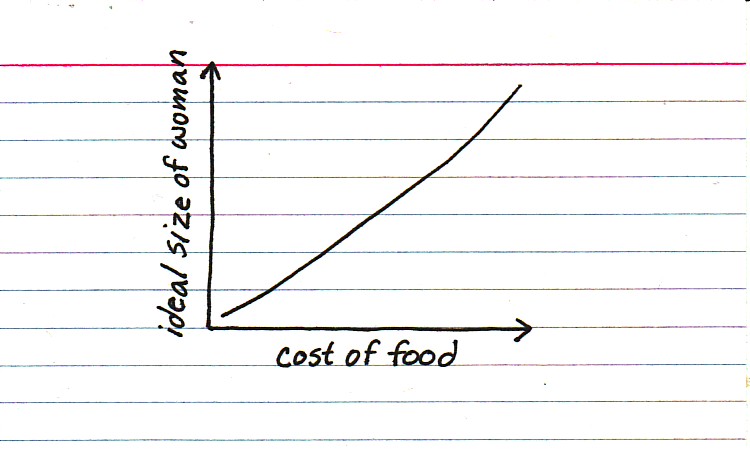
...as captured by Jessica Hagy at Indexed:


I'm far from the only person who remains slightly perplexed about the modern fixation on thin. Why now? Why is thin so venerated when fat/plump/round/large was for so many eons?

The answer, my friends, is simple: rarity.

I could get into evolutionary psychology (where fat women were fertile, therefore more desireable to men), but I think it's more in the aesthetics of beauty than anything.

Beauty, by its nature, has to be rare. Yes, beauty is everywhere and we're all beautiful in one way or another, but I'm talking basic, physical attractiveness. A dandelion may be beautiful, but it's common. We see it all the time. No big deal. But a wild orchid- we stop and look and admire and ohh and ahh. Or a Yugo vs. a Maserati. They're both cars, but the Maserati is unusual. Very few can have it, making it much more desireable.

Large women may have been considered generally more attractive simply because extras in food were rare, giving it the lure of the exotic. Now, food is more abundant, and thin becomes a rarity- which is just what the indexed card says. It's also a status symbol- and it's really hard to deny that.
And maybe (I'm going out on a limb here, and not even sure I believe it myself but...), just maybe, our fears over obesity and the size of our butts is fueling the whole "size zero" model thing. The more we see ourselves as fat, the more alluring the skin and bones of models become. It's the same reason. Corporations feed into this, trying to tell you and sell you on how to become something you're not.

By saying "fat is ugly," the almost automatic correlate is "skinny is beautiful." Which is bullshit, really, but there's a lot of people who buy into it.

I don't know that there's a solution to this problem. Because beauty (as judged by large-scale, cultural standards) is always going to be rare and hard to get. It just is. But maybe we just have to try a little harder, and widen our perceptions of it.

posted under , | 5 Comments

When all else fails, blame the patient

"You just don't want to get better. Why don't you want to get better?"

My therapist (pretty much all of 'em before about 2006) was annoyed with me. I was going to therapy, talking, working on my "issues," and still I wasn't getting any better. I was still batty, still underweight or losing weight, still restricting or purging. I saw a therapist, psychiatrist, dietician, and internist as needed. I was doing everything I was "supposed" to.

And still I was sick. I had all of the proper treatments, with all of the experts, and I was still sick. I certainly blamed myself for my illness (and still sort of do). So why shouldn't my treatment team? It had to have been my fault...right?

Turns out many doctors and psychologists think that way. After all, they're human, too.

Writes Richard Friedman:

[A therapist] had been working with [a man with clinical depression] for nearly three years without significant progress, and she was now doing what many clinicians do when the chips are down: blame the patient for failing to improve.

“I think he has an unconscious desire to remain sick,” she told me.

About a month later, I saw this patient respond remarkably well to a novel treatment. Free of depression at last, he was joyful and relieved — an odd reaction, you must admit, from someone who secretly wished to be ill.

When Friedman questioned the man about the differences between his current state and his depressed state, the man responded "I guess I just think like that when I'm down."

The negative, pessimistic thinking was a result of the depression, not necessarily its cause (at least not totally). So the therapist was, essentially, colluding with this man's illness by saying he didn't want to get better.

And if you don't see the similarities with eating disorders by now, please go snort some espresso grounds and come back once the spots clear from your eyes.

Of course, EDs are a little different. Anorexia in particular is egosyntonic- that is, the sufferer doesn't mind the illness. Furthermore, anorexia tends to be anosognostic and the sufferer doesn't even think they're ill to begin with. Which makes blaming the patient all that much more ironic. How can someone "want" to stay ill if they don't think there's much of a problem in the first place? And what's more, even when illness is recognized, the very illness makes the symptoms more palatable and denies their seriousness.

So maybe lack of progress in treatment doesn't call for blame (of the sufferer, of their parents, of carbon emissions, of this barmy election season), but rather a different approach.

You'd think they would teach this in "therapist school," but the simple matter is that therapists are all too human.

Concludes Friedman:

Chronically ill, treatment-resistant patients can challenge the confidence of therapists themselves, who may be reluctant to question their treatment; it’s easier — and less painful — to view the patient as intentionally or unconsciously resistant...

But a vast majority of patients want to feel better, and for them the burden of illness is painful enough. Let’s keep the blame on the disease, not the patient.

It's true- even the most anosognostic anorexic* is miserable, as much as he or she may deny it. An eating disorder is such a tremendous burden that the sufferer and his or her family don't need any more heaped on top of them in the form of blame.

*Say that three times fast. It's a good test to see if the snort of espresso grounds really worked.

A return to the simple joy of food

I've railed about the many problems the diet industry and mentality has created for us. Besides helping to trigger disordered eating and outright eating disorders in people, it has taken away the joy of eating.

Part of my master's thesis at Hopkins was discussing a mosquito-borne virus outbreak in Italy. The virus had arrived in the US, but there weren't any secondary cases; just the person who had been to India got sick. Everyone else stayed healthy. Why Italy? The region where the virus landed had a warm, dry August. People sat outside all day, enjoying good food and wine. They didn't have A/C, and they just ate and enjoyed each other's company. Being outside, of course, put them at risk for the virus. Part of the reason was that, in the US in Houston in August, you're not going to be relaxing outside. Too freaking humid. But the other reason is that people aren't going to be relaxing outside around a good meal.

Some people are trying (rightly) to change that. I read the book "Animal, Vegetable, Miracle" by Barbara Kingsolver, and even if you don't agree with her "locavore" food style, her love of food and eating will take your breath away. Food is fuel, yes. But food--and it's growing and preparation--can be joyful and loving.

Writes Tara Parker-Pope in the New York Times in an interview with Alice Waters:

My solution is not to try to feed children in the same way that fast food nation does — which is to figure out a gimmick to get them to eat something. It’s to bring them into a whole relationship with food that’s connected to nature and our culture.

No other country thinks about food as just fueling up. It’s always connected to the seasons, to nature, to what’s growing, to celebrations with family and friends. It’s a kind of moment in the day when you collect your thoughts and stop to sit down and to eat. Food is considered precious and vital, and farmers are treasured. We’ve allowed ourselves to be completely indoctrinated into another way of thinking about food in this country.

Food is fuel, of course. From a biological standpoint, it is. But food is intimately tied to culture, and while there's nothing wrong with grabbing the burger and eating it in the car (let's face it, sometimes it's necessary and it's not wrong and bad), but food can be so much more than just fuel.

Dieting takes that away. Food becomes good or bad, yes or no, saint or sin. Food is tallied: how many calories, how many fat grams, how many Points? It becomes a number, a lifeless, breathless entity of "I shouldn't have" staring up from your plate. My dietician- a first generation Italian immigrant- loved her food, and it was a wonderful model for me. Yes, my parents loved eating, too, but it was nice to see someone else doing that, too.

Some schools are bringing gardens to school. I don't agree with the let's-fight-childhood-obesity bent, but I do like the idea that kids are expanding their horizons with food. Seeing it as something to be savored and enjoyed.

I don't like the idea of "kid food," of just assuming that kids are going to want the chicken nuggets and fries because they're three. I actually didn't like fries as a kid, and even now I'm really selective. But I liked salads, I liked fruits, I liked vegetables because that's what I was served and expected to eat.

Food isn't about no, I already ate, or no, I'm on a "cleanse." Food is about give and take, about trying new things, about showing you care.

Food is good.

posted under , | 3 Comments

Because normal is hard

I've spent the last day or two feeling sorry for myself. Why? Because being "normal" is still so incredibly hard, a tremendous consumption of time and energy that leaves me feeling exhausted at the end of the day.

I was getting my lunch in the cafeteria at work yesterday, and I was in tears. All of the menu options had the calories and fat grams printed on the signs- right under the names. It was pretty hard not to see it. Ed wasn't keen about most of those choices. Too many calories, too much fat, too much sodium. Too much, too much, too much.

I was wandering around in tears, my pride at having challenged myself to eat at a completely unknown place dashed. I saw my boss, who made some comment, I don't remember what, and I pulled myself together because I didn't want him to see his new hire crying over lack of lunch choices.

I did find something to eat, and yes, it was appropriate (ie, not plain lettuce). But still.

I hear Ed telling me to use the worksite gym at lunch instead of eating. And I say, "Shut up, Ed. Shut up. Shutupshutupshutup."

All of this inner dialogue takes time and energy. Time and energy when I should be focusing on my new job, or my new surroundings, or trying to make new friends. And instead I'm crying about lunch.

I know I need more therapy to deal with this anger, sadness, and downright bitterness, not just of being sick for so long. But also about recovery, about the awful unfairness of it all. About how much I would like credit from people for getting out of bed and eating breakfast.

Writes Hortence in Jezebel:

It took a very long time, but once I went into recovery, I never looked back. When you lose that part of yourself, you begin to remember who you were before you were just bones and numbers and calories. You start to see things differently, to appreciate small, quiet things that your ED never let you notice before. You eat a fucking Snickers bar for breakfast and you feel like Michael Phelps should mail you a gold medal, because you are such a champion.

And I thought: yes. That's it! That's why I'm pissed. Because it takes most of my energy sometimes to just get up and eat and not have a total meltdown when the bus is five minutes late and you think crap I'm going to be late, I just started work, they're gonna think I'm lazy, they're gonna fire me, my apartment is expensive, crap crappity crap! And then I have to go to work and write my stuff, which is downright simple after figuring out what to eat and how much and when, for Christ's sake.

I try to remind myself that, dammit, life isn't fair. That I got a crappy genetic luck of the draw and live in a freaky diet culture and here I am and here we all are. That yes, I have it easier in some ways. I'm not rich, but I'm not destitute. I have a (mostly) loving family. I have the ability to seek treatment, and the support to keep in recovery.

Then I have to remind myself that, dammit, it doesn't make any of the rest easier.

I would like a break. I would like to remember what normal is, to experience it just for a moment. But instead, I wait and I hope.

Recovered. Period.

I was at an Eating Disorders Coalition event this past Wednesday when I ran into my good friend Jenni Schaefer. I love Jenni. She is truly one of my heroes.

That day, she was wearing a t-shirt that said

"Recovered."

Now, a shirt that says "recovered" rocks, in my opinion.

I, however, was most drawn to the period at the end.

It says, "I am recovered, and will be. I am done with Ed, through with the lies. I am fully committed to my health and my life."

"Recovered" is a statement.

"Recovered." is a way of life.

Add that period, people. It does make a difference.

A good thing gone wrong?

Former anorexic Mimi Anderson intends to run the length of Great Britain (from John O'Groats in the north to Land's End in the south) to raise money for B-EAT, the British eating disorders charity. She is an "ultra-runner," meaning she regularly runs distances that are longer than marathon (26.2 miles) distance.

That Ms. Anderson is doing better with respect to her eating disorder--well enough to run such distances--is fantastic.

However, I'm wondering: should we be supporting such exertions in an ED sufferer, even if they claim their illness is behind them? What would B-EAT have to say?

The trip is 840 miles. Ms. Anderson will need to run for almost 13 days, at about 75 miles per day to break the record. That's three marathons each day.

It strikes me less that she has totally recovered from anorexia than she has found a way to substitute frightening amounts of exercise for restricted food intake.

Says Anderson in a newspaper interview: "Eating disorders are about control. People with them tend to be high achievers. Possibly I have swapped one thing for another, but I have to eat or I could not do what I do. So in that respect it has been fantastic and made me realise there are more important things in life."

Which could be true. Or it might not be. I'm wondering if Ms. Anderson would eat just as well if she weren't in training. Because running could be a way to purge those calories. And I'm not entirely positive how different it would be if the only reason you eat is so that you can run. More so, how would she feel if she couldn't run?

I don't want to accuse her of anything. No doubt she is genuine; but is she playing with fire? We wouldn't let an ex-alcoholic do a drink-a-thon to support Mothers Against Drunk Driving. Is there a real difference here?

posted under , | 10 Comments

Relativity

How come:

a can of Slim Fast has 180 calories and 4 tablespoons of sugar and is supposed to make us thin, while a can of Coke has 150 calories and 3 tablespoons of sugar and is supposed to make us fat?*

Does printing "Slim" on the label change the actual quality of the food? Or just our perceived quality? What does this tell you about marketing, advertising, and the media? About our knowledge of food and metabolism?

*Note: I got these statistics from a book review, and have verified them to the best of my ability. If they are wrong, please (nicely) let me know.

posted under , | 11 Comments

Up the stairs

"A culture that invents both escalators AND StairMasters is a culture that needs to assess what it's actually talking about."
--Jennifer Hecht
(h/t Cammy)

As I collected my mail after I got home from work today, I had to walk by the fitness room. And, like most days, I saw the same girl in there. I don't know her name, or her life story. But I know enough. I know that she is in that gym too freaking much.

Obviously, I get habit. She very well might work out after work everyday- which isn't a cause for concern, even in my highly trained eyes. My highly trained eyes see something else, however. I don't get home at exactly the same time every day. Sometimes I will take different trains and buses. So there can be great variation- up to about an hour and a half difference. Yet this girl is always there.

What's more is that she's dripping with sweat and exhausted on those machines. I can see that. I also know from using the gym that it's hot in there. You get sweaty. But she is dripping. And exhausted. She doesn't use different machines each day, which is what I initially thought. I learned this today after I went in there to get a drink out of the water cooler. No. She hops from machine to machine as she gets tired.

This girl has issues. Are they an eating disorder? I don't know, and it's not my job to ask.

She has issues, and I am feeling a bit jealous.

I miss that feeling of superiority and discipline and strength that I had when I was ill. I do. I miss it. Even knowing now that it was a false sense of discipline, an alcoholic bragging she could chug six beers, but still.

Now that I am in recovery, I can discipline myself to learn about esoteric, complicated subjects and then explain them to people who know nothing about science. I can discipline myself to make jewelry, to play with my kitty, to talk to friends and loved ones on the phone.

Discipline.

Yet it doesn't feel that way.

Maybe it's the gap between what society calls "discipline," which is the rough equivalent of a spanking, and what really is discipline. The dictionary says that it can be learning a skill, learning from experience, training in music or other talent. Learning.

What is the girl in the fitness room learning? That she can work out for X hours a day? Lift X pounds? Run X miles? Is that discipline? Is that learning? Or is that an addiction? A behavior that is clearly out of control.

Maybe I still miss it. Maybe I'm still jealous. But it's not because I lost my discipline.

posted under | 6 Comments

It's not over 'till it's over

I had a therapy appointment today, and part of what came up was the continuing anorexic thoughts that I have. I've been at a healthy weight for a little over a year, I'm eating a wide variety of foods, most of the time I eat enough fat, I exercise moderately--in a nutshell, all of the things that I am "supposed" to be doing in recovery.

So what gives? Why, after all this time, do I still instinctively want to restrict? Why, in times of stress, do I want to exercise like a madwoman? Some of it, I know, is how my brain is wired. But I had hoped that after a year of all of this turmoil, it would get a lot better.

And it has gotten somewhat better. Somewhat. But I still have to talk myself through a lot of things. I still have to remind myself that butter is not something that exists for the sole purpose of decorating my fridge. That I can cook with it. Put it on my bread, or baked potato. I have to remind myself that exercise feels good, but only as long as I don't overdo it. Sometimes I still get horrifically anxious if I can't exercise as I had planned. So I sit myself down and have a long pep talk with myself and try to get through it.

No wonder my roommates all used to think I was whacked. Luckily Aria doesn't seem to mind.

Yet all of these thoughts are a several-times-a-day thing. I had hoped they would be more fleeting. Can I manage them? I suppose- I've been doing it for a year now. But it's exhausting, and I'm tired of it. Not tired enough to give up recovery, however. Just tired in the sense that I have this plaintive question that remains: when will it get easier?

My therapist reminded me that, considering I've been sick for almost 8 years now, it's going to take more than just a year of a healthy weight and eating properly for the thoughts to go away. Which, okay. I do logically get that. I'm just frustrated with it all. I had hoped I would bounce back more quickly. I guess, ultimately, I'm having a hard time accepting how ingrained the AN thoughts were/are. I don't like to think about that.

I can function on the outside, and that's something. That's an achievement. I can go out with friends, even if that going out involves dinner. But it's still just so damn hard. And I almost wish that the inner turmoil was more visible, that yes, I look and act moderately normal, but my head is still a little screwed up.

I was also reminded that the thoughts may never fade entirely, but I will instinctively replace them with positive reminders of why I need to eat. That it won't be such an effort. I'm not entirely thrilled with that thought, but if it does become my reality, I can at least figure out ways to deal with it.

I used to be told that the eating disorder would end when I chose to end it. Obviously, I have several problems with this. First of all, someone with an eating disorder can't just randomly "choose" to start eating again. Believe me, if we could, we would. But secondly, I can't totally control how long these thoughts will stay with me. I am ultimately in charge of managing my recovery. I am ultimately responsible for feeding myself properly, for ensuring I don't start exercising compulsively. These behaviors will have a HUGE impact on whether the AN thoughts go away. But I can't control how long the thoughts will stick around.

All I can do is remind myself that if I want to get well, I need to stay at a healthy weight. And I can certainly start losing again, but that will just mean I'll have to gain weight again. The relief of restricting is NOT equivalent to the torture of weight restoration. So I'll have to sit it out, and get the hell on with my life.

posted under , , | 10 Comments

So now what?

I'm done. With school.

::insert cheer here::

And I'm sitting here, after spending my Friday night alone (as I do most Friday nights), wondering now what?

I knew that nothing was going to change when I handed in my thesis to the library book bindery today. They guy said "congratulations" and I went to my last class and that was it. Which was anti-climactic to say the least. Now I can truthfully write "Carrie, MA, MPH" after my name and nothing else has changed. I have the same issues, the same pitfalls, the same bizarre fits of creativity.

So now what?

I have been waiting for my life to start, well, all my life. After high school. After college. After I get a job. After I get my Master's degree. After I recover. After after after. It's my ten year high school reunion sometime soon, which makes a decade of afters. And no, I'm not going. I've kept in contact with the two people I actually liked, and the rest don't stir any feelings of nostalgia and longing.
I want to say, "What are you waiting for, Carrie?" What am I waiting for? I feel like I've been muddling through for so long, trying to manage all of my mental illnesses/brain diseases, that I have to kind of prioritize my needs. Think Maslow's hierarchy. If I'm struggling to make it through the day, to feed myself, to sleep, to not anxiously tap my leg off my freaking body, then things like enjoyment and self-actualization are probably not going to make it in my to-do list. Yet I know that enjoying myself and finding something pleasurable are important and can lead to improvements in eating, sleeping, and anxiety.

I think I feel some odd sort of internal pressure now, knowing that I can't put everything off any longer. School is over. I know I didn't go to grad school deliberately to put things off. And I did learn a lot this year and it wasn't as hellish as my other school experiences have been. But now there's just me and my life, and I haven't the slightest clue what I'm going to do.

I had free time tonight, and after picking some things up around my apartment, I essentially sat and stared at the wall. I don't know how to deal with free time. It baffles me. So what am I going to do with an entire life?

I suppose I don't need to be in a huge hurry to answer that question. I will find out soon enough. Nor do I need to fill an entire life. I have a lifetime in which to fill it. I'm trying to ask myself what I would like to do right here, right now.

I don't know the answer to that.

I know getting some quality rest is (or should be) up there. Ditto for enriching the inventory for my Etsy shop, Frenchroast Designs. And scraping off the whatever-it-is that is crusted on the top of my stove.

Other than that? I guess I'll have to wait and see.

posted under , | 9 Comments

Past Imperfect

This is a question I've always been asked: do you think you will struggle with your eating disorder forever? Will it always be there?

Jenni Schaefer posted this question on her blog, and I thought I would answer it here.

I do believe in full recovery, but I also believe in care and caution. I long for a day when eating disorder thoughts are no longer in the forefront of my mind. Indeed, there are the occasional times when they're not. When I have other, more important things to think about besides food and weight, calories and exercise. Sometimes these things are fairly petty (did I clean out Aria's litter box?); sometimes they're more significant (will I screw up my job interview* tomorrow?).

Then, of course, it's back to worrying if my stomach sticks out in my pants or if I overate at lunch or if I should take a day off from exercising.

So how in the hell can I possibly believe in full recovery?

Because I have to.
Because I've seen it.
Because I've been told it's impossible.

Some of it is pure bull-headed stubbornness that keeps me going, the same stubbornness that Ed used to keep me ill all of these years. I am trying (against all odds) to live my life as if I didn't have an eating disorder.

And there, my friends, is the catch. I might be able to live without the eating disorder in my life, but I would be foolish to forget that it ever existed. I dream of being nonchalant about food, not worry about what I'm eating. But I can't be nonchalant about eating. I have to eat regularly. I can't afford to skip meals. I will never be able to relax about this- nor should I.

An eating disorder diagnosis forever changes you, changes how you relate to the world. But the fact that I will have to remain vigilant for signs of relapse, and vigilant of how I take care of myself, doesn't mean that I can't recover. It doesn't mean the AN thoughts will rule my life.

It just means I had an eating disorder. Past tense. Not present. The past. A part of my history, but not my future.

*Yes, kids, wish me luck. I'm interviewing for a permanent position at the newsmagazine where I'm interning this summer in DC. I'm not going to mention where for privacy reasons. If you want to know more, drop me an email. I will be more than happy to oblige.

Survivor's Guilt

Being a part of the Eating Disorders Lobby Day was incredibly empowering. "Fun" is not perhaps the right word for it; "worthwhile" certainly is. However, I was left with some nagging little feelings that took me a while to sort out.

Lobby Day made me feel incredibly guilty.

That I was doing well enough in recovery to go.

That I ate two little bags of chips with my sandwich on the way home.

That my mom was able and willing and happy to come with me.

Part of the frustrations of eating disorders--both for those who have them and those who love people with eating disorders--is an inability to realize you're sick. It's different than denial, if in subtle but significant ways. The point is this: I still don't think I was that sick. I've written two books about my experiences, and I still don't think I was really sick. I have plenty of bouts of irrationality, but I am able to sort through those with a fair amount of skill and get on with things (even if I end up insisting that I am right but going along with the so obviously wrong beliefs of everyone else will get me what I want).

However, eight years and two books later, it doesn't register that I was sick. I know I looked thinner, but I didn't think I was, you know, skinny. Certainly not emaciated. And certainly not in danger of dying from starvation and cardiac abnormalities. I was told this, many times, by family, friends, and medical professionals. To me, they were the delusional ones. I rarely saw myself as fat, but there was NOTHING WRONG WITH MY WEIGHT, thank you very much. Or my eating habits.

I still don't believe them. Which means that acknowledging my recovery makes me feel very guilty.

Why? I wasn't sick enough to "deserve" it. I didn't suffer enough. Or long enough. Or lose enough weight. How dare I be happy if I didn't have it bad to begin with? I was a faker, a charlatan, a fraud.

Why, I ask myself, did I survive and enter recovery when so many other people didn't. People like Anna and Andrea, who died as a result of their eating disorders. People like Kathleen who struggled for 18 years. People who were tube fed or on life support.

I no longer think of these as status symbols; I'm not jealous of those who were sicker than I. They only reason I wish I were them is that I feel it would make recovery easier to accept if I was actually, really truly sick. Which given the nature of eating disorders means that no matter how ill I had gotten, I still wouldn't have seen it.

So why did I make it out of this upside-down, topsy turvy world of anorexia? I know I owe some of it to the hard work I did in recovery. I also know that I owe even more to the fact that my mom decided to stop sitting around the watching me starve. I had a great treatment team. I could (mostly) afford the treatments that insurance refused to pay for. Yet still the guilt remains.

Why was I lucky enough to have these things so easily at my disposal? Why me? Why me and not them? Maybe it was dumb luck, cosmic karma of the strangest kind. Who knows.

I want to see myself as having been ill. In a sense, that knowledge feels it will set my mind at ease, that I will be able to let go of the unease I feel when I discuss my illness and recovery. I've been known to make my story sound worse than it really is, not because I want sympathy but because I want to convince myself (and others!) that I really was sick. That I have a right to be here with everyone else in recovery.

The other supreme irony is that no one else in this "club" really gives a damn.

posted under , , | 7 Comments

Being a Consumer

It's odd. When you hear the verb "consume," you probably think of food. She consumed X calories today. He consumed the whole cheesecake. I've yet to hear someone say "she consumed a celery stick." She snacked, she nibbled...but not she consumed.

Then there are the scary statistics about Americans' use of gasoline and oil. "...consumed at a rate of X gallons per day." Ditto for water. It referred to something in excess.

We live in a consumer society. We want. We buy. We use. We consume.

I don't always like that. I don't want to be a "consumer." I don't want to want, to need, to consume. Eating was a part of that. Soon, it traveled beyond food and eating. I didn't want to spend money or get myself nice things. Don't be a consumer, Carrie. Don't waste. Don't use up. Don't need. Don't want. You can get by without another pair of jeans or shoes or towels or books.

The amount of food I ate was excessive. Cut back. I was excessive. Want less, need less. You can make do. With 300 calories a day. With 5 hours of sleep a night. With an 8-year-old pair of jeans. Sandals that were almost worn through. Socks that were worn through.

I'm astounded, really, that I didn't try to cut down on the amount of oxygen I used. If I could have figured out a way, I'm sure I would have tried.

Where does this mentality come from? It's very common in people with anorexia- the pinched purses, the fear of excess. Could there be a neurological basis for this? Is it cultural? Is it both?

I was told by some therapist somewhere (there's been far too many) that it was a rebellion against the culture at large. I was rebelling against being a woman, I was rebelling against a me-driven, want want want culture. I don't really agree with the first part, but the second makes me stop and think. I will confess- I like being a little different. When a band I like gets popular, it really annoys me. My preferences have become almost cliche.

More than that, though, there was a subtle sense of superiority at not going shopping, at not buying much. The same that went along with not eating much. Those people, I sniffed. With their new cars and new clothes and pizza dinners. I don't need that. My celery stick suits me just fine.

I was, of course, also jealous of those people. Jealous that they could want and need and have. I couldn't- or at least wouldn't let myself. So I prided myself in the opposite. It made the quasi-existential crisis somewhat easier to bear.

Did this fear of consumption start with the eating disorder? I remember going to the mall with my friends in middle school and high school, helping them carry their packages since I had bought nothing. At most a pair of earrings or some lip gloss. I went to a Rennaisance Festival with my high school BFF and she bought a $100 costume thingy. I was shocked. First of all, it was kind of tacky. No- it was really tacky. Secondly, it had no use. Thirdly, it was wasteful. She didn't need something like that. I couldn't imagine forking over that amount of cash for something like that.

It definitely got worse with the eating disorder. The only things I continued to buy were coffee, Diet Coke, and books. For me, books have their own sustanance. I don't eat the paper or anything, but they do help sustain my mind and soul. Any new clothes I got were because my mom couldn't stand to see my old jeans hanging off my butt. Or because she had cleaned out my closet while I was inpatient and I wasn't about to go out in January in my skivvies.

Walter Kaye at UCSD did some studies in weight-restored anorexics measuring the amount of dopamine in the brain. What he found was interesting: anorexics had higher levels of dopamine than healthy controls. The theory is that people with anorexia are stimulated and get pleasure at much lower levels. An attempt to restrict food and consumption is a way to modulate the levels of dopamine. Other experiments found that those with addictive behaviors (alcohol, drug abuse, gambling) had lower levels of dopamine. They were the pleasure seekers. There wasn't enough dopamine, so they did things to increase it.

I don't know that we'll ever fully tease this apart. Nature and nurture has no distinct division. They influence and tug back and forth on each other. I still have to work daily to modulate my tendency to avoid and do without. It is helpful when you don't have a job, true, but I'm also not totally destitute. I can afford food. Socks. New chap stick. It's okay. We're all consumers- and there's nothing wrong with that.

posted under , | 4 Comments

Chew on This

I had read the book "Appetites" by Caroline Knapp a number of years ago, and picked it up tonight after I knocked it off the bookshelf while trying to dust. On page 3 was this quote:

Cottage cheese, of course, is the food God developed specifically to turture women, to make them keen with yearning. Picture it on a plate, lumpy and bland atop a limp lettuce leaf and half a canned peach. Consider the taste and feel of it: wet, bitter little curds. Now compare it to the real thing: a think oozing slab of brie, or a dense and silky smear of cream cheese. Cottage cheese is one of our culture's most visible symbols of self-denial; marketed honestly, it would appear in dairy cases with warning labels: this substance is self-punitive; ingest with caution.


Though I don't always agree with Knapp, I think this paragraph is particularly poignant of the ways that food is used in our culture as a symbol of morality, of how strong and how good you are.

If I walked into my old office during their diet psychosis, with only a bowl of cottage cheese for lunch, no one would say, "That's it?" They would say, "Oh, you're being so good." Many of my co-workers were nurses. Yet still they were held hostage by this same mentality.

I still wait for the day when food is food and that is that.

posted under , | 9 Comments

Enough Already!

I feel like I have been writing all day. Between writing my own stuff and grading student papers, my brain has almost had it.

The grading is taking longer than it should because I feel compelled to grade "perfectly." To correct every mistake, re-arrange the sentences properly, help them on grammar and sentence structure.

I have to remember: that's not my job. Okay, yes, I do need to give them good feedback and suggestions and that's fine. But I'm not supposed to re-write their papers for them. I just want to make it perfect.

Ah, yes. Perfection. You ethereal creature, always beckoning. Like Odysseus' sirens- so seductive and alluring, but then you get there and they kill you. So many things in life are like that, aren't they?

Yet I don't always think I'm a perfectionist because I don't feel that I try hard enough. I mean, there are things in my life that I totally let slide. Sometimes, my Christmas shopping isn't done early. There is (gasp!) clutter in my apartment. My car needs to be washed. Badly.

See? If I were a perfectionist, these things would all be done and ready and things would never be out of place and I would be all together and never have zits.

I just need to try harder. That's all.

It's an asinine argument, to be sure, but I also believe it. On the one hand, I know I'm a perfectionist. I hate making mistakes. I like things to be 'perfect.' But I feel it's an adjective, not a real diagnosis. Not in the way of some of the people in my family. I'm not good enough to be called a perfectionist.

That really sounds ridiculous when I read it. I mean, completely, utterly whacked-out.

And only a true perfectionist would think that.

I don't really think that being a perfectionist is a good thing. I don't really consider it a character flaw, but I do think it can get in the way of things. I mean, is it really appropriate to lock yourself in your room for several days after getting your first A- in college? Um, not really.

My problem is knowing when enough is enough. What is 'enough' exercise? What is too much? Ditto for dietary vigilance. And studying. And damn near every other thing.

Common with perfectionism is all or nothing thinking. That I don't dispute. I'm good at seeing the nuances of arguments and things like that. I can easily put myself in other people's shoes. But with pretty much everything else? All or nothing. If I make a mistake, the whole thing sucked. However, because I made the mistake, I can't be a perfectionist. Because- get this- perfectionists don't make mistakes.

Duh.

I get that no one is perfect. On a weird sort of intellectual level. But I always thought that if I got this award, or this grade, or could lose enough weight, eat few enough calories, exercise enough hours each day, then I could be perfect. I could be 'enough'.

To be continued tomorrow...

Older Posts Home

ED Bites on Facebook!

ED Bites is on Twitter!

Search ED Bites

People's HealthBlogger Awards 2009
People's HealthBlogger Awards 2009 - Best 100 Winner!
Wellsphere

About Me

My photo
I'm a science writer, a jewelry design artist, a bookworm, a complete geek, and mom to a wonderful kitty. I am also recovering from a decade-plus battle with anorexia nervosa. I believe that complete recovery is possible, and that the first step along that path is full nutrition.

Drop me a line!

Have any questions or comments about this blog? Feel free to email me at carrie@edbites.com


nour·ish: (v); to sustain with food or nutriment; supply with what is necessary for life, health, and growth; to cherish, foster, keep alive; to strengthen, build up, or promote


Archives

Popular Posts

Followers


Recent Comments