Reality check, podiatry-style

This winter has not been easy on me- I have been hanging in there by the skin of my teeth. Around November or so, the amount of exercise I was doing began to creep up...and up and up. Yet it took until the middle of this month for me to realize that things were really out of control. My weight had dropped some, nothing catastrophic, but also nothing to sneeze at. I have managed to get back on track with the exercise and eating, in part due to a painful left foot.

For the past month or so, I have had this nagging foot pain that wasn't getting any better. I got a referral to the podiatrist about two weeks ago, and finally got in for an appointment this morning. He took one look at my foot, poked at a spot he said "looked puffy" (I couldn't really tell the difference), poked it causing me to yelp, and said, "Yep- that's a stress fracture." X-rays confirmed the diagnosis.*

What does this mean for Carrie? No exercise--none--for about three weeks, and then only non-weight-bearing things like swimming or a stationary bike. I also have some fun footwear in the form of a walking cast, aka The Boot. Otherwise, rest, Advil, and ice, with orders to come back for more x-rays in about a month.

Well, shit.

A metatarsal stress fracture is pretty classic of the female athlete triad, the combination of osteoporosis, disordered eating, and amenorrhea. Although I currently get a period, I do have a history of osteoporosis/osteopenia (depends on the bone- my spine is the worst), and the disordered eating--well, you knew that. It's not that I think I'm invincible. I've experienced too many things to really believe that. But I didn't think the ED would keep affecting me, even after being in recovery.

And the more I think about it, the more I realize exactly how driven and disordered my behavior was. I was exercising several hours a day on a fractured foot. This sort of behavior is light-years away from wanting to look like the ingenue of the week or getting some sort of revenge at Mommy Dearest for not letting me go on Spring Break in high school. This sort of behavior is tremendously biologically driven and very addictive in nature.

I'm kicking myself (with my good foot) for letting the exercise get out of hand. I feel I should have known better. Although I've had exercise issues in the past, they never approached many of the stories I would hear in treatment. My behavior was compulsive, although not phenomenally excessive. This time around, however, it was both.

I want to forget, I really want to forget, how much ED lurks and may always lurk. I want to think there will be a day when I can relax and be a little less vigilant. But for now, I have to remember that Mad-Eye Moody said it best: The price of freedom is eternal vigilance.

*It's not uncommon for stress fractures in the foot to fail to appear on an x-ray, but sometimes they do.

Causes of anorexia, explained?

Perhaps, if the folks at the Great Ormond Street Hospital in London are right. New research, which will be presented at the Institute of Education conference this week, sheds light on the brain changes that accompany anorexia. Rather than a size zero fad or an overcontrolling mother, anorexia may be caused by changes to the brain that occur in the developing fetus.

In an article in the UK's The Guardian titled "Anorexia risk 'could be predicted'," lead researcher Ian Frampton says that

"Our research shows that certain kids' brains develop in such a way that makes them more vulnerable to the more commonly-known risk factors for eating disorders, such as the size-zero debate, media representations of very skinny women and bad parents."

Slight quibble: those are stereotypical risk factors. The first two may cause people to diet, which would then trigger an eating disorder, but in and of themselves, they don't have a whole lot to do with EDs. The last has been thoroughly debunked- bad parents don't help you in life, but they don't cause eating disorders, either.

And these brain changes--whatever they may be--don't make you more vulnerable to "the size zero fad and the cult of the super-thin celebrity," as the author writes. Anorexia is deadly, not a fad a little too far by a bunch of vapid teenage girls. The brain changes make you more likely to develop a serious mental illness that might look like a fad, but let me tell you: it ain't about celebrities.

Frampton and his colleagues conducted in-depth neuropsychological testing on more than 200 people in the UK, America and Norway who suffer from the condition...They found that about 70% of the patients had suffered damage to their neurotransmitters, which help brain cells communicate with each other, had undergone subtle changes in the structure of their brains, or both.

One in every few hundred girls may be affected in this way, according to Frampton, who said the condition was random and not the result of poor maternal diet or environmental factors, such as widespread use of chemicals. Imperfect wiring in the brain's insular cortex that may lead to dyslexia, ADHD or depression in other children produces what he calls "an underlying vulnerability" among some young people that makes them more likely to develop anorexia.

This research is, of course, preliminary, and there are many questions I would like to see answered, such as:

  • How do you know these brain changes aren't a result of malnutrition? If the girls being studied are currently in the hospital for AN, they're malnourished, which we know changes the brain. I'm assuming they authors have an answer for this and I am all ears.
  • How do you intend to show that these brain changes came first?
  • Are there other people with these brain changes that don't develop AN? In other words, are these brain changes diagnostic, or just suggestive?
  • If the process is random, why does AN run in families? Did you look at siblings?

These studies are absolutely important, and I'm glad they're being done, but I'm not sold that this study will "revolutionize" anorexia treatment. Yet.

The authors of the study naturally mention screening and prevention, efforts that are no doubt important. However, dieting is ineffective for everyone, and malnutrition is dangerous for everyone. There should be a zero-tolerance for it across society, not just for those with EDs. The stakes are almost certainly higher for those with the genetic wiring for EDs, but that doesn't mean everyone else has a "get out of jail free" card, either.

Still, the take-home message is this: anorexia is the result of differences in neurobiology and neurochemistry that is triggered by things in the environment.

EDITED: I found another story in the Sydney Herald-Sun that had a few slightly different quotes and seemed to portray the research just a bit better, without some of the dodgy paraphrasing by the writer. See the story here. I'm still waiting for the American newsmedia to weigh in (no pun intended).

Tips for coping with stress from rats, baboons and other animals

I'm a geek- I freely admit it. One of my new favorite geeky activities is iTunes U, which contains a bunch of free lectures and videos on virtually any subject under the sun. I listen to these a lot on my way into work, as they make the ride go a lot quicker. Yesterday and today, I listened to two lectures by neurobiologist Robert Sapolsky, author of the book Why Zebras Don't Get Ulcers.

Sapolsky researchers specifically the neuro-psycho-biology of the stress response- what the physiological outcomes are, and what psychological and environmental factors can mediate this response. And his research, combined with a rich background provided by other scientists, has led him to figure out a bunch of very basic tips to help us cope with stress:

  • An outlet or hobby. Rats who could gnaw on a piece of wood after receiving a very mild shock didn't develop any stress-related diseases, while those with no way to "cope" with the stress did develop diseases (ulcers, high blood pressure, etc).
  • Predictability. If the rats received a brief warning that the shock was going to happen, even if they couldn't avoid it, they did not develop stress-related diseases.
  • Sense of control. This one is pretty self-explanatory.
  • An ability to tell the important stressors from the not-so-important ones. This one came from Sapolsky's own work with baboons. If male baboons reacted to every minor threat from another male as needing a massive, aggressive response, they had higher levels of stress hormones.
  • A sense that things are improving. Also pretty self-explanatory.
  • Friends. This, says Sapolsky, is perhaps the most important mediator of stress. Cloning and medication and all of these advances are saving human lives, but having a friend to talk to, to share things with, to understand what it is you're going through, may be the most live-saving of all.
Maybe this is why blogging is so therapeutic for me- it incorporates all of these elements. I still have a lot of work to do in order to better incorporate these ideas into my everyday life, but I think these are really basic, really important elements to making it through the day intact.

What do you think? Anything to add to the list?

To listen to these lectures, go to iTunes and do a search for "Robert Sapolsky". The two I listened to were "Why Zebras Don't Get Ulcers" and "Stress and Coping: What Baboons Can Teach Us." They're an hour each but extremely entertaining.

An ED Bites milestone

When I started this blog over two years ago, I had pretty much no expectations of how it would turn out. I thought my readers would be, essentially, me, supplemented by the random person who stumbled by from Google.

Well sometime earlier this week, I bypassed 100,000 unique visitors. I am blown away. People actually search for my blog! They also search for more random things that ultimately point them my way.

More than just hits, I've found a wonderful community of people to support and challenge me, who keep my thinking from becoming stagnant. I never, ever expected this, and I am forever grateful.

posted under | 9 Comments

More than a river in Egypt...


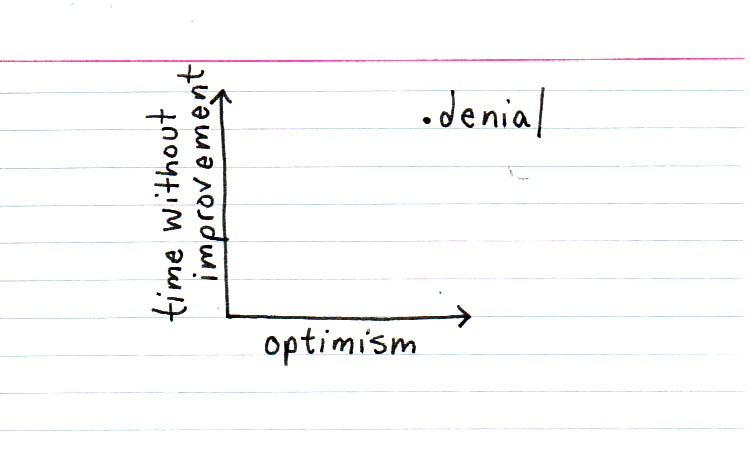
This reminds me of all the time I spent in therapy, with my ex-therapist's optimism that one day I would get to the bottom of things and leave the AN behind. Yet I remained ill.

I don't know which one of us was more in denial that this therapeutic approach just wasn't working. Even the best of guesses at why I was so afraid of eating couldn't remove the roadblock that stood between my fork and my mouth.

It's quite common in the ED world, the dogged belief that if you just figure out what's causing your disorder, you'll get better. And time passes, and passes and passes. Some people eventually get better, yes. But some don't.

We really need to ask ourselves: is this really the best way to treat eating disorders, or are we just kidding ourselves?

(Image courtesy Indexed)

Saver's remorse

In the news lately, I've read a lot about buyer's remorse and the role overspending may have played in the current economic crisis. But in today's New York Times, a story looks at the dangers of oversaving. Psychologists have dubbed this phenomenon "hyperopia," the medical term for farsightedness, as "it’s the result of people looking too far ahead. They’re so obsessed with preparing for the future that they can’t enjoy the present, and they end up looking back sadly on all their lost opportunities for fun."

Just as the immediate rush of a purchase doesn't last forever (hence buyer's remorse), neither does the guilt over the purchase. Researchers found that students who spent more of their spring break studying/working, as opposed to relaxing/partying, had more regrets over the way they spent their time when they were surveyed one year later. Dr. Ran Kivetz of Columbia University, and someone who researches consumer behavior said, "what builds up is this wistful feeling of missing out on life’s pleasures.”

This...this I understand. In fact, this pretty much summarizes my life. I'm not unsympathetic to those who have trouble with managing their money, nor am I particularly proud of this. But I also know that the regret is very true and very real. I don't remember much of college. I remember the chair in which I studied so often. I remember being so exhausted that I was constantly on the brink of tears, and then became even too exhausted to cry. I hate the scent of Juniper Breeze lotion from Bath and Body Works because I used it during the worst of my days and the scent always takes me back to that awful place.

Obviously, mental illness contributed to this hell. I won't deny it. Yet I don't know for sure whether I would have been able to loosen up even if I wasn't clinically anxious and depressed.

Kivetz has this to say:

“Don’t be too hard on yourself,” he said. “Obviously you need to be responsible and conserve your savings. But it’s been a depressing winter, and there’s nothing wrong with indulging yourself a little. This is a chance to reassess the quality and the balance of your life and to think how you’ll feel in the future. As long as you can afford it, it’s not a bad thing to be enjoying yourself.”

Enjoyment is the key word, as the hyperopia I experience extends far beyond money, and I'm guessing that's the case with others as well. It's about the price of enjoyment, or even (might I suggest) the fear of enjoyment. I will occasionally "enjoy" things, but only if I've earned them. And I put a high price on fun and relaxation. I'm not talking about making sure the cat has food before you go out for dinner. I'm talking about making sure the carpet is vacuumed, the laundry is folded and put away, the papers are organized, and the bills are paid.

This is some of the hardest thinking to break, because I've always been this way, and my parents definitely tend towards this way and I don't know any other way to exist. My threshold for fun and enjoyment are probably way lower than others' and I'm okay with that. But this article just really summarizes the dilemma in which I find myself so often, and the worldview that really contributes to the anorexic thinking.

Thoughts?

In another time and place

Laura's recent post on the paradigm shift that's occuring in the ED world, and similarities with the germ theory of disease, got me thinking. My background is in biochemistry and infectious disease, and I worked in tuberculosis control for a while after graduating with my master's of public health. The germ that caused tuberculosis (Mycobacterium tuberculosis) was one of the first disease-causing germs to be formally identified, all the way back in the 1880s.

During the 19th century, TB was almost de rigeur. People, among them the poet Lord Byron, but especially young, upper class females, would kind of cultivate the wasted, pale look of TB patients. It was considered almost a romantic disease- aside from the fact that you probably were coughing up blood everywhere, were dropping scads of weight, and were tortured with night sweats. But make no mistake, TB was still on the fashionable side of things, and the experience of a TB sufferer was quite romanticized.

It sounds silly, doesn't it? That someone would want to get tuberculosis*? That they would desire a deadly disease? That TB would be almost like...oh, I don't know...a lifestyle?

Catch my drift?

That's the paradigm shift that I'm hoping for: that one day, we will look back on all of the I-want-to-be-anorexic, the please-teach-me-to-be-ana, the EDs-are-a-lifestyle, the I-need-to-choose-to-get-better groups and movements and identities and all of that and wonder why in the hell anyone would want a deadly but treatable disease like an eating disorder.

*Although, I must add that the weight loss factor still makes TB somewhat appealing to some people. On the list of one of the most all-time, utterly horrific comments I have ever heard: I was listening to a case presentation by a public health nurse, who joked about the TB patient's dramatic, rapid weight loss caused by TB: "wouldn't we all like that?" Never mind that the patient faced almost a full year of antibiotics that could fry her liver.

Importance of treating malnutrition

Although malnutrition and eating disorders go hand-in-hand, EDs aren't the only conditions that are frequently accompanied by malnutrition. Cancer is, too, with up to 87% of cancer patients becoming malnourished at some point during treatment.

A new study looks at the relationship between malnutrition and the psychological distress experienced by cancer patients. The 213 cancer patients were taking part in a nutrition rehabilitation program, and were asked to rate their psychological distress on a scale of 0 (no distress) to 10 (high distress). Researchers found a significant correlation between malnutrition and distress: the higher the distress, the greater the malnutrition.

"Our data suggest that nutrition status may contribute to the level of distress in patients with cancer," Dr Amdouni says. "Evaluation of the nutrition status should be included in the evaluation of distress experienced by these patients."

The connection between malnutrition and psychological distress in cancer patients seems somewhat obvious, and lots of people are (hopefully) going to coax the cancer patient into eating and improving their nutritional status, which will then improve their psychological distress.

So why is the same thing so controverisal and seemingly unorthodox among ED patients? Why is it that people don't flat-out say: of course you're depressed and feel like crap. You're not eating properly! Instead, hours of therapy and thousands of dollars are spent trying to make you feel better in the hopes that you might eat. Of course, one meal isn't a cure. One meal won't make you feel better.

Brain tumor or brain disease, nutrition is important.

UH sociologist has different perspective on obesity 'epidemic'

Although most of the reporting on obesity and the accompanying "epidemic" has appeared in health or science reports, the accompanying sociocultural aspects of obesity and what it means have been much less covered. A new article from the journal Sociological Inquiry by sociologist Samantha Kwan titled "Framing the Fat Body: Contested Meanings between Government, Activists, and Industry," examines the creation of the obesity epidemic as a cultural--as opposed to a purely medical--phenomenon.

Overweight and obesity are not just medical facts; they are social issues that various groups, industries, and "moral entrepreneurs" vie to define. Sociologists have long recognized that social problems do not derive solely from objective conditions but from a process of collective definition...Thus at the core of some social problems are framing competitions—struggles over the production of ideas and meanings.

"I am trying to get students and audiences to understand that there are competing cultural meanings about the fat body," Kwan says in a press release. "Fat does not, in itself, signify unhealthy and unattractive. These are cultural constructions. We as a society say what it means to be fat, and right now cultural discourses say it's ugly and unhealthy to be fat. … It's also assumed that the body is a reflection of the psyche, including one's moral fiber."

In the paper, Kwan puts it this way:

In many ways then the medical frame depicts the healthy body as a symbol of accomplishment. Individuals who work hard exercising and practice restraint by eating healthily are perceived as victorious. Their reward is weight loss. This symbol is especially ubiquitous in Western societies with a pervasive ethos that bodies can be transformed at will with discipline, hard work, and determination alone (Brownell 1991) and where the body is a metaphor for the psyche (see Bordo 1993). In this social context, fat becomes a morally suspect identity.

And it is this "moral panic" that is so dangerous. There are both medical and social aspects to obesity, but I think it's very valid to examine how this became an epidemic. Considering the amount of money to be made on preventing and remedying obesity, it's obvious who immediately stands to benefit. Before YOU spend YOUR money, I think you should ask yourself whether you have a problem that even needs to be remedied--and if those remedies will even work.

Bulimia more common in poor, minority girls than previously thought

I don't have much time right now, but I couldn't let this one pass by without making immediate comment: a new decade-long study has just been released that tracked bulimic symptomatology among adolescent girls of varying racial and socioeconomic groups. And the results blow any notion that eating disorders are a rich, white girl's disease straight out of the water.

In a survey of 2300 girls from around the country, a team of researchers led by USC economist Michelle Goeree and economist John Ham of the University of Maryland, found that

"girls who are African American are 50 percent more likely than girls who are white to be bulimic, the researchers found, and girls from families in the lowest income bracket studied are 153 percent more likely to be bulimic than girls from the highest income bracket."

Furthermore, African American girls measured higher on a clinical index of bulimia severity than their white counterparts. Overall, 2.2% of the girls had clinical bulimia nervosa, equivalent to other population estimates.

Many measures of eating disorders depend on rates of diagnosis; however, given the secretive and shameful elements of eating disorders, combined with mental health stigma and the expense of care, the population of sufferers presenting for treatment is not necessarily the same as the total population of people suffering from bulimia. This research, which surveyed girls annually and asked questions relating to ED symptoms, body image, and depression, paints a much more heterogeneous picture of sufferers than those that appear in the popular media.

"The results illustrate the importance of having objective information on behavior rather than relying solely on data on diagnoses," Ham says.

According to Goeree, past research has over-relied on hospital admission data, creating a "sample selection bias" that overlooks those who exhibit bulimic behavior but do not receive — or have the means to receive — professional help.

"One explanation is straightforward: Girls with an eating disorder who are African American or come from low-income families are much less likely to be diagnosed. Who goes to the hospital? Those who have insurance. Who tends to have insurance? Wealthier, better-educated people," Goeree says, noting that another part of the difference may be due to parents' sensitivity to bulimic behaviors.

The findings also affect educational spending: "What we thought was that bulimia affects high income, high education white women. And, if that's the case, then you should try to tailor educational programs — because education is expensive — to the group that it will help the most," Goeree explains. "Now we're finding that it's really important to reach a completely different group than we thought."

And these results have implications for treatment.

"Based on their findings about the persistence of bulimic behavior and who is afflicted, the researchers argue that bulimia, which is currently classified as a disorder, would perhaps be more accurately described — and treated — as an addiction. As with drug and alcohol addictions, this would mean more federal, state and local treatment programs and fewer out-of-pocket insurance costs."

The summary didn't show what, if any, correlations were found between measures of depression, body image dissatisfaction, and bulimic behaviors, which was about the only thing missing. The main message? EDs don't discriminate.

Full of food and feelings

I actually let myself eat a little something extra tonight (a bowl of low-fat ice cream, if you must know), which resulted in my feeling full for once.

Let me be clear: I don't walk around hungry anymore. But I typically only let myself eat until I am "not hungry," which is slightly, but perceptibly, different from feeling "full." Not hungry is just fine and dandy with me. I kind of like that state, where I'm not obsessing about food all the freaking time, but I'm not...well...full.

This full feeling has me a bit agitated. I ate too much, I think. Surely, I ate too much and now I'm going to get fat and gross and...

Wait a minute, Carrie.

Although my episodes of binging have been relatively few (and all of those were likely subjective binges), tonight's "extra" didn't leave me with the big Lawd-have-mercy feeling, that there is so much food in my stomach I feel like Sigorney Weaver in Alien. I wasn't stuffed.

On the other hand, I don't really remember what full feels like all that well. I know "a little bit hungry," "a lot hungry," and "not hungry," but full is (forgive me) a bit of an alien feeling. Is this what normal people feel after eating? Or is this more full than I should be? Could this be the discrepancy that leads towards weight gain?

Then again, it's just one little bowl of ice cream. Ah, if only my brain could be that consistently rational. It would be nice.

Maybe part of my issue is that "full" is an affirmative statement, while "not hungry" means I'm not a glutton, I do have control, I am in charge of the situation. Houston, we most definitely don't have a problem. But feeling full means that I certainly did eat, and not just a trifling amount. Only in my eating disordered brain, full means "excess," it means no willpower. That I don't feel full often leads my brain to dwell on the novelty of the physical sensation of having a significant amount of food in my stomach.

I know food and eating should be more straightforward than this. I also know (intellectually, at any rate) that one bowl of ice cream is no big deal. It just feels way more difficult than it should be.

How big (or small) is large?

It's no secret that clothing sizes are somewhat random. Although I do mostly wear one size (let's say X), I do own several pairs of pants in size Y, and several in size W. Furthermore, even in the same brand, all pairs of size X pants are not the same size. Finding clothes is pretty much a crap shoot- and I'm lucky. I wear "standard" size clothing- I don't have to try and find the one "plus-size" item crumpled at the back of the rack, nor am I exceptionally tall or exceptionally curvy.

Turns out people with eating disorders aren't the only ways getting annoyed and frustrated at this. A new survey of people from Norway, Sweden, and Finland shows dissatisfaction with the non-standardized clothing sizes.

The report shows that the sizing systems used today are perceived as confusing and varied by consumers. The results of the measurements of the trousers support this as they show enormous variations between and within clothing sizes. Trousers labeled as size L can in some cases even be smaller than trousers labeled as size S. The variations are greater for women's trousers than for men's trousers, especially women's trousers in big sizes. Despite this, the report shows that there are few systematic variations between sizes and size labeling that can be referred to the country of origin of the clothing make, the producing country, or general differences between the Nordic countries. The exception is shops aimed at young women, in which the trousers were slightly smaller than they were in shops for adult customers...

...Improved knowledge about the link between the body, clothes and size labeling will make it easier for consumers to find clothes that fit and thereby also reduce the number of incorrect purchases. This knowledge is also important in relation to current discussions on body weight and body ideals.

Which poses the exact question I had when I initially started reading the press release: how would you standardize clothing sizes? And how would our culture's fear of obesity and love of thinness play into this? What about vanity sizing?

Any thoughts?

Spyware, adware and other malicious crap clogging up my brain

When I booted up my computer at work this morning, I had some very interesting pop-ups for a "spyware protection program" that didn't stay removed once I shut them down, which led me to believe that the program itself was spyware. So I called the IT helpdesk (which, contrary to popular stereotype, consists of helpful humans that speak English), who sent a guy to take a look at my computer.

Like I thought/feared, I had a few gremlins on my computer. The guy asked me what websites I had been visiting (I do a lot of Googling, for starters), and if I'd downloaded anything recently. I was afraid that he thought I had been trowling around those sites, the kind for grown-ups only, with women with fake boobs and lots of heavy breathing and such. But I hadn't, and I just said I had no idea and he said most people don't. A lot of times, he said, these little trojan viruses just start downloading when you visit normal websites.

While the program was running, he asked me some other questions, like if I'd noticed any other unusual pop-ups (nope), if I'd been directed to websites I hadn't clicked on (nope), or if my computer had been running slower than usual (I didn't think so).

So, after an hour or so, all of the little nasties were off my computer and I was on my way.

Why am I blogging about this? Because it reminds me of ED. Aside from the fact that I am the Metaphor Queen (does this allow me to use the royal "we"?), I think there's more than a shred of truth to this, especially if you think of eating disordered thoughts as little memes.

Most people run across those ED thoughts initially through everyday life: school, sports, magazines, relatives, friends, you name it. Those little virus-y thoughts just sort of download themselves along with the bazillions of other things entering our brains. Some people have super-duper virus protection for ED viruses, and others don't. Sometimes, a person needs several viruses gunking up their brains simultaneously for a problem to develop. For others, just one little spyware program will do.

And the signs aren't always obvious at first. I mean, if a virus causes your computer to run just a bit slower, how is one to notice that? The same with an ED. You might just be more careful about not eating too much fat or sodium or cholesterol. In and of itself, that's not immediately life-threatening, although red flags would be shooting up in my brain. Yet all of this obsessing about food makes your brain run just a bit slower. It takes you more and more time to respond to normal, daily tasks.

Then there are those little pop-ups. In ED-land, those pop-ups tend to contain images of skinny people and/or food, with your daily calorie and exercise totals, and with text telling you such things as "I'm fat! I'm stupid! I'm lazy!" One or two of these means you click on the "X" in the upper right hand corner and go on with your day. But ED pop-ups keep on comin'.

The big difference between real viruses and ED viruses is that you can always reformat your hard drive. You can't do that to your brain. You basically have to leave the operating software* in tact and try and fix your laptop with all of the programs still running. The IT guy didn't do that with my computer, which may explain while my tech problems were fixed within an hour but it's been nine years and my brain is still effed up. ED memes still dominate my thinking, but not quite as much as they used to.

I just need some better anti-virus software.

And if you have any real computer spyware, here is the program I used to get rid of everything: Spybot Search and Destroy. It's more frequently updated than most anti-virus programs, and it's free. The IT guy says he recommends it to everyone. It does, however, take up to an hour to scan your hard drive, and then you have to reboot your computer and do it all again. But it will get everything.

*I'm not saying your brain is just like a computer, because it's not. But I am willing to say that your neurons and such are like computer hardware, while the connections between them are like software.

Going genes shopping...

I read a new study outlining a potential gene therapy treatment for obesity. The point is not the potential for gene therapy (it's still too early to tell, in my opinion), or whether obesity even needs gene therapy treatment. Rather, I got thinking about how similar treatments might be used to treat eating disorders.

There is, of course, the small problem that researchers don't exactly know enough about the bio- and neurochemistry of what causes eating disorders for this to be practical. Again, we'll kind of pretend that's not an issue.

A more pressing problem would be research funds. Eating disorders get the short shrift when it comes to research funds. EDs affect more Americans than Alzheimer's disease but get less research dollars. And considering that gene therapy is controversial enough, I don't think the NIH is going to be eager to fund such a venture.

However, the question remains: would using gene therapy for EDs work? Or, if gene therapy isn't your thing, would a similar pharmaceutical treatment work?

I think first we would have to understand the interplay between such molecules as serotonin, dopamine, norepinephrine, leptin, ghrelin, and a whole host of others. We just don't know. Nor do we know exactly what would happen if these systems were altered. The same, of course, goes for obesity, although this lack of knowledge doesn't seem to be stopping anyone from trying.

Considering how little we know about both the genetics and biochemistry of EDs, I don't think it's going to be a reasonable proposition anytime soon. But I think we should keep our minds open. There is such room for improvement on current ED treatments AND knowledge of the disorder that I would hate to overlook something simple and potentially life-saving.

Whether it will be gene therapy? I doubt it. But who knows where the breakthroughs will come from...

Just...today

You know how you're supposed to add the words "...IN BED" to the end of your fortune cookie reading? So now your fortune reads something like "The best is yet to come...in bed." And so on. Basically, you get to change a quasi-serious saying into something a little funny and risque.


Well, like many people, I get overwhelmed a lot. Even though most of the time, the things for which I am responsible aren't life shaking, I still feel exhausted and just overwhelmed with everything. How am I going to get everything done? How am I going to stay sane? Ultimately, I almost always wind up feeling like I dropped the ball and ruined things.

But I read about a way to kind of ease those thoughts of doom and gloom and sturm und drang. Just add "...today" to those thoughts.

"I dropped the ball...today."
"I burned dinner...today."
"I have too much to do...today."
"I feel like I ate too much...today."

It helps remind me that these feelings are temporary and that they will pass. That I can do something about what's going on. And that what just happened is in the past and I can't change it.

But I can move forward.

posted under , | 6 Comments

What a dud...


After I finished this photo shoot, Aria gave me this look of "With what have you violated my ears, woman?" Though I ended up with bite marks on my hand, it was well worth it.
I'm not sure she agrees...

posted under , | 9 Comments

In the eye of the beholder

With the never-ending dangers of obesity seemingly appearing around every corner, coupled with an encouragement of dieting and unrealistic looking celebrities, I'm almost astonished that anyone has an accurate view of what they look like anymore. For teens especially, when notions of self are forming yet still so fragile, self-perception can easily become distorted. And this body image distortion can be very dangerous.

A new study found that teens who think they're overweight (regardless of their actual weight) are much more likely to report suicidal behaviors than those teens who thought they were of normal weight. This effect was effectively limited to females, which doesn't really surprise me as women have always been first in line for diet/weight/health/appearance invectives from society at large.

The study revealed that body dissatisfaction had a strong impact on all suicidal behaviors for girls and was generally insignificant for males. For instance, any perception of being overweight by girls raised the probability of suicidal thoughts by 5.6 percent, the probability of a suicide attempts by 3.2 percent, and the probability of an injury causing suicide attempts by 0.6 percent...

"The prevalence of body dissatisfaction, among special populations of youths such as non-black girls, is significantly higher than the general youth population, even when the underlying weight is in a healthy range," Inas Rashad, an assistant professor of economics at Georgia State University, said. "Interventions that identify and assist these youths and educate them regarding a healthy body image will succeed in lowering suicide attempts."

My problem is with Rashad's statement that "the risk of suicide by adolescent females could potentially add about $280 to $350 million to the costs of adolescent obesity, which includes the direct cost of illnesses and associated health care and indirect costs such as productivity losses, reduced income and premature mortality" is wrong on so many levels. Adolescent obesity isn't the issue here, it's the distorted body image that is being fostered by obesity prevention programs.

I'm not going to hold anti-obesity programming solely responsible for distorted body image among teenagers- that's too simplistic, and body image issues have been around long before the health/weight zeitgeist of the previous several decades. But clearly, it's not helping. If you're going to promote healthy body image, telling a teen that she can only have good body image if she conforms to certain standards essentially defeats the purpose.

I do support programming that helps kids move around for fun and eat a wide array of foods, but let's take the "weight" aspect out of the equation, shall we? I don't think it's helping.

Ain't that the truth...

The satire in The Onion always seems to be more truthful than the straightforward newspaper articles. And once again, they nail it, this time with this little gem:

Woman Upset At Herself For Feeling Hungry
MODESTO, CA—Telling friends that she "just ate a huge thing of yogurt four hours ago," local woman Vanessa Stroud chided herself Tuesday for feeling hunger, a natural urge experienced by all living creatures to ensure they consume the sustenance necessary to maintain metabolic processes and other vital biological functions. "God, I have no willpower at all," Stroud said regarding her inability to go without nourishment of any kind until the start of bikini season. "It's just my stupid brain telling me I need to eat when what I really need is another three-day cleanse." Stroud was later seen swatting her own hand as it reached out for a blueberry muffin.

How many of us can relate? It seems obvious that such behaviors are odd and irrational in others, but it's so hard to see it in ourselves.

posted under , , | 5 Comments

What are we missing?

It's odd that it took over a century between the first recognition of anorexia as a medical illness to the first specific use of food as therapy. I'm not talking the idea that people with eating disorders ultimately need to eat (though I'm sure this, too, was revolutionary at a point in time), but that food could be medicine.

For over 100 years, this idea was really overlooked. What else could we be missing?

Although I don't have an answer specific to the ED world, the field of addition and alcohol abuse might have some interesting new leads. A new book out by a recovering alcoholic and renowned cardiac surgeon speaks of his recovery thanks to a drug called baclofen. Baclofen isn't a new drug, nor was it developed for use in addictions. The drug is actually a muscle relaxant, and works on the brain's GABA receptors to increase levels of GABA in the brain. In this manner, it provides many of the similar anxiolytic properties of alcohol in much the same way.

Several years ago, a case series (a series of case studies of addicts who were treated with baclofen) appeared in the medical journals, with seemingly promising results. Later studies--both in humans and in mice--showed mixed results. But our alcoholic cardiologist either didn't know or didn't care. Down and out and headed even further down, he got a friend to prescribe him baclofen* and found that his cravings for alcohol had disappeared.

Olivier Ameisen, the cardiologist in question, wrote a book about his experiences called "The End of My Addiction," which was reviewed on the wonderful blog Neurotopia. While the review is interesting (and provided much of the background information here), it is the ending that really got me thinking about the parallels to the field of eating disorders

The book ends in bafflement that more studies are not taking advantage of what could be the cure addiction researchers have been looking for for years.

And I also wonder, why not? The book was published very recently, and I still haven't heard of a large scale clinical trial for baclofen (though I could have missed it, of course). The drug appears relatively safe in high doses (as is known through its use in treating muscle spasms), and appears to provide relief from both the craving and the anxiety that drug users experience. What is going wrong?


Ameisen proposes one theory. He believes that, since baclofen is an old drug and no longer under patent, drug companies will never fund a large scale clinical trial. There's no money in it. He may very well be right. But I've got another theory. Most researchers who work in addiction know that addiction is a disease. It's something that you simply cannot cure through an exercise of will. It's not a problem with will power or lack of faith. And though we all know this, I wonder how many addiction researchers really believe it. A lot of the resistance that Ameisen encountered was from people who could give no real reason as to why they weren't interested in a clinical trial. Could it have been the concept of a cure? The idea that you just take a pill and make it go away? It is possible that, even though we all know that alcoholism and other kinds of drug abuse are diseases that cost the public billions of dollars per year, that society has still made up believe in will power. That we think, at some level, that addicts should suffer for what they have done. Ameisen had no suffering. He just stopped. Is our society ready to accept that kind of a cure?

I don't think that most people in the field of EDs think that people need to "suffer" because of their illness. I have yet to meet a specialist who wasn't ultimately compassionate and didn't want people to get better. However, instead of feeling that people need to "suffer," the mentality is that people need to "figure it out" in order to get better.

It's true- some people do "figure it out" and get better and if you're an adult, that's the most researched option we've got. But are we so busy trying to figure out causes and effects that we could be missing a cure that's right underneath our noses?

*I don't know what potential for abuse this drug has, but if it's being used to treat addictions, I'll bet it's fairly low. But you never know.

It's a feminist issue

I read an interview in the New York Times with Susie Orbach, author of Fat is a Feminist Issue and Hunger Strike, and the newly released Bodies. Although I don't agree with her assertion that feminism will 'solve' eating disorders (as EDs are biologically based mental illnesses), I do believe that they are a feminist issue. Why? Eating disorders do affect women which makes them a feminist issue.

And I think many of her points are relevant to today's society: that corporations stand to make a lot of money when women hate their appearance. Also that a pervasive dissatisfaction with your appearance ultimately takes away from our culture. Who knows what things I might have thought if I weren't preoccupied with food and weight.

What Orbach touches on, but doesn't expressly say, is that we are equating what you look like with who you are as a person. Think about the literature on obesity. "Fat" doesn't just mean "more adipose tissue." On a cultural level, "fat" means "lazy," "no willpower," "gluttonous," "stupid," etc.

I don't agree with Orbach when she says that a striving to have the 'perfect' body causes eating disorders. Because they'd be a lot more common than they currently are, if that were the case. It also doesn't explain the existence of EDs before thin was popular. But much of her wisdom on our societal obsession with thin and with dieting is spot on.
"I wish we could treat our bodies as the place we live from, rather than regard it as a place to be worked on, as though it were a disagreeable old kitchen in need of renovation and update," Orbach says. "Now we’re all invited to believe that we can be beautiful, but accompanying that is that we must be preoccupied with how we look from the age of 6 to the age of 75. We’re expected to look like Angelina Jolie from childhood to the old-age home."

posted under , | 1 Comments

Control?

People love to say that an eating disorder is an issue of "control," that if you can't control the events around you, at least you can control your food.

I'm not exactly fond of this theory, although there are elements of truth to it. Stress often precedes the onset of an eating disorder, and people typically feel out of control when they're stressed. As well, most people do want to control what they eat. I think this is natural. I'm not talking about "control" here like I will only eat X calories or only fat free foods or what have you. Just that you will pick what--and how much--you want to eat.

Nothing messes with that more than dieting!

However, a new study suggests that preschoolers who are ordered to clean their plates at mealtime* tend to eat more at snacktime.

"We found that the more controlling the parents were about telling their child to clean their plate, the more likely the kids, especially the boys, were to request larger portions of sweetened cereal at daycare," says lead author Brian Wansink at the keynote address of the Carolinas HealthCare System Obesity 2009 Conference in Charlotte, NC on Friday.

First off, I have major criticisms about some of Brian Wansink's work that I won't go into here. Suffice to say, he deals with some shaky assumptions and occasionally questionable methodology. I do find his work interesting, if occasionally dubious. As well, any results being presented at a conference on obesity also make me look a little more closely at what is going on.

However, from what little I've been able to find of this study, it seems straightforward. Mothers of preschoolers were asked how much they encouraged their children to clean their plates at mealtimes. Then the preschoolers were allowed to eat as many Froot Loops as they wanted at snacktime in day care. The researchers found that the kids who were told to clean their plates ate more sugary cereal.

Yet this sense of rebellion would also seem to hold true in people who diet. Having been there myself, eating something "forbidden" can seem like the perfect way to give the diet police the finger.

Is this a control thing? Perhaps. Could it be that the kids who are told to clean their plates have less sugary foods around and therefore at more of them at daycare? Perhaps. Could it be the actions of loving parents trying to make sure that their children eat a balanced diet? Probably.

But it really drives home the wisdom of Ellyn Satter and how to feed young children, so that they may be "joyful and competent eaters."

*My parents pulled the starving-kids-in-China line on me once, until I offered to ship what was left on my plate over to Beijing. But otherwise, I never remembered having to eat everything.

posted under , , | 4 Comments

A revolution in a revelation

As I was browsing in the grocery store this afternoon, people were handing out samples and telling me what they were, what was in them, and so on. And some items I sampled, others I didn't. The samples, however, weren't what stuck out in my mind. It was the comments by the people handing out the samples.

The scene: some garlic bread. Not the buttery kind, the actual bread-with-roasted-garlic-baked-in. The lady handing out the samples was putting just a dab of butter on each little piece. So I took one and she said, "It's fat free butter, of course." I looked at her blankly. "You know, [giggle], the butter doesn't have any fat [giggle]." Oh. So if I just pretend something doesn't have fat, I don't have to feel guilty for eating it!

If I wanted a piece without butter, I could have just, I don't know, asked for it. I don't have to play an elaborate game of charades to give myself permission to eat about a half teaspoon of butter.

It IS just butter.

Scene two: I was deciding between sorbet and gelato at the bar at Whole Foods. The guy behind the counter was doing his little spiel, telling me what was in the sorbet and what was in the gelato. But, he told me, we use LOWFAT milk to make the gelato so it has LESS FAT than the other kinds. Not that there was any other kind right there, nor was I objecting to it on the grounds of it having fat.

(I went with the raspberry orange sorbet, which I highly recommend.)

Scene three: last night, I was looking at a tea place in the mall. They had several kinds out to try, which I was duly tasting. And--you guessed it--a helpful clerk came over and hyped each one up. Annoying enough, though it was his job. But with the last kind, he told me that it could curb my cravings for all of those sweets I wanted but shouldn't have. I thought, "I don't have problems with that," and left.

I get that these are sales pitches, and that because I am young and female and decently dressed, I am assumed to be Watching My Weight to Prevent Obesity and Stay Thin and Catch A Man. Yet I gave no outward indication that any of this information mattered to me. Frankly, the extra information just pissed me off and, other than the sorbet, I didn't purchase anything.

Maybe I'm the exception to the rule. That could be. But I don't want the comments from the peanut gallery. I don't need to pretend that the butter isn't there, or that it's fat free. I can drink tea without needing to curb a craving for sweets. I can just eat the bread and drink the tea.

Sad that this is becoming revolutionary.

posted under , , | 9 Comments

The Great Starvation Experiment

I've mentioned the Minnesota Starvation Study many times on my blog. For those who may not have heard about it, a (very) brief summary: at the end of WWII, it was obvious that Europe was going to be facing famine, but no one knew the best way to refeed people. So Ancel Keys recruited a group of healthy, young conscientious objectors (all male) to undergo a period of semi-starvation so that various diets for re-feeding could be tested.

The results are fascinating: all of the men developed symptoms that today would be classified as stereotypical of those with an eating disorder. Although none of the men actually developed an eating disorder as a result of the experiment, they became obsessed with food, anxious, depressed, irritable, etc.

But in studying the results of the experiment, it's easy to forget the men who actually participated in the study. An article from the Journal of Nutrition summarized the experiment* and the experiences of the surviving participants 60 years later. One of the participants recalled:

I don’t know many other things in my life that I looked forward to being over with any more than this experiment. And it wasn’t so much ... because of the physical discomfort, but because it made food the most important thing in one’s life ... food became the one central and only thing really in one’s life. And life is pretty dull if that’s the only thing. I mean, if you went to a movie, you weren’t particularly interested in the love scenes, but you noticed every time they ate and what they ate.

Yet despite this, virtually all of the participants expressed a willingness to do the experiment over again. They wanted to take part in the war effort and bring peace to the world, just as non-combatants. They saw it as a way to truly help the suffering.

Of course, no one realized then how relevant this would be to the field of eating disorders, but this is perhaps one of the areas where the results of the experiment are most widely used.

There's a book out about the experiment, titled The Great Starvation Experiment by Todd Tucker, that I would like to read as well.

*There are a few potentially triggering pictures in the article. Just an FYI.

Even T. rex can't catch a break...

Apparently, you can be judged on your skeleton, too.

The study I stumbled upon (which was really cool!) explained the development of a technology to reconstruct a dinosaur's 3D body structure from 2D fossil specimens, using lasers to capture the image and a computer program to build them up. The results, say the authors, will allow researchers to better study the locomotion of dinosaurs and other extinct animals.

One of the lead scientists of the paper--titled "Estimating Mass Properties of Dinosaurs Using Laser Imaging and 3D Computer Modelling"--said: "Our technique allows people to see and decide for themselves how fat or thin the dinosaurs might have been in life. You can see the skeleton with a belly. Anyone from a five-year-old to a Professor can see it and say, ‘I think this reconstruction is too fat or too thin’."

But did the press release really need this title?

Fattysaurus or thinnysaurus? How dinosaurs measure up with laser imaging

And this smashing subtitle: University of Manchester scientists are using laser imaging to investigate how fat – or fit – T. rex and his fellow dinosaurs were.

At least they can't put fossil skeletons on a diet. Or can they?

posted under , | 5 Comments

Enhancing long-term recovery

This is a subject I'm rather interested in: long-term recovery. Much of the research on recovery focuses on the acute phase of treatment--and, to some extent, rightly so. If you can't start getting better, than figuring out how to stay better is somewhat secondary. Except there are a lot of people who have crawled their way out of the hellhole of the eating disorder and are now focusing on staying well.

So what do we know about how to stay well from an eating disorder?

Answer: not a whole lot. Continuing nutrition, obviously. Management of co-occurring mental and physical disorders. Therapy as needed.

But these are all very vague things. Everyone is different, and so getting too prescribed in terms of treatment isn't super useful, either.

However, a group out of the University of Iowa and Harvard University followed women with AN or BN for 10 years, and found that "worse psychosocial function and overconcern with weight or shape demonstrated statistical significance in increasing the risk of relapse." The researchers found that approximately one-third of women whose eating disorders had gone into remission ultimately relapsed, and rates were the same regardless of initial diagnosis. And regardless of whether the person presented with the restricting subtype of anorexia, the binge/purge subtype of anorexia, or bulimia nervosa, most people relapsed into binge/purge behaviors.

Several interesting points:

  • the researchers defined remission as "having a period of 8 consecutive weeks in which no or minimal symptoms of the syndrome were present," which doesn't seem like a super long time to define something as ephemeral as 'recovery' or 'remission.' Then again, that also would seem to imply a relative freedom from body image issues and other ED thoughts, which is pretty indicative of significant progress towards recovery.
  • only ONE THIRD of the women presenting with a diagnosis of anorexia nervosa even achieved an eight week period of remission. If that doesn't signal the need for better treatments, I don't know what does.

The authors say that

Women with poor psychosocial function may be less equipped to cope with life stressors. Thus, stress coupled with poor coping may lead to a return of symptomatic behaviors...In addition, poor psychosocial function among recovered patients may contribute to the emergence of such stressors. Such a pattern may explain why interpersonal psychotherapy has demonstrated efficacy in the treatment of bulimia nervosa at follow-up.

As a solution, the authors say that "Thus, the combination of poor psychosocial function and increased concern about weight and shape may trigger the return of full eating disorders. Teaching patients to cope effectively with psychosocial stressors and to accept their bodies may help prevent relapse into eating disorders."

It's an older study (from 2005), but it does provide some useful information on an area that's not well-researched. If only the authors hadn't thrown that "food is something sufferers can control..." stuff into the last paragraph. Oh well.

Help the Academy for Eating Disorders Scholarship Fund!

Most of you probably know that I'm a huge advocate for better research on eating disorders. This research, however, takes money- something that is never in large supply even when the economy isn't reeking like a foul outhouse on an August afternoon. Furthermore, clinicians need to learn about this research if patient treatment is to be improved

However, the Academy for Eating Disorders has a scholarship fund to help clinicians attend their annual conference. This year, it's in Cancun, baby! So help an overworked clinician learn the latest on eating disorders in the freaking tropics. Read the text here, sent to me by Cindy Bulik:

Around the world, many people with eating disorders struggle to find the treatment they so much need and deserve. One important reason for this is a shortage of trained, informed clinicians to provide that treatment.

You can help by sending a donation (however big or small) to the AED Clinician Scholarship Fund.

Each year the AED hosts a conference which provides a wonderful mix of up-to-date research perspectives, best-practice treatment options and access to many of the best minds working in the field today. Making it possible for clinicians from other countries and under-represented roups to get to this conference is a practical and cost-effective way to increase the chances that people with eating disorders will be able to find effective treatment.

Your donation will help make it possible for clinicians such as Sebastian Soneira to gain the skills and information they need to provide caring and professional treatment for people with eating disorders. For information:
http://www.aedweb.org/donation/donate.cfm

Sebastian writes:

This year I had the wonderful news that the AED had granted me the Clinician Scholarship. For me it was a unique experience since it was the first time I attend to a congress outside Argentina and it wouldn’t have been possible without the scholarship help.
I enjoyed every hour of the conference since I had the chance to know face to face many experts and to exchange experiences with other colleagues from around the world. Additionally, I was accepted as a member of the advocacy committee and I joined two special interests groups.


Back in Argentina I organized a special session at the center to share the experience and knowledge I acquired with my colleagues. I’m in touch with many people I met at the conference and I guess this is one of the great benefits of belonging to an organization with world wide members such as the AED. It its highly motivating and inspiring to receive such an award and I guess this kind of things are the ones that assure you that you are on the right path and justify the efforts made to pursuit professional excellence.

Many Thanks!

Sebastian Soneira, MD
Buenos Aires--Argentina

posted under | 0 Comments
Home

ED Bites on Facebook!

ED Bites is on Twitter!

Search ED Bites

About Me

My Photo
I'm a science writer, a jewelry design artist, a bookworm, a complete geek, and mom to a wonderful kitty. I am also recovering from a decade-plus battle with anorexia nervosa. I believe that complete recovery is possible, and that the first step along that path is full nutrition.

Drop me a line!

Have any questions or comments about this blog? Feel free to email me at carrie@edbites.com


nour·ish: (v); to sustain with food or nutriment; supply with what is necessary for life, health, and growth; to cherish, foster, keep alive; to strengthen, build up, or promote


Archives

Popular Posts

ED Digest

Followers


Recent Comments