Showing posts with label life. Show all posts

Like Begets Like

I had myself a good brainstorming session yesterday afternoon. I had a few ideas for new writing projects leftover from when I dropped most other things to finish up my book. However, I've done what I can with those, and now I need something else to work on. So I sat down at my desk and started looking at research articles, at magazines, at a strange array of content both online and off.

I started the session utterly stumped as to what I would work on next. Either I had already eliminated the topic as a possibility or someone else had already written about it or there was something else that meant it just wouldn't work. But then I got one idea, and then another, and then it was a flood. I was practically drowning in good ideas.

It led me to better formulate one of my Rules of Life: like begets like. One idea begets another idea. Cleaning one room means I'm more likely to clean another. Practicing recovery behaviors makes me want to do even more recovery-oriented actions. The flipside is also true: engaging in the eating disorder means I want to do more disordered behaviors.

Like begets like.

Some of it is momentum, or even cadence. Life has a rhythm. It's now normal for me to wake up, brew the coffee, and eat breakfast. Eating breakfast today makes me ready to eat breakfast tomorrow. Skipping breakfast today makes me want to skip tomorrow.

Life builds on itself. Today's breakfast not only means that I'm more likely to eat breakfast tomorrow, it means that I'm more likely to want to eat breakfast tomorrow. It's that little ping of dopamine when we do something well. It's the foundation for later actions. Sitting and ruminating about why my life sucked only brought more suckiness into my life. That's all I could see, all I could think about. I didn't have enough space in my brain for anything else.

Not that I don't ruminate and perseverate now (believe me, I do!) but I try to keep it in check. Like begets like.

I'm not saying that if you think happy things then only happy things will happen. I know that's total BS. What I am saying is that the more you do something, the more likely you are to bring similar things into your life. Want to be a painter? Start painting. Want recovery? Start practicing recovery behaviors. This especially works if you want to want recovery. Like everything else, your recovery will build on itself. You've got to start somewhere.

Recovery as a gift

Some days, I think recovery can go shove it. The process sucks. It's expensive, time-consuming, and it makes me really, really cranky. Like, you know, it's doing right now.

On other days--days when I feel more positive, well-rested, and can take the long view--I can see that recovery, naturally, doesn't totally suck.  Especially on days like today when I'm crotchety and short-tempered, I need to read things like what my friend says about how recovery is a gift:

  1. When we stop letting our eating disorders determine our self worth and begin to focus on health, it’s easier to make time for ourselves – no longer over-committing to others or trying to find meaning simply in what we mean to others.
  2. Recovery allows us to re-set our priorities. Rather than believing that the only thing that matters is losing x pounds, or running some arbitrary distance, or. . . recovery allows us to see that there are friends who love us, healthy goals to achieve, and life that needs to be lived.
  3. Recovery gives us the opportunity to talk out long-buried issues and to grow from our past rather than always living in it.
  4. Recovery can teach us life skills. Whether it’s saying no to that one last thing, speaking up when we need support, using yoga/meditation/journaling to gain perspective, or something else altogether, identifying the simple steps needed to get through an anxiety attack, an evening with a large group of people, a moment, an hour, a week, or a year, the process of recovery enables us to draw on a variety of techniques and skills that – sometimes, at least – it seems like others don’t draw on.
  5. Recovery allows us the opportunity to construct life on our terms, and to see that there are times when we’re not going to have control – and that those things are okay.
  6. Recovery lets us learn more about the parts of ourselves that we’ve buried – and often, while this can be related to pain, it’s the strengths that we’ve given over that we’re able to reclaim.
I don't think my eating disorder is a gift, mind you, but I also think that recovery can force us to reconsider some fundamentals about who we thought we were. I'm still a workaholic and overachiever (I'm writing this after a 12+ hour day, and I'd have kept working except I'm working on that sleep thing), but I'm also much more willing to take a break.  I also have an identity outside of my occupation.  Before the ED struck, all I cared about was schoolwork. I wrecked friendships and had a bloody miserable time in high school and college because of it.

Also before recovery, I never would have had the guts to quit my previous path and apply to writing school. I was going to be a researcher. End of story. That had been my path since I was 12 (the subject had changed slightly, from genetics, to biochemistry, to virology, to public health), and it never occurred me to question that.  I did enjoy the work and the field, but I never would have asked myself if there was something out there I might enjoy more.  Then again, I never would have had so little to lose by making the decision unless the ED had sucked all of that away.

An ED is a nasty thing, and no matter how many people I help, I'm never going to say that I'm glad I developed anorexia all those years ago.  But I can also be grateful for the lessons of recovery, however horribly and awkwardly I might have had to learn them.  That, I think, is the moral of the story. Use the crap of the eating disorder to fertilize something better in your life.

Getting back to work

I was sorting through some of the links I had bookmarked on my Twitter page this morning, trying to use the current lag in work to get some other stuff done.  Like looking at random web pages I had one marked as "potentially useful."

Which is how I found this blog post from PsychCentral on creativity and work. The blogger quotes author Elizabeth Glibert:

Always, at the end of the day, the important thing is only and always that: Get back to work. This is a path for the courageous and the faithful. You must find another reason to work, other than the desire for success or recognition. It must come from another place.

It has a lot to do with writing and the creative life, yes.  But it also has a lot to do with recovery.

Many of us start down the road to recovery (if not dragged there, kicking and screaming) mostly because we want to feel better.  The ED is making us miserable.  This isn't to say we're especially keen to stop ED behaviors--an eating disorder does have an adaptive function, after all--but we generally get sick and tired of being sick and tired.

Which makes for a rude awakening when we realize just how miserable recovery is.  It's why many of us find we need the support of a hospital, treatment center, and family/friends.  Recovery is making us even more miserable than the ED (as if that were even possible!), so clearly our goal of feeling better was misguided.  So we piss and moan, something I'm rather expert at.

Get back to work.

I love writing, yes, but the process isn't always pleasant. I regularly sit down in front of my computer feeling like my brains have turned to spaghetti and I have totally forgotten how to put a simple sentence together.  The only solution is to start writing. Get back to work. 

Nor does recovery always seem intuitive or natural or even always more pleasant than the eating disorder. I've fantasized about "taking a break" from recovery or trying to get people to understand just how hard recovery is.  But easy isn't the point, nor is other's recognition.  The hard work of recovery doesn't stop with a pat on the back or even a trip and fall.

At the end of the day, there's only one thing left for us to do: get back to work.

Stress and exhaustion

My life has been more than a little chaotic and stressful lately. This explains a lot of why I haven't been blogging quite as much over the past week- by the time I actually sit down at my computer to blog, I'm often too tired to put a sentence together.  I'm taking some pretty big steps in my life, and it's draining me.

So what am I doing?

Yesterday afternoon, I put an offer on a condo.  It's about 15 minutes from my parent's house.  I had a really cool townhouse all picked out, but I crunched the numbers and realized that finances would be way the hell too tight for comfort.  So I reluctantly abandoned that townhouse and found something quite a bit cheaper.  Here are some pictures of the inside (I'm not showing the outside for privacy reasons- if you want to see, send me an email and I'll send you a photo):

Living Room


Another view of the living room


Dining Room


Kitchen


There's a nice little nook for my office, and there's two bedrooms and two baths.  The other photos are pretty nondescript because it's just tan carpeting and white walls. The unit had never been lived in, which is good from an OCD standpoint!
But this whole process has been time consuming and stressful, leaving me completely knackered.  I think I'm ready for such a step, but it's still extremely nerve-wracking.

I will keep you posted.

No looking back

Well, I did it. I'm done at the bakery, I've submitted my new insurance information, and I am now officially a full-time freelance writer.


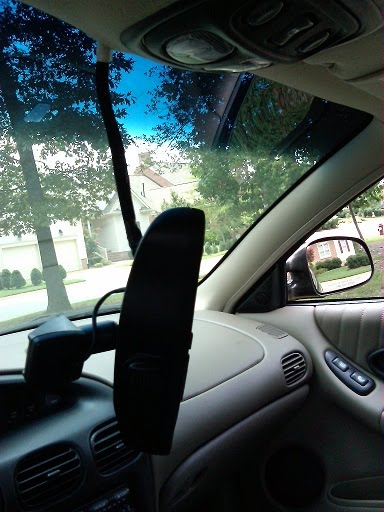
Last night was my last day at the bakery, my last day as a bread slinger, pie wrangler, and muffin maven. I was getting ready to leave and drive home a woman who lives near me, when told her tonight was going to be a fun ride home. Her initial thought was that I was going to be all giggly and buzzing because I was leaving. No, I told her, the ride home was going to be fun because my rearview mirror fell off my windshield and was dangling by its wires. It looked something like this:


She laughed and said it was a very appropriate malfunction because for my life right now, there is no looking back. "So if you're not looking back," she said, "Why would you need a rearview mirror?"
(I'm fairly certain the police wouldn't buy this logic if I got pulled over, but I was prepared to use this line if it should happen.)

Right now, I'm scared. And exhilarated. And not a little in shock.

Although my rearview mirror is now fixed (super glue, not duct tape, for once), there is still no looking back.

posted under , , , | 14 Comments

Life on autopilot

When I drive to TNT's office each week, I have to turn the opposite way on the road that I usually take to my job at the bakery. This past Saturday, my appointment was earlier than usual and I was running late, so I had many different things on my mind, the least of which was the roads I needed to be driving to TNT's.

I'm guessing you can tell what happened next: I took a wrong turn. Already late, I kept driving like I was going to work instead of to my therapy appointment. I realized my mistake right as I had committed to the wrong turn, but by then, it was too late. I had to keep driving until I could get to a place to turn around. Which I did, and with a little help from my lead foot, I arrived to my appointment with TNT on time.

The moral of the story isn't driving directions and how I shouldn't be trusted to follow them, the moral of the story is about when habits get ingrained. Of course, we all have habits, and habits can make life more livable. If we had to think about every single decision we made, all we would do is sit around and make decisions. (And by "we," I mean the royal we, as in me, myself, and I. You should know better than to let someone with OCD make a decision.) So we have habits and operate on autopilot. This, in and of itself, is not a problem. The problem is knowing when to stop living on autopilot.

One of the really good times to stop living on autopilot is when you're doing something completely different than what your autopilot is used to doing. Such as driving to therapy instead of work. Or eating lunch instead of exercising. Autopilot says "Turn right!" and "Go for a run!" Okay, fine. No big deal. But if I'm not aware I'm operating on autopilot, I'm going to go ahead and turn right and go for that run when I should be turning left and having a sandwich.

When I was driving to see TNT, I wasn't aware that I was driving on autopilot. I don't always consciously think about where I'm going, but I also don't think that I'm not actually thinking about where I'm going, either. On Saturday, clearly I wasn't thinking about where I was going. I was just driving. If I had been headed to work, there wouldn't have been a problem. This past Saturday, though, I was doing something a little out of the ordinary and I should have paid attention to where I was going.

What I've come to realize in recovery that it's not the presence of ED thoughts that gets me in trouble. My problem is when I stop paying attention to whether these ED thoughts are subtlely influencing my behavior. Of course, this can lead to hours of rumination and perseveration on "is-this-ED-or-is-this-me," but I also can't be deliberately unaware of it, either.

A lot of the inspirational and self-help literature says to live life with intention, and I don't disagree with that. But sometimes, you just need to get from point A to point B and autopilot is just fine for that. When you're trying to find your way out of a tropical jungle with no compass and no map, however, it might be a good thing to start paying attention.

The Contest

As a card-carrying perfectionist (and the card must be replaced if the card gets dirty or bent), I have often viewed life as a competition. There is The Best, and there is everyone else. My lifelong goal has been to be The Best at whatever it was--not out of a healthy sense of competition, but more because I viewed myself as a failure if I wasn't The Best. My constant striving was fueled by a desire to stop hating myself and finally feel like I could measure up to everyone else.

The anorexia only amplified this thinking process. Losing weight, conquering my need for food, rest, sleep, and affection, was the way I found to "win" the competition. Anorexia made me feel special. It was my trump card. Giving up my eating disorder meant giving up this one way I had of feeling special, of being The Best. As long as I ate less, weighed less, and exercised more, then at least I could be The Best at that. Right? Too bad this contest is so tremendously self-destructive.

Although I've learned in the past few years that this is a very distorted and disordered way of thinking--a way of thinking that preceded the eating disorder by decades--it's still very much there and very much present. Reading my college's alumni magazine is an exercise in self-loathing. The accomplishments of my classmates make me almost feel ill when I look at my life. Now, I can't even say "Well, at least I'm eating less then they are!" Because I'm almost certainly not.

My metabolism has once again gone through the roof. It calmed down somewhat during my Europe trip and yet again with my stomach bug, but now that I'm back in my work routine at the bakery, my metabolic rate has gone into overdrive. It seems I am hungry all the time. Adding an Ensure Plus each day is starting to seem like a good idea (it's quick, easy, and convenient). All of this means I am eating more than anyone I know.

This brings me right back to the contest, and how I defined being The Best for so long as eating the least. Now, I seem to be The Worst, which is pretty much a living hell for someone who has perfectionism. I feel like a failure because I cannot seem to resist my hunger and I feel like I should. I don't want to restrict as much as I just don't want to eat more than my minimum meal plan. Of course, eating less than what my body needs is restricting, but I never said an eating disorder was logical.

I don't always want to feel I need to participate in the contest--after all, Lily Allen said that whoever wins the rat race is still a rat--but I don't know how else to feel okay with myself without these concrete measures. I have no sense of myself except in relation to others. I only know I'm smart because people tell me I'm smart, not because I have an innate sense of my intelligence. It goes along with my body dysmorphia, and how I'm always comparing my size to others', in large part because I really don't have a sense of what size I am and what my body looks like. I can't do that with my life, either. I always have this profound sense of inadequacy, and this was mediated, temporarily, by the eating disorder. It quelled the anxieties of not measuring up, of not being good enough.

I know that I need to stop defining myself in relation to others. And not just any "others," but those who have achieved the most and done the most and make me feel like utter crap when I think about what my life is and what it has done. I know I need to compare me to, well, ME and to hell with everyone else. I'm following my dream to be a writer, which I know darn well isn't going to put me on a financial par with most of my classmates (although I've never been much worried about the financial yardstick, thankfully). I'm starting from scratch and busting my buns, and I need to start giving myself credit for overcoming a difficult and lethal illness.

The question is: how? How and where do I start?

Normal vs. normalcy

My friend Angela, who is in recovery from anorexia, asked today whether her life would ever be normal again. It's a question I've often asked myself: when will my life stop being ruled by my eating disorder? When will I start to feel normal again?

Normal, we are told, is relative. Normal is just a setting on a washing machine. I'm not normal- I'm not even sure that I'm psychologically capable of being normal. I've come to accept that I'm never going to be normal. This is fine, and yet here I am, still searching for "normal," whatever that means.

What one of Angela's friends pointed out is that maybe normal isn't the exact thing that we're looking for. Maybe we're actually looking for a sense of normalcy in our lives.

I think the actual definition of normalcy will differ from person to person, but to me, I define normalcy as the loss of that feeling that your life has been hijacked by the eating disorder and other mental illnesses. It's the sense that you are living an authentic life, rather than being obsessed with food and weight.

I don't look around at my life now and think, "Damn, this is the life I've been wanting to live." I'd rather not spend my days wrangling pies and slinging bread. I'd love to support myself by freelancing alone. However, there is that pesky little thing called reality to deal with. Despite all of this, the normalcy in my life has dramatically increased compared to when AN was ruling all of my thoughts and behaviors.

One of the biggest advantage of this return to normalcy is the knowledge that I don't need to hide how I spend my time (reading cookbooks in the gym--yes, I've done that!). Not that I spent my time like some sort of stereotypical twenty-something; this normalcy isn't the sense that I'm doing what everyone else is doing. But as I leave the ED behind, I don't feel like my ED is making me life a freakish life. My life now involves things like eating and watching TV. It involves resting and napping and licking the spoon when I bake brownies. It involves chatting with the girls at work about the cute customers and visiting with old friends and their new babies. It's a normalcy I never thought I would ever see again...and yet here I am.

No, I'll never be normal, but I am starting to experience some normalcy.

Experiential Calories

When it comes to edible calories, I'm pretty much an expert. I can eyeball and guess the calories in pretty much anything, and those numbers seem to stick in my mind for the rest of eternity. Need to know the calories in a stalk of celery or a cucumber? I'm your girl.

A large part of my eating disorder was limiting the number of calories I ate (or at least balancing that with how much I exercised). Life became a series of numbers: calories, fat grams, pounds, minutes exercised. And the more I could limit the first three of those numbers, the better I tended to feel. Though my diet was rather bland and boring, I enjoyed how it "tasted" of control and strength and willpower. I enjoyed how soothing it was to know exactly what I was going to eat and when.

Calories. The fewer, the better. That was my life for the past decade in about five words.

It was relieving, in a sense, to be told what to eat. Either the anorexia was telling me what to eat, or it was my dietitian. Deciding (remember The Paradox of Choice?) was often freakishly difficult, and I still rely on rules and regulations to help me meet my dietary needs. Often I fantasize about someone giving me The Perfect Food Plan that tells me exactly what to eat and when.

But I was reading the 360 Degrees of Mindful Living blog, and the author, Pavel Somov, wrote about Experiential Calories:

A Nutritional Calorie is a unit of energy. The job of a Nutritional Calorie is to fuel your Body. An Experiential Calorie – to coin a term — is a unit of awareness, a unit of conscious presence, a unit of meaning. The job of an Experiential Calorie is to enrich your Mind.

Of course, the chief thing I restricted in the course of my eating disorder was food. I'm not trying to deny that. But throughout my eating disorder, "restricting" became more than just a way of eating, it became a way of life. I restricted money but not letting myself buy things (or panicking when I did). I restricted social experiences by isolating myself. I restricted fun by always making myself work or do something "useful."

The very first therapist I saw, just as the ED was taking hold and a good 6 months before I had a clue that my increasing food obsessions were in any way problematic, assigned me 30 minutes of "fun" each day. I told her I was too busy for fun, fun was for sissies, I'm already living on 4 hours of sleep- how am I going to manage on three-and-a-half?, I had no use for fun. No, she told me, 30 minutes of fun, every day. Fine, I said, I'll do my fun but you can't make me enjoy it!

Not surprisingly, the thought of spending thirty! whole! minutes! doing! nothing! caused so much anxiety that I never really did it. I never realized this restriction-of-fun had anything to do with my eating disorder. And I never realized how hard it would be for me to begin incorporating other sorts of "calories" in my life.

I've never especially had a problem fueling my brain with Intellectual Calories. I'm a geek. If my brain doesn't get enough Intellectual Calories, it seems that restricting my food calories can't be far behind. But things like Social Calories and Fun Calories and Soothing Calories? They seem somehow bizarre and unnecessary- much like food does when I'm in the throes of anorexia. Yet they very much are necessary (yes, Carrie, just like food!), even though they remain absurdly nebulous.

I think these Experiential Calories are a bit more neglected in eating disorder recovery, in part because it is hard to measure them precisely. But at this past year's NEDA conference, Nancy Zucker spoke of how, even well into recovery, many of her patients' lives seem somewhat rigid or restricted somehow, as if the AN mindset has permeated their lives in every respect, not just food. Obviously, correcting the intake of food calories needs to come first, because a deficit of food calories is immediately life threatening. Experiential calories can wait a bit, if for no other reason than a malnourished person can't take in experiential calories very well. But me and others with EDs need to learn how to regulate both food and experiential calories in our lives.

Guidelines on how many food calories we should eat each day permeate our culture. They're not always right for everyone, but they're there. These Experiential Calories of which I write tend to vary even more between person to person. Whether the Faceless Internet Nutrition Providers will take a hint from the Experiential Calorie folks remains to be seen, but I would love nothing more than a set of rules or guidelines to tell me how much socializing I need to do and how much "fun" I need to have.

I guess this means I need to increase my intake of Flexibility Calories, eh?

posted under , , | 7 Comments

Anorexia as Plan B

As I was writing yesterday's post, I mentioned refusing to have a Plan B for my dream of being a writer. This dream may ultimately look very different than the plan I have envisioned now (especially considering that a beach house on Bora Bora with a hot cabana boy features largely in these dreams), but I can't not write.

Not that a Plan B isn't good- I develop them all the time. I did in middle school, when I adjusted to the changing class schedule (if this hall is crowded, I'll go this way, or use this drinking fountain instead of that one, or...). I did when I was applying to college and grad school by applying to several different schools. I do when I'm driving during rush hour.

Mostly, though, my Plan B of Life has been anorexia. If things ever got super-difficult, or they didn't go as planned, or I turned into a "failure," there was always the eating disorder. I always had this crutch of knowing I could go back to losing weight and feel confident in my "abilities." Even understanding that anorexia is an actual illness failed to dislodge anorexia-as-Plan-B.

A few days ago, Cammy blogged on one of her AN mantras, which was "if I can't be pretty, at least I can be thin." Which I totally relate to. Anorexia, for me, let me say "if I can't be good at X, at least I can be good at losing weight." If I got criticized at work, I told myself that I might suck at what I do, but I'll show my boss that I'm good at losing weight. If I got a less than perfect grade, I told myself that I might not be smart, but I can be thin. Or I can eat less. Exercise more. It propped up my self-esteem when nothing else really did.

Of course, the eating disorder also tore down my self-esteem like Hurricane Katrina moving through Gulfport, Mississippi, but I didn't really see that.

Whenever I made a choice over the past decade, I felt safe and secure that the anorexia would always be there for me if the choice didn't pan out. The complications and messiness of life could be boiled down to three little questions: how much did I eat? How much did I exercise? And what do I weigh? A decent answer to all three meant that I could handle...whatever. It didn't matter if the rest of my life went to pot, at least I could be thin.

I never really considered that losing weight was causing my life to go to pot, and when I did, the solution was (you guessed it!): lose more weight, eat less, and exercise more. I had a math minor- I should have damn well known that this equation didn't add up. But expecting rationality during an eating disorder is a rather futile endeavor.

Yet if I expect to recover from this eating disorder that is approaching its tenth anniversary, I need to let go of the comfort that it provides. I need to learn how to accept life in all of its imperfections with the knowledge that I can handle it. Anorexia isn't a crutch; it's an illness. If I don't make it as a writer, will anorexia still be waiting for me? Certainly. I can't expect my eating disorder to go anywhere. But I need to stop using it as my universal Plan B.

Besides, I can always buy Plan B at the pharmacy counter if I really need it.

The Long Shadow of Temperament

Anxiety is not fear, exactly, because fear is focused on something right in front of you, a real and objective danger. It is instead a kind of fear gone wild, a generalized sense of dread about something out there that seems menacing — but that in truth is not menacing, and may not even be out there. If you’re anxious, you find it difficult to talk yourself out of this foreboding; you become trapped in an endless loop of what-ifs.


This is a quote from one of the best articles on anxiety that I've ever read: Understanding the Anxious Mind. The article discusses not so much the subjective experience of anxiety (which varies from person to person and would be fairly difficult to discuss), but the physiological correlates and the behavioral responses to anxiety. Researchers have found that an anxious temperament--one that I possess--can be detected even at birth. Babies with this temperament are highly reactive, responding to all the stimuli in their environment, but not always in a good way. These babies are fussy, they cry a lot, they're unsettled.

And as these children were followed through childhood and adolescence, researchers found that their anxious temperament stayed with them. These kids were called "behaviorally inhibited": they didn't break rules, they didn't step out of line, they didn't experiment with drugs, alcohol, and sex, and they didn't get in trouble. More than that, perhaps, is that they didn't need to be told to be careful and not break the rules. It came naturally.

In college, my apartment one year was right across from a skateboard park. Aside from the fact that watching 12-year-old boys show off in a mating ritual as old as time was usually far more interesting than memorizing the crystalline structures of various salts, I couldn't help but cringe as I watched them. In fact, I couldn't ever imagine doing such a thing. I sat on my brother's skateboard and rode it down the driveway, but standing up? No, thank you. My parents didn't need to tell me not to do it, or wear a helmet or whatever. I just did these things. When pressured to do something against the rules, I would freeze in fear, overwhelmed with two horrible sensations: being thought a wuss and getting in trouble. The latter usually won out.

Perhaps what was more interesting about this longitudinal research was how the expression of the anxious temperament changed over time. Many children outgrew their severely inhibited behaviors and managed to cope with life reasonably well. Were they a little more high-strung than their peers? Usually, but their anxiety didn't interfere with their life and their happiness. But their physiological responses to fear and anxiety--as measured by activation in the amygdala, which is involved in the instinctual processing of emotion--remained elevated compared to their never-anxious peers.

What happened? These kids learned to cope.

And maybe that is the task for me, and others like me who struggle with significant and severe anxiety. It doesn't go away, and that's not the goal. The goal is to learn how to manage those feelings that inevitably crop up. Biological temperament casts a long shadow, but it's up to us to make that shadow as small as possible.

posted under , | 8 Comments

Everyday Living

Life is just so...daily. I wake up, smack the snooze button a few times, go to work, come home, cook dinner, do stuff, go to bed. And most people's lives aren't a whole lot more exciting. Recovery is such a monumental task that it's easy to start putting things off. Some of the things I'm postponing are necessary- do I really want to take a trip when there's a chance Ed might join me? But recovery is a part of life, and to do that with everything would only make our work so much harder.

I found these tips for simple ways to start enjoying today on the blog On Simplicity:

  • Spend a few extra minutes in bed today, luxuriating in the warmth of slept-in sheets.
  • Eat breakfast without multi-tasking. Enjoy the sight, smell, and taste of your food.
  • Play a song that gets you revved up before you start your day. Repeat as many times as you need. (”Here I Go Again” by Whitesnake is my embarrassingly regular go-to song. I get to feel like a bad-ass and complete dork at the same time. Sweet!)
  • Stop saying, “I’ll be happy when…” You don’t need security, true love, prestige, or good taste to be happy. Food, safety, and a good sense of humor will get you through in a pinch.
  • When you step out the door for the first time, take 10 seconds to really notice your surroundings. Drink them in without judging. (Even if, like me, you live uncomfortably close to cow pastures…)
  • Remember how badly you wanted to be an adult so that you could live life by your own rules? Enjoy the fact that, for the most part, you get to make your own decisions today.
  • Say “hi” to your coworkers instead of brushing by them. Ditto for family members.
  • Celebrate inconsequential victories just for the fun of it. Didn’t burn dinner? You clearly rock.
  • Leave a kind note for someone to find. Your spouse, child, or janitor will appreciate it, and you’ll probably feel better as well.
  • Stop waiting for someone else’s approval. If you like where you’re at (or simply where you’re headed), that’s good enough.
  • Check your progress on your larger goals. The steps you take to get there can be the best part.
  • Give in to a craving! Nearly everything is okay in moderation.
  • Find five minutes to sit back and just breathe. Close your eyes and let your concerns take a backseat for just a few moments. Remember that even high priorities are rarely as urgent as our adrenaline tells us they are.
  • Smile for absolutely no reason. You’re alive; that’s a pretty damn good excuse.
  • Slip into a pair of comfy socks.
  • Set aside 15+ minutes for something that’s purely fun. Not all hobbies need to have a purpose or redeeming value. Remind yourself that’s it okay to just have fun.
All of these are a good way to practice mindfulness. What are your favorite ways to just sit back and enjoy a slice of life? If you don't have any, do you have any ideas?

posted under , , | 8 Comments

It's not over 'till it's over

I had a therapy appointment today, and part of what came up was the continuing anorexic thoughts that I have. I've been at a healthy weight for a little over a year, I'm eating a wide variety of foods, most of the time I eat enough fat, I exercise moderately--in a nutshell, all of the things that I am "supposed" to be doing in recovery.

So what gives? Why, after all this time, do I still instinctively want to restrict? Why, in times of stress, do I want to exercise like a madwoman? Some of it, I know, is how my brain is wired. But I had hoped that after a year of all of this turmoil, it would get a lot better.

And it has gotten somewhat better. Somewhat. But I still have to talk myself through a lot of things. I still have to remind myself that butter is not something that exists for the sole purpose of decorating my fridge. That I can cook with it. Put it on my bread, or baked potato. I have to remind myself that exercise feels good, but only as long as I don't overdo it. Sometimes I still get horrifically anxious if I can't exercise as I had planned. So I sit myself down and have a long pep talk with myself and try to get through it.

No wonder my roommates all used to think I was whacked. Luckily Aria doesn't seem to mind.

Yet all of these thoughts are a several-times-a-day thing. I had hoped they would be more fleeting. Can I manage them? I suppose- I've been doing it for a year now. But it's exhausting, and I'm tired of it. Not tired enough to give up recovery, however. Just tired in the sense that I have this plaintive question that remains: when will it get easier?

My therapist reminded me that, considering I've been sick for almost 8 years now, it's going to take more than just a year of a healthy weight and eating properly for the thoughts to go away. Which, okay. I do logically get that. I'm just frustrated with it all. I had hoped I would bounce back more quickly. I guess, ultimately, I'm having a hard time accepting how ingrained the AN thoughts were/are. I don't like to think about that.

I can function on the outside, and that's something. That's an achievement. I can go out with friends, even if that going out involves dinner. But it's still just so damn hard. And I almost wish that the inner turmoil was more visible, that yes, I look and act moderately normal, but my head is still a little screwed up.

I was also reminded that the thoughts may never fade entirely, but I will instinctively replace them with positive reminders of why I need to eat. That it won't be such an effort. I'm not entirely thrilled with that thought, but if it does become my reality, I can at least figure out ways to deal with it.

I used to be told that the eating disorder would end when I chose to end it. Obviously, I have several problems with this. First of all, someone with an eating disorder can't just randomly "choose" to start eating again. Believe me, if we could, we would. But secondly, I can't totally control how long these thoughts will stay with me. I am ultimately in charge of managing my recovery. I am ultimately responsible for feeding myself properly, for ensuring I don't start exercising compulsively. These behaviors will have a HUGE impact on whether the AN thoughts go away. But I can't control how long the thoughts will stick around.

All I can do is remind myself that if I want to get well, I need to stay at a healthy weight. And I can certainly start losing again, but that will just mean I'll have to gain weight again. The relief of restricting is NOT equivalent to the torture of weight restoration. So I'll have to sit it out, and get the hell on with my life.

posted under , , | 10 Comments

So now what?

I'm done. With school.

::insert cheer here::

And I'm sitting here, after spending my Friday night alone (as I do most Friday nights), wondering now what?

I knew that nothing was going to change when I handed in my thesis to the library book bindery today. They guy said "congratulations" and I went to my last class and that was it. Which was anti-climactic to say the least. Now I can truthfully write "Carrie, MA, MPH" after my name and nothing else has changed. I have the same issues, the same pitfalls, the same bizarre fits of creativity.

So now what?

I have been waiting for my life to start, well, all my life. After high school. After college. After I get a job. After I get my Master's degree. After I recover. After after after. It's my ten year high school reunion sometime soon, which makes a decade of afters. And no, I'm not going. I've kept in contact with the two people I actually liked, and the rest don't stir any feelings of nostalgia and longing.
I want to say, "What are you waiting for, Carrie?" What am I waiting for? I feel like I've been muddling through for so long, trying to manage all of my mental illnesses/brain diseases, that I have to kind of prioritize my needs. Think Maslow's hierarchy. If I'm struggling to make it through the day, to feed myself, to sleep, to not anxiously tap my leg off my freaking body, then things like enjoyment and self-actualization are probably not going to make it in my to-do list. Yet I know that enjoying myself and finding something pleasurable are important and can lead to improvements in eating, sleeping, and anxiety.

I think I feel some odd sort of internal pressure now, knowing that I can't put everything off any longer. School is over. I know I didn't go to grad school deliberately to put things off. And I did learn a lot this year and it wasn't as hellish as my other school experiences have been. But now there's just me and my life, and I haven't the slightest clue what I'm going to do.

I had free time tonight, and after picking some things up around my apartment, I essentially sat and stared at the wall. I don't know how to deal with free time. It baffles me. So what am I going to do with an entire life?

I suppose I don't need to be in a huge hurry to answer that question. I will find out soon enough. Nor do I need to fill an entire life. I have a lifetime in which to fill it. I'm trying to ask myself what I would like to do right here, right now.

I don't know the answer to that.

I know getting some quality rest is (or should be) up there. Ditto for enriching the inventory for my Etsy shop, Frenchroast Designs. And scraping off the whatever-it-is that is crusted on the top of my stove.

Other than that? I guess I'll have to wait and see.

posted under , | 9 Comments

Move the Sofa, Patch the Roof

This is the title of a chapter from Jenni Schaefer's book Life Without Ed. It deals with relapse and, more importantly, getting out of relapse. The theory is this: if your roof is leaking, you don't watch the water fall on your nice sofa and just wring your hands. Nope. You move the sofa and have the roof fixed.

It's a brilliant theory, and one that really needs to be applied not only to relapse but to ED treatment in the first place. Patch the roof; stop behaviors.

What triggered this chapter in my life today was much more literal.

Remember when my ceiling caved in back in January? It's leaked twice in the past week. Twice. Thankfully, nothing was damaged this time. But I'm going to be delivering a long tirade to management about their crap roof.

Which brings me back to the analogies. So you move the couch and patch the roof. Yay, you. And then the roof leaks again. So you patch it better. Yay, you again. The problem comes when the roof keeps leaking. Face it: the patch ain't doing the trick.

For a lot of my treatment, my insurance would (oh so graciously) allow the doctors to admit me to the hospital because of medical and psychiatric instability. Move the couch. I would gain weight. Patch the roof.

The problem was, the couch wasn't moved until it was already soaked. At 65% IBW, mildew was setting in. The couch was fairly ruined- it was more like a waterbed than a couch. But, says the noble health insurance company, we will pay to have it dry cleaned! And we'll paint the ceiling! Be happy! We don't have to do this!*

And on the day (and I do mean the exact day) I hit 85% IBW, I would be discharged. The roof was patched. I was good to go. Move the sofa back and get on with life.

The roof would leak again. Why? Any roofer looking at the patch would say they basically put a band-aid on a bullet hole. It looked better, but not a whole hell of a lot was fixed. Dry clean the couch, patch the roof.

Soon, of course, no one was willing to pay to patch the ceiling anymore. Clearly, there was something wrong with ME if my ceiling was still leaking. They had done their job. They had replaced the drywall, painted over the rust spots, added a support or two. Except the problem wasn't my ceiling; it was the roof itself. Someone needed to call in the big guns, the professional roofers, to get to the root of the problem and fix the roof once and for all. To bring my weight back up to the range where my biology meant it to be.

That would be expensive, I was told. Too expensive. I was on my own.

The irony is that, with all of the couch cleaning and ceiling patching, to have just re-roofed the place immediately would have been cheaper in the long run. Insurance companies don't think that way, however.

Apartment management is being like insurance companies. Fix the damn roof already! I want to scream. Pay for adequate treatment! Couches are being ruined, people are dying. If the patch keeps breaking, maybe you don't need another patch, a more sophisticated patch. Maybe you need a new roof.

Here's my idea for a new eating disorders roof:

  • Don't accept anything less than 100% IBW and total cessation of ED thoughts and behaviors.
  • Don't accept formal calculations of IBW; use growth charts, DNA, and a good helping of common sense.
  • Weight restoration is only the first step. Healthy weight doesn't equal healthy mind.
  • Don't blame people for "not moving the couch in time." The past is past. Let's move on.
  • Enlist everyone possible to move the couch and keep it out of the way while the roof is fixed.
  • And pay for treatment so that people have a roof to lay under when they are done with everything. Health care is a right, not a privilege. Don't make people feel guilty for something they had no control over.

*Does anyone else get pissed off when they see the ads from the health insurance companies saying how they care about the health of the people? BCBS of Michigan says that they will NEVER terminate you because of illness. Nope. They'll just stop paying for anything. That just frosts my cookies.

**Except BCBS will punish you for eating those cookies they just frosted because the frosting has trans fats which will make you fat and then you will get sick and die. Which is, like, all your fault.

Well ain't that somethin'

This must have been the weekend for big news: I'm also going to be an aunt! Holy crap, peeps!

There is also, however, this sense of distance from me and the rest of the world. Life has a strange way of happening to me, rather than me happening to life. The strange, strange world of anorexia recovery (or, for that matter, the strange, strange world of anorexia itself) has a way of separating you from the events going on around you.

My brother and his wife are expecting their first child. I am moving home until I go to school in the fall.

There's a bizarre discord there. Yes, I know in many ways I am more mature than my brother, even though he's almost five years older than I am. I also have way the hell more hair, though way the hell more gray hair as well. Win some, lose some, I suppose.

I'm not trying to compare lives here, even though that's sort of inevitable. We are where we are in life, blah blah blah. While that's true, it's also true that I feel quite odd moving back in with my parents just as my brother is expecting his first child. He's going to have- holy crap!- a family. I have...a cat.

My kitty is lovely, and I wouldn't trade her for anything. I also love my parents.

But at the end of the day, I go to sleep in my girlhood room (all 9 feet by 9 feet of it) by myself. Okay, myself and a stuffed animal. I can never shake that loneliness, that sense of drifting and floating, suspended above the life around me. That lack of connection was what really pushed me over the edge into the abyss of depression this past December. The anorexia had so isolated me from everything, that I'm having a hard time catching up.

I hate feeling all "oh, pity me" and I absolutely HATE being pitied. I have a good life, all things considered. Part of me would like to swap some parts out, but that's not the way it works, and I can deal with that. Life is a chain reaction. If I never would have gotten so depressed, I never would have had my parents drop off a book written by a graduate of the Johns Hopkins program. I never would have gotten to the point of being so disgusted with my present existence that I was willing to take a leap into the unknown.

I don't have a whole lot of belief in fate. Or destiny. People have too much of a tendency to wind up where they're going. Was I destined to be a writer? Hell if I know. But once I started down this path, once I first saw my name in print, there was no turning back. I could still choose to do something else in my life besides write. I could, but I don't know that I'd want to. Maybe I'll find something more interesting, maybe I won't.

I just need to accept that my life is going to look waaaaaayyyy different than my brother's. We are so completely different, so why would I expect us to be the same?

posted under , , | 1 Comments

Expanding My Horizons

I thought I had quite nicely expanded my horizons when I lived in Scotland for six months and studied at the University of Aberdeen. I learned how to drink beer like a man- a skill which, I am proud to say, I have since forgotten. I learned that I could find lodgings in any town, big or small, on basically no notice. I accompanied world-class musicians in open music nights in dimly lit smoky pubs (simultaneously learning the whole drinking-like-a-man thing). Lastly, I learned that such a thing existed as a deep-fried Mars bar.

And who said Scottish cooking sucked?

Life with anorexia was completely different. For me, it consisted of three things: the scale, the treadmill, and the calorie counting guide. I was too afraid of anything else. It was so much like when I was walloped by OCD in high school. I wanted to stop washing my hands, I wanted to NOT be afraid to go out in public or eat at a restaurant without thinking about how many germs were crawling all over the damn place. But I couldn't. Yet the anxiety that would accompany not washing or not counting calories was so overwhelming that I felt basically compelled to do it.

It was a singularly dull, miserable life.

Now, however, I am turning things around. My latest fascination, besides crochet, which is still holding its own, is beading. I've gotten quite into it and am almost ready to set up an online store to sell some of my creations. I am trying my hand at fiction writing, though it sounds awfully autobiographical at this point. Tomorrow night I am taking a basic beading class. I have picked up the basics on my own, but I want to make my stuff look more professional. So I can charge more.

This summer, I am hoping to go on a trip out west, to see all of those really cool national parks they have in the travel shows, and to go hiking. Now, the strange thing is that even eating a french fry is expading my horizons.

For someone with OCD, beading and crochet and other repetitious crafts are therapeutic because they tap into the very parts of my brain that are giving me trouble. Yes, OCD and anorexia are problems. I will be the first to deny that. But there's also a sense of calm that accompanies focusing them on something different.

I suppose this is where the chipper writer signs off and says brightly, "Who knows what my life will bring?" Though this is true, I have never been classified as chipper. Ever. Not unless I've had a double triple latte with about 80 packets of sugar. The simple fact is that none of us know what tomorrow will bring, none of us know how we will handle it, what will come of everything.

There is a certain kind of relief in knowing that I can handle it. Whatever it is.

posted under , , | 4 Comments

Little Things

There are so many things in life. For a long time, there was nothing that made me want to get out of bed and greet the world. Absolutely nada. I didn't care, I didn't want to care, I practically couldn't care.

I'm not saying that now I leap out of bed with joy, fling open the blinds and say "Good morning sunshine!" No, I whack the snooze button as long as humanly possible, roll out of bed at the last minute, and immediately make a beeline to the coffee pot. I am NOT a morning person. I'm a night person- I love the silence, the quiet. It's a nice contrast to the constant buzzing of thoughts in my head, thoughts that swarm like bees, and occasionally sting.

However, I still get up and greet the day, however begrudging it may be. I ask myself why? Not so long ago I decided hell with it and attempted to not see another sunrise again. Ever. So what is it that enables me to put my feet on the floor, even as I curse God, the Greek gods, the Egyptian gods, and every other religious icon I can think of that I have to wake up so damn early.

My cat's eyelashes. I never knew that cats have eyelashes, but they do. Teeny tiny things, but eyelashes nonetheless. Just watching them, as Aria glances around the room. Also her fascination with a flushing toilet. I can't help but chuckle as her head follows the swirling water.

Seeing the next day on my page-a-day calendar. It's a crochet pattern one, and I almost always enjoy seeing what other people thought up. Yesterday's was for an itty bitty friendship bra.

Going into a yarn or bead store and just putting together items in my head. Then, seeing the final product.

I have made a pact with myself that I will not even think about trying to off myself until the last Harry Potter book comes out. I'm not saying I have any plans to stay up all night reading, snap the book shut and then chug a liter of Drano. Not at all. But I've been waiting almost 7 years to see how everything turns out, and there's no way I'm going to give up with only 6 months to go.

I still haven't exactly found a reason to live. But I can cling to reasons to keep going.

posted under , | 5 Comments
Older Posts Home

ED Bites on Facebook!

ED Bites is on Twitter!

Search ED Bites

People's HealthBlogger Awards 2009
People's HealthBlogger Awards 2009 - Best 100 Winner!
Wellsphere

About Me

My photo
I'm a science writer, a jewelry design artist, a bookworm, a complete geek, and mom to a wonderful kitty. I am also recovering from a decade-plus battle with anorexia nervosa. I believe that complete recovery is possible, and that the first step along that path is full nutrition.

Drop me a line!

Have any questions or comments about this blog? Feel free to email me at carrie@edbites.com


nour·ish: (v); to sustain with food or nutriment; supply with what is necessary for life, health, and growth; to cherish, foster, keep alive; to strengthen, build up, or promote


Archives

Popular Posts

Followers


Recent Comments